shockhash
Towards Optimal-Space Minimal Perfect Hashing Beyond Brute-Force
Science Score: 67.0%
This score indicates how likely this project is to be science-related based on various indicators:
-
✓CITATION.cff file
Found CITATION.cff file -
✓codemeta.json file
Found codemeta.json file -
✓.zenodo.json file
Found .zenodo.json file -
✓DOI references
Found 2 DOI reference(s) in README -
✓Academic publication links
Links to: arxiv.org -
○Committers with academic emails
-
○Institutional organization owner
-
○JOSS paper metadata
-
○Scientific vocabulary similarity
Low similarity (13.0%) to scientific vocabulary
Repository
Towards Optimal-Space Minimal Perfect Hashing Beyond Brute-Force
Basic Info
- Host: GitHub
- Owner: ByteHamster
- License: gpl-3.0
- Language: C++
- Default Branch: main
- Size: 1.04 MB
Statistics
- Stars: 13
- Watchers: 5
- Forks: 2
- Open Issues: 0
- Releases: 0
Metadata Files
README.md
ShockHash


A minimal perfect hash function (MPHF) maps a set S of n keys to the first n integers without collisions. Perfect hash functions have applications in databases, bioinformatics, and as a building block of various space-efficient data structures.
ShockHash (small, heavily overloaded cuckoo hash tables) is an MPHF that achieves space very close to the lower bound, while still being fast to construct. In contrast to the simple brute-force approach that needs to try e^n = 2.72^n different hash function seeds, ShockHash significantly reduces the search space. Instead of sampling hash functions hoping for them to be minimal perfect, it samples random graphs, hoping for them to be a pseudoforest. In its most space-efficient variant, it can reduce the running time to just 1.16^n, while still being asymptotically space optimal.
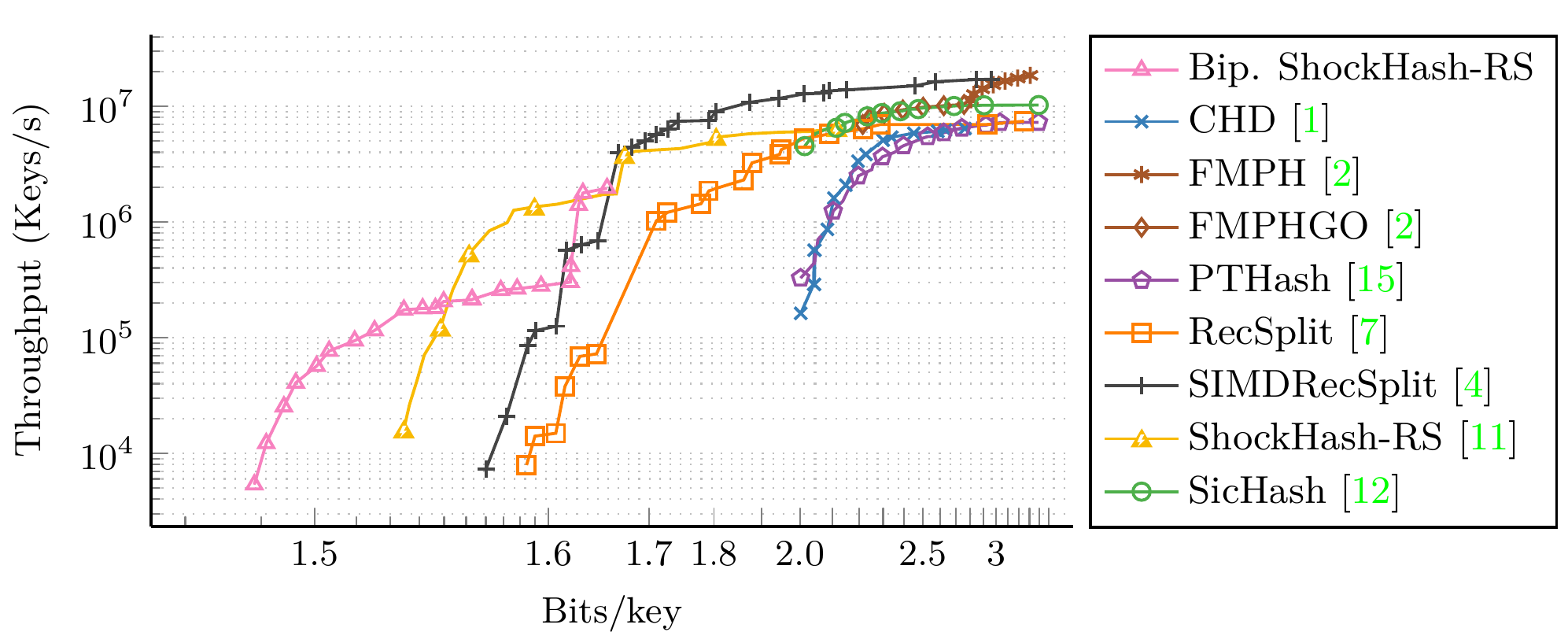
Still being an exponential time algorithm, we integrate ShockHash into several partitioning frameworks. Our implementation inside the RecSplit framework achieves the best space efficiency. Using ShockHash inside our novel k-perfect hash function achieves fast queries while still being faster to construct and more space efficient than any previous approaches.
Library Usage
Clone this repo and add the following to your CMakeLists.txt.
Note that the repo has submodules, so either use git clone --recursive or git submodule update --init --recursive.
cmake
add_subdirectory(path/to/ShockHash)
target_link_libraries(YourTarget PRIVATE ShockHash)
Then use one of the following classes:
- ShockHash is the original ShockHash algorithm integrated into the RecSplit framework.
- SIMDShockHash is the SIMD-parallel version of the original ShockHash algorithm. Both ShockHash and the RecSplit framework are SIMD-parallelized. If this implementation is used on a machine without SIMD support, it is slower than the non-SIMD version because SIMD operations are emulated.
- ShockHash2 is the bipartite ShockHash algorithm. Only the inner ShockHash loop is SIMD-parallel, the RecSplit framework is not. If this implementation is used on a machine without SIMD support, the implementation uses sequential operations without explicitly emulating SIMD. To turn off SIMD, change to SIMD lanes of size 1 in ShockHash2-internal.h.
Constructing a ShockHash perfect hash function is then straightforward:
cpp
std::vector<std::string> keys = {"abc", "def", "123", "456"};
shockhash::ShockHash<30, false> shockHash(keys, 2000); // ShockHash base case size n=30, bucket size b=2000
std::cout << shockHash("abc") << " " << shockHash("def") << " "
          << shockHash("123") << " " << shockHash("456") << std::endl;
// Output: 1 3 2 0
We also give the base-case implementations without the RecSplit framework, which makes it easier to understand the main idea.
- Original ShockHash.
- Bipartite ShockHash. The outer loop that is also given in the pseudocode of the paper is given in
BijectionsShockHash2::findSeed.
Construction performance
Licensing
ShockHash is licensed exactly like libstdc++ (GPLv3 + GCC Runtime Library Exception), which essentially means you can use it everywhere, exactly like libstdc++.
You can find details in the COPYING and COPYING.RUNTIME files.
If you use ShockHash or bipartite ShockHash in an academic context or publication, please cite our papers:
``` @inproceedings{lehmann2023shockhash, author = {Hans-Peter Lehmann and Peter Sanders and Stefan Walzer}, title = {{ShockHash}: Towards Optimal-Space Minimal Perfect Hashing Beyond Brute-Force}, booktitle = {{ALENEX}}, pages = {194--206}, publisher = {{SIAM}}, year = {2024}, doi = {10.1137/1.9781611977929.15} }
@article{lehmann2023towardsArxiv, author = {Hans-Peter Lehmann and Peter Sanders and Stefan Walzer}, title = {{ShockHash}: Towards Optimal-Space Minimal Perfect Hashing Beyond Brute-Force}, journal = {CoRR}, volume = {abs/2308.09561}, year = {2023}, doi = {10.48550/ARXIV.2308.09561} } ```
Owner
- Login: ByteHamster
- Kind: user
- Location: Germany
- Company: Karlsruhe Institute of Technology
- Website: https://www.bytehamster.com
- Repositories: 50
- Profile: https://github.com/ByteHamster
I'm a PhD student at Karlsruhe Institute of Technology. In my freetime, I maintain AntennaPod and contribute to other projects like K-9 Mail and Baikal Server.
Citation (CITATION.cff)
cff-version: 1.2.0
message: "If you use this software in an academic context or publication, please cite it as below."
authors:
- family-names: "Lehmann"
  given-names: "Hans-Peter"
  orcid: "https://orcid.org/0000-0002-0474-1805"
- family-names: "Sanders"
  given-names: "Peter"
  orcid: "https://orcid.org/0000-0003-3330-9349"
- family-names: "Walzer"
  given-names: "Stefan"
  orcid: "https://orcid.org/0000-0002-6477-0106"
title: "ShockHash: Towards Optimal-Space Minimal Perfect Hashing Beyond Brute-Force"
preferred-citation:
  type: conference-paper
  title: "ShockHash: Towards Optimal-Space Minimal Perfect Hashing Beyond Brute-Force"
  authors:
    - family-names: "Lehmann"
      given-names: "Hans-Peter"
      orcid: "https://orcid.org/0000-0002-0474-1805"
    - family-names: "Sanders"
      given-names: "Peter"
      orcid: "https://orcid.org/0000-0003-3330-9349"
    - family-names: "Walzer"
      given-names: "Stefan"
      orcid: "https://orcid.org/0000-0002-6477-0106"
  doi: "10.1137/1.9781611977929.15"
  journal: "ALENEX"
  year: 2024
GitHub Events
Total
- Watch event: 3
- Delete event: 1
- Push event: 6
- Create event: 1
Last Year
- Watch event: 3
- Delete event: 1
- Push event: 6
- Create event: 1
Committers
Last synced: about 1 year ago
Top Committers
| Name | Commits | |
|---|---|---|
| ByteHamster | i****o@b****m | 209 |
| Dominik Bez | d****z@w****e | 2 |
Committer Domains (Top 20 + Academic)
Issues and Pull Requests
Last synced: about 1 year ago
All Time
- Total issues: 0
- Total pull requests: 0
- Average time to close issues: N/A
- Average time to close pull requests: N/A
- Total issue authors: 0
- Total pull request authors: 0
- Average comments per issue: 0
- Average comments per pull request: 0
- Merged pull requests: 0
- Bot issues: 0
- Bot pull requests: 0
Past Year
- Issues: 0
- Pull requests: 0
- Average time to close issues: N/A
- Average time to close pull requests: N/A
- Issue authors: 0
- Pull request authors: 0
- Average comments per issue: 0
- Average comments per pull request: 0
- Merged pull requests: 0
- Bot issues: 0
- Bot pull requests: 0