figuratenum
Figuratenum is the most comprehensive Python library for figurate numbers, capable of generating up to 233 different sequences across various dimensions and generalizations. Based on the book ‘Figurate Numbers’ (2012) by Elena Deza and Michel Deza.
Science Score: 44.0%
This score indicates how likely this project is to be science-related based on various indicators:
-
✓CITATION.cff file
Found CITATION.cff file -
✓codemeta.json file
Found codemeta.json file -
✓.zenodo.json file
Found .zenodo.json file -
○DOI references
-
○Academic publication links
-
○Academic email domains
-
○Institutional organization owner
-
○JOSS paper metadata
-
○Scientific vocabulary similarity
Low similarity (11.0%) to scientific vocabulary
Keywords
Repository
Figuratenum is the most comprehensive Python library for figurate numbers, capable of generating up to 233 different sequences across various dimensions and generalizations. Based on the book ‘Figurate Numbers’ (2012) by Elena Deza and Michel Deza.
Basic Info
- Host: GitHub
- Owner: edelveart
- License: mit
- Language: Python
- Default Branch: main
- Homepage: https://pypi.org/project/figuratenum/
- Size: 762 KB
Statistics
- Stars: 1
- Watchers: 2
- Forks: 0
- Open Issues: 0
- Releases: 10
Topics
Metadata Files
README.md
FigurateNum
FigurateNum is a collection of 235 figurate number generators based on the book Figurate Numbers by Michel Deza and Elena Deza, published in 2012.





What is the purpose of FigurateNum?
FigurateNum helps discover patterns in figurate number sequences and supports numerical computation in mathematics-related projects. It integrates with other tools for visualizing geometric structures and serves as a companion to the book.
How to install?
bash
pip install figuratenum
Optional: Graphical Visualization (v2.1.0)
Enable the FigurateViz class (requires numpy and matplotlib) by installing the optional dependencies:
bash
pip install figuratenum[figurate-viz]
Features
The main class, FigurateNum, provides access to all figurate number sequences across different dimensions, while dedicated classes let you work with each dimension separately:
- 79 Plane figurate numbers →
PlaneFigurateNumclass — Explore on GitHub - 86 Space figurate numbers →
SpaceFigurateNumclass — Explore on GitHub - 68 Multidimensional figurate numbers →
MultidimensionalFigurateNumclass — Explore on GitHub - 2 Zoo figurate numbers →
ZooFigurateNumclass — Explore on GitHub
FigurateViz Visualization
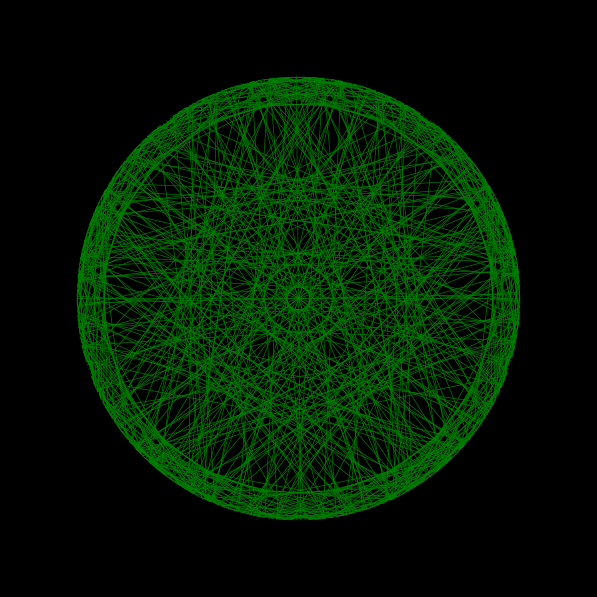
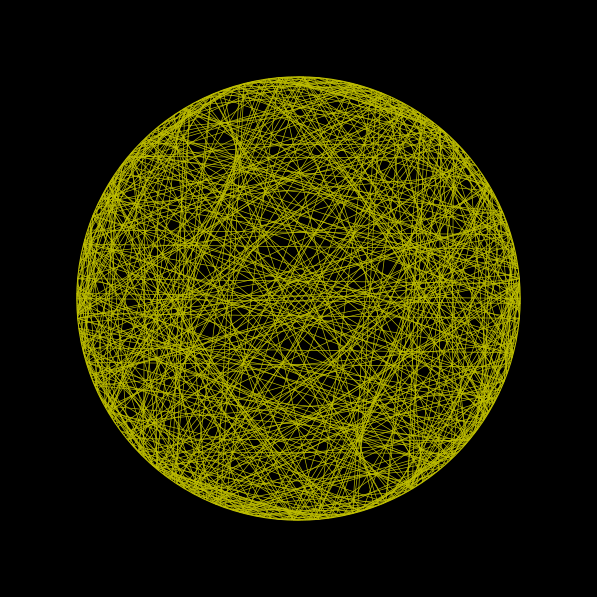
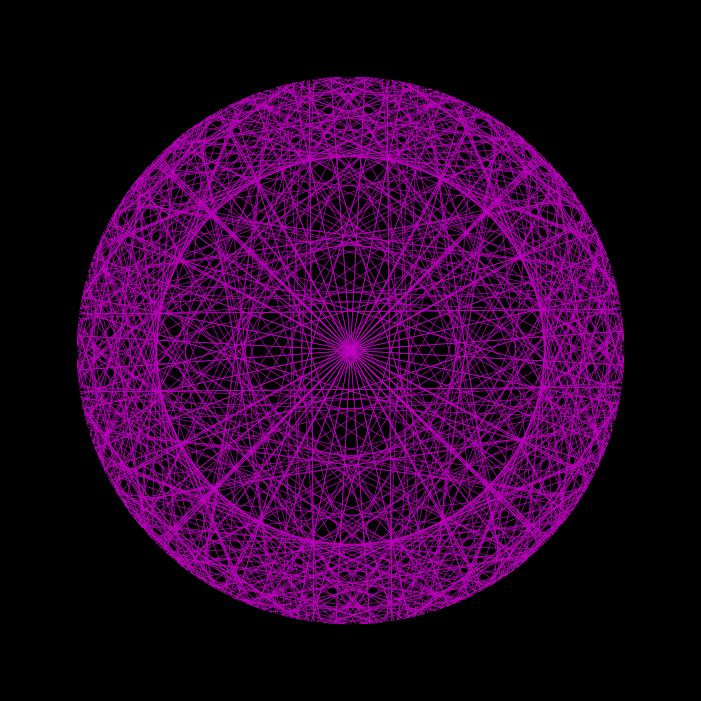
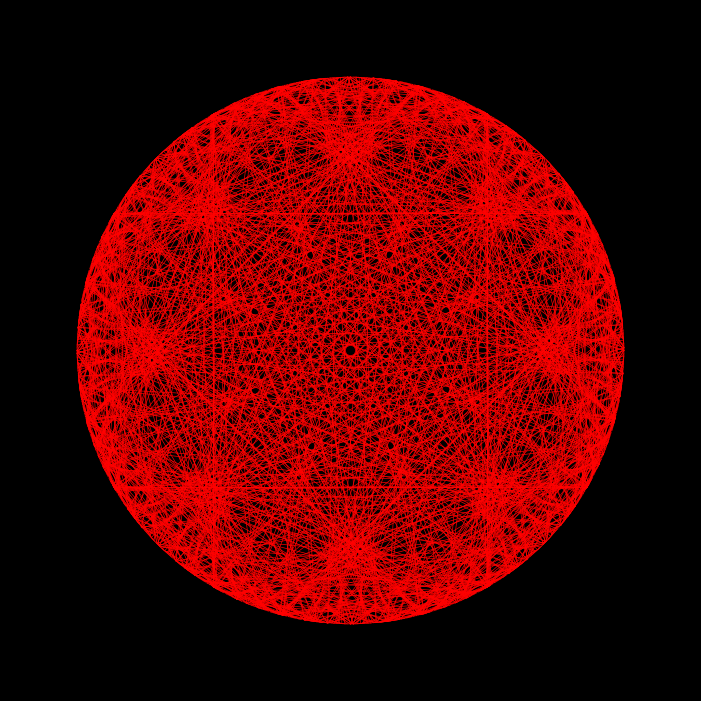
- Gaussian plots (2D) in polar coordinates with customizable colors, visibility options, and export capabilities.
- Seamless integration with any figurate number sequence (
list[int]ortuple[int, ...]).
How to use?
1. Import and generate sequences with FigurateNum and related classes
```python from figuratenum import FigurateNum, MultidimensionalFigurateNum
1. General use: generate any figurate sequence via FigurateNum
seq = FigurateNum() hyperdodecahedralgen = seq.hyperdodecahedral() print([next(hyperdodecahedralgen) for _ in range(4)])
Output: [1, 600, 4983, 19468]
2. Specialized classes: PlaneFigurateNum, SpaceFigurateNum,
MultidimensionalFigurateNum, ZooFigurateNum
multi = MultidimensionalFigurateNum() hypertetrahedrongen = multi.kdimensionalcenteredhypertetrahedron(21) print([next(hypertetrahedron_gen) for _ in range(12)])
Output: [1, 23, 276, 2300, 14950, 80730, 376740,
1560780, 5852925, 20160075, 64512240, 193536720]
```
2. Using FigurateViz to visualize and export
```python from figuratenum import FigurateNum as fgn from figuratenum.figurate_viz.FigurateViz import FigurateViz
Generate figurate numbers
seqloop = fgn() gen = seqloop.fivedimensionalhyperoctahedron() figuratenum_seq = [next(gen) for _ in range(704)]
Create and draw the Gaussian plot
viz = FigurateViz(figuratenumseq, figsize=(6, 6)) viz.gaussianplot( circcolor="m", bgcolor="k", numtext=False, numcolor="g", ext_circle=True, rotate=-1 ).draw()
Export plots as .svg, .pdf, .png (matplotlib compatible),
with options e.g., dpi, transparent, bboxinches, padinches, etc.
viz.exportplot( "figure1.svg", circcolor="cyan", transparent=True ) ```
3. Get sequence values easily with NumCollector
```python from figuratenum import NumCollector as nc, FigurateNum
gen = FigurateNum().pentatope() print(nc.taketotuple(gen, 10)) # first 10 values as tuple
Output: (1, 5, 15, 35, 70, 126, 210, 330, 495, 715)
Available methods:
- take(n) : first n values as iterator
- taketolist(stop, start=0, step=1)
- taketotuple(stop, start=0, step=1)
- taketoarray(stop, start=0, step=1)
- pick(n) : nth value
```
Version History
🚨 Version 2.0.0 includes renamed methods and changes in class usage. These changes are incompatible with previous versions. Please review the updated usage instructions below to adapt your code to the new structure.
Additional Resources
List of Figurate Numbers
Plane Figurate Numbers
Show 79 sequences of the PlaneFigurateNum class
1. `polygonal`
2. `triangular`
3. `square`
4. `pentagonal`
5. `hexagonal`
6. `heptagonal`
7. `octagonal`
8. `nonagonal`
9. `decagonal`
10. `hendecagonal`
11. `dodecagonal`
12. `tridecagonal`
13. `tetradecagonal`
14. `pentadecagonal`
15. `hexadecagonal`
16. `heptadecagonal`
17. `octadecagonal`
18. `nonadecagonal`
19. `icosagonal`
20. `icosihenagonal`
21. `icosidigonal`
22. `icositrigonal`
23. `icositetragonal`
24. `icosipentagonal`
25. `icosihexagonal`
26. `icosiheptagonal`
27. `icosioctagonal`
28. `icosinonagonal`
29. `triacontagonal`
30. `centered_triangular`
31. `centered_square` = `diamond`
32. `centered_pentagonal`
33. `centered_hexagonal`
34. `centered_heptagonal`
35. `centered_octagonal`
36. `centered_nonagonal`
37. `centered_decagonal`
38. `centered_hendecagonal`
39. `centered_dodecagonal` = `star`
40. `centered_tridecagonal`
41. `centered_tetradecagonal`
42. `centered_pentadecagonal`
43. `centered_hexadecagonal`
44. `centered_heptadecagonal`
45. `centered_octadecagonal`
46. `centered_nonadecagonal`
47. `centered_icosagonal`
48. `centered_icosihenagonal`
49. `centered_icosidigonal`
50. `centered_icositrigonal`
51. `centered_icositetragonal`
52. `centered_icosipentagonal`
53. `centered_icosihexagonal`
54. `centered_icosiheptagonal`
55. `centered_icosioctagonal`
56. `centered_icosinonagonal`
57. `centered_triacontagonal`
58. `centered_mgonal(m)`
59. `pronic` = `heteromecic = oblong`
60. `polite`
61. `impolite`
62. `cross`
63. `aztec_diamond`
64. `polygram(m)` = `centered_star_polygonal(m)`
65. `pentagram`
66. `gnomic`
67. `truncated_triangular`
68. `truncated_square`
69. `truncated_pronic`
70. `truncated_centered_pol(m)` = `truncated_centered_mgonal(m)`
71. `truncated_centered_triangular`
72. `truncated_centered_square`
73. `truncated_centered_pentagonal`
74. `truncated_centered_hexagonal` = `truncated_hex`
75. `generalized_mgonal(m, start_numb)`
76. `generalized_pentagonal(start_numb)`
77. `generalized_hexagonal(start_numb)`
78. `generalized_centered_pol(m, start_numb)`
79. `generalized_pronic(start_numb)`
Space Figurate Numbers
Show 86 sequences of the SpaceFigurateNum class
1. `m_pyramidal(m)`
2. `triangular_pyramidal`
3. `square_pyramidal` = `pyramidal`
4. `pentagonal_pyramidal`
5. `hexagonal_pyramidal`
6. `heptagonal_pyramidal`
7. `octagonal_pyramidal`
8. `nonagonal_pyramidal`
9. `decagonal_pyramidal`
10. `hendecagonal_pyramidal`
11. `dodecagonal_pyramidal`
12. `tridecagonal_pyramidal`
13. `tetradecagonal_pyramidal`
14. `pentadecagonal_pyramidal`
15. `hexadecagonal_pyramidal`
16. `heptadecagonal_pyramidal`
17. `octadecagonal_pyramidal`
18. `nonadecagonal_pyramidal`
19. `icosagonal_pyramidal`
20. `icosihenagonal_pyramidal`
21. `icosidigonal_pyramidal`
22. `icositrigonal_pyramidal`
23. `icositetragonal_pyramidal`
24. `icosipentagonal_pyramidal`
25. `icosihexagonal_pyramidal`
26. `icosiheptagonal_pyramidal`
27. `icosioctagonal_pyramidal`
28. `icosinonagonal_pyramidal`
29. `triacontagonal_pyramidal`
30. `triangular_tetrahedral[finite]`
31. `triangular_square_pyramidal[finite]`
32. `square_tetrahedral[finite]`
33. `square_square_pyramidal[finite]`
34. `tetrahedral_square_pyramidal[finite]`
35. `cubic`
36. `tetrahedral`
37. `octahedral`
38. `dodecahedral`
39. `icosahedral`
40. `truncated_tetrahedral`
41. `truncated_cubic`
42. `truncated_octahedral`
43. `stella_octangula`
44. `centered_cube`
45. `rhombic_dodecahedral`
46. `hauy_rhombic_dodecahedral`
47. `centered_tetrahedron` = `centered_tetrahedral`
48. `centered_square_pyramid` = `centered_pyramid`
49. `centered_mgonal_pyramid(m)`
50. `centered_pentagonal_pyramid`
51. `centered_hexagonal_pyramid`
52. `centered_heptagonal_pyramid`
53. `centered_octagonal_pyramid`
54. `centered_octahedron`
55. `centered_icosahedron` = `centered_cuboctahedron`
56. `centered_dodecahedron`
57. `centered_truncated_tetrahedron`
58. `centered_truncated_cube`
59. `centered_truncated_octahedron`
60. `centered_mgonal_pyramidal(m)`
61. `centered_triangular_pyramidal`
62. `centered_square_pyramidal`
63. `centered_pentagonal_pyramidal`
64. `centered_heptagonal_pyramidal`
65. `centered_octagonal_pyramidal`
66. `centered_nonagonal_pyramidal`
67. `centered_decagonal_pyramidal`
68. `centered_hendecagonal_pyramidal`
69. `centered_dodecagonal_pyramidal`
70. `centered_hexagonal_pyramidal` = `hex_pyramidal`
71. `hexagonal_prism`
72. `mgonal_prism(m)`
73. `generalized_mgonal_pyramidal(m, start_num)`
74. `generalized_pentagonal_pyramidal(start_num)`
75. `generalized_hexagonal_pyramidal(start_num)`
76. `generalized_cubic(start_num)`
77. `generalized_octahedral(start_num)`
78. `generalized_icosahedral(start_num)`
79. `generalized_dodecahedral(start_num)`
80. `generalized_centered_cube(start_num)`
81. `generalized_centered_tetrahedron(start_num)`
82. `generalized_centered_square_pyramid(start_num)`
83. `generalized_rhombic_dodecahedral(start_num)`
84. `generalized_centered_mgonal_pyramidal(m, start_num)`
85. `generalized_mgonal_prism(m, start_num)`
86. `generalized_hexagonal_prism(start_num)`
Multidimensional Figurate Numbers
Show 68 sequences of the MultidimensionalFigurateNum class
1. `k_dimensional_hypertetrahedron(k)` = `k_hypertetrahedron(k)` = `regular_k_polytopic(k)` = `figurate_of_order_k(k)`
2. `five_dimensional_hypertetrahedron`
3. `six_dimensional_hypertetrahedron`
4. `k_dimensional_hypercube(k)` = `k_hypercube(k)`
5. `five_dimensional_hypercube`
6. `six_dimensional_hypercube`
7. `hypertetrahedral` = `pentachoron` = `pentatope` = `triangulotriangular` = `cell_5`
8. `hypercube` = `octachoron` = `tesseract` = `biquadratic` = `cell_8`
9. `hyperoctahedral` = `hexadecachoron` = `four_cross_polytope` = `four_orthoplex` = `cell_16`
10. `hypericosahedral` = `hexacosichoron` = `polytetrahedron` = `tetraplex` = `cell_600`
11. `hyperdodecahedral` = `hecatonicosachoron` = `dodecaplex` = `polydodecahedron` = `cell_120`
12. `polyoctahedral` = `icositetrachoron` = `octaplex` = `hyperdiamond` = `cell_24`
13. `four_dimensional_hyperoctahedron`
14. `five_dimensional_hyperoctahedron`
15. `six_dimensional_hyperoctahedron`
16. `seven_dimensional_hyperoctahedron`
17. `eight_dimensional_hyperoctahedron`
18. `nine_dimensional_hyperoctahedron`
19. `ten_dimensional_hyperoctahedron`
20. `k_dimensional_hyperoctahedron(k)` = `k_cross_polytope(k)`
21. `four_dimensional_mgonal_pyramidal(m)` = `mgonal_pyramidal_of_the_second_order(m)`
22. `four_dimensional_square_pyramidal`
23. `four_dimensional_pentagonal_pyramidal`
24. `four_dimensional_hexagonal_pyramidal`
25. `four_dimensional_heptagonal_pyramidal`
26. `four_dimensional_octagonal_pyramidal`
27. `four_dimensional_nonagonal_pyramidal`
28. `four_dimensional_decagonal_pyramidal`
29. `four_dimensional_hendecagonal_pyramidal`
30. `four_dimensional_dodecagonal_pyramidal`
31. `k_dimensional_mgonal_pyramidal(k, m)` = `mgonal_pyramidal_of_the_k_2_th_order(k, m)`
32. `five_dimensional_mgonal_pyramidal(m)`
33. `five_dimensional_square_pyramidal`
34. `five_dimensional_pentagonal_pyramidal`
35. `five_dimensional_hexagonal_pyramidal`
36. `five_dimensional_heptagonal_pyramidal`
37. `five_dimensional_octagonal_pyramidal`
38. `six_dimensional_mgonal_pyramidal(m)`
39. `six_dimensional_square_pyramidal`
40. `six_dimensional_pentagonal_pyramidal`
41. `six_dimensional_hexagonal_pyramidal`
42. `six_dimensional_heptagonal_pyramidal`
43. `six_dimensional_octagonal_pyramidal`
44. `centered_biquadratic`
45. `k_dimensional_centered_hypercube(k)`
46. `five_dimensional_centered_hypercube`
47. `six_dimensional_centered_hypercube`
48. `centered_polytope`
49. `k_dimensional_centered_hypertetrahedron(k)`
50. `five_dimensional_centered_hypertetrahedron`
51. `six_dimensional_centered_hypertetrahedron`
52. `centered_hyperoctahedral` = `orthoplex`
53. `nexus(k)`
54. `k_dimensional_centered_hyperoctahedron(k)`
55. `five_dimensional_centered_hyperoctahedron`
56. `six_dimensional_centered_hyperoctahedron`
57. `generalized_pentatope(start_num = 0)`
58. `generalized_k_dimensional_hypertetrahedron(k = 5, start_num = 0)`
59. `generalized_biquadratic(start_num = 0)`
60. `generalized_k_dimensional_hypercube(k = 5, start_num = 0)`
61. `generalized_hyperoctahedral(start_num = 0)`
62. `generalized_k_dimensional_hyperoctahedron(k = 5, start_num = 0)`
63. `generalized_hyperdodecahedral(start_num = 0)`
64. `generalized_hypericosahedral(start_num = 0)`
65. `generalized_polyoctahedral(start_num = 0)`
66. `generalized_k_dimensional_mgonal_pyramidal(k, m, start_num = 0)`
67. `generalized_k_dimensional_centered_hypercube(k, start_num = 0)`
68. `generalized_nexus(k, start_num = 0)`
Zoo Figurate Numbers
Show 2 sequences of the ZooFigurateNum class
1. `cuban_prime`
2. `pell`
Errata for Figurate Numbers (2012)
Show errata and corrections
This section lists the errata and corrections for the book *Figurate Numbers (2012)* by Michel Deza and Elena Deza. If you find any errors in the content, please feel free to contribute corrections. - Chapter 1, formula in the table on page 6 says: | Name | Formula | | | ------ | ------------------- | --- | | Square | `1/2 (n^2 - 0 * n)` | | It should be: | Name | Formula | | | ------ | -------------------- | --- | | Square | `1/2 (2n^2 - 0 * n)` | | - Chapter 1, formula in the table on page 51 says: | Name | Formula | | | -------------------- | ------------------ | --------------------- | | Cent. icosihexagonal | `1/3n^2 - 13n + 1` | `546, 728, 936, 1170` | It should be: | Name | Formula | | | -------------------- | ----------------- | --------------------- | | Cent. icosihexagonal | `13n^2 - 13n + 1` | `547, 729, 937, 1171` | - Chapter 1, formula in the table on page 51 says: | Name | Formula | | | --------------------- | ------- | ----- | | Cent. icosiheptagonal | | `972` | It should be: | Name | Formula | | | --------------------- | ------- | ----- | | Cent. icosiheptagonal | | `973` | - Chapter 1, formula in the table on page 51 says: | Name | Formula | | | -------------------- | ------- | ---- | | Cent. icosioctagonal | | `84` | It should be: | Name | Formula | | | -------------------- | ------- | ---- | | Cent. icosioctagonal | | `85` | - Chapter 1, page 65 (polite numbers) says: > `inpolite numbers` It should read: > `impolite numbers` - Chapter 1, formula (truncated centered pentagonal numbers) on page 72 says: > `TCSS_5(n) = (35n^2 - 55n) / 2 + 3` It should be: > `TCSS_5(n) = (35n^2 - 55n) / 2 + 11` - Chapter 2, formula of octagonal pyramidal number on page 92 says: > `n(n+1)(6n-1) / 6` It should be: > `n(n+1)(6n-3) / 6` - Chapter 2, page 140 says: > centered square pyramidal numbers are 1, 6, 19, 44, 85, 111, 146, 231, ... This sequence must exclude the number 111: > centered square pyramidal numbers are 1, 6, 19, 44, 85, ~~111~~, 146, 231, ... - Chapter 2, page 155 (generalized centered tetrahedron numbers) says: > `S_3^3(n) = ((2n - 1)(n^2 + n + 3)) / 3` Formula must have a negative sign: > `S_3^3(n) = ((2n - 1)(n^2 - n + 3)) / 3` - Chapter 2, page 156 (generalized centered square pyramid numbers) says: > `S_4^3(n) = ((2n - 1)(n^2 - n + 2)^2) / 3` Formula must write: > `S_4^3(n) = ((2n - 1)(n^2 - n + 2)) / 2` - Chapter 3, page 188 (hyperoctahedral numbers) says: > `hexadecahoron numbers` It should read: > `hexadecachoron numbers` - Chapter 3, page 190 (hypericosahedral numbers) says: > `hexacisihoron numbers` It should read: > `hexacosichoron numbers`Contributing
FigurateNum is currently under development, and we warmly invite your contributions. Just fork the project and then submit a pull request:
- Sequences from Chapters 1, 2, and 3 of the book
- New sequences not included in the book: If you have new sequences, please provide the source.
- Tests, documentation and errata in the book
When making commits, please use the following conventional prefixes to indicate the nature of the changes: feat, refactor, fix, docs, and test.
Owner
- Name: Edgar Delgado Vega
- Login: edelveart
- Kind: user
- Location: Lima-Perú
- Repositories: 1
- Profile: https://github.com/edelveart
Hi, I'm Edgar, a person motivated by art and technology. My interests are mathematical music theory and live coding (Sonic Pi).
Citation (CITATION.cff)
cff-version: 1.2.0
message: "If you use this software and its documentation, please cite it as below."
authors:
  - family-names: "Delgado Vega"
    given-names: "Edgar Armando"
    orcid: "https://orcid.org/0000-0002-9672-9087"
title: "Figurate Numbers for Python"
version: 2.1.0
doi:
date-released: 2024-07-08
url: "https://github.com/edelveart/figuratenum"
GitHub Events
Total
- Release event: 10
- Watch event: 3
- Delete event: 1
- Push event: 93
- Create event: 11
Last Year
- Release event: 10
- Watch event: 3
- Delete event: 1
- Push event: 93
- Create event: 11
Packages
- Total packages: 1
-
Total downloads:
- pypi 142 last-month
- Total dependent packages: 0
- Total dependent repositories: 0
- Total versions: 15
- Total maintainers: 1
pypi.org: figuratenum
Generate 235 infinite figurate number sequences across multiple dimensions for mathematical research, applications, and exploration in Python.
- Homepage: https://github.com/edelveart/figuratenum
- Documentation: https://figuratenum.readthedocs.io/
- License: mit
-
Latest release: 2.1.0
published 11 months ago