tesseroids
Forward modeling of gravity fields in spherical coordinates
Science Score: 41.0%
This score indicates how likely this project is to be science-related based on various indicators:
-
✓CITATION.cff file
Found CITATION.cff file -
○codemeta.json file
-
○.zenodo.json file
-
✓DOI references
Found 8 DOI reference(s) in README -
✓Academic publication links
Links to: zenodo.org -
○Committers with academic emails
-
○Institutional organization owner
-
○JOSS paper metadata
-
○Scientific vocabulary similarity
Low similarity (13.5%) to scientific vocabulary
Keywords
Repository
Forward modeling of gravity fields in spherical coordinates
Basic Info
- Host: GitHub
- Owner: leouieda
- License: bsd-3-clause
- Language: C
- Default Branch: master
- Homepage: http://tesseroids.leouieda.com
- Size: 16.1 MB
Statistics
- Stars: 33
- Watchers: 6
- Forks: 12
- Open Issues: 9
- Releases: 0
Topics
Metadata Files
README.md



Forward modeling of gravitational fields in spherical coordinates.
Developed by Leonardo Uieda in cooperation with Carla Braitenberg.
About
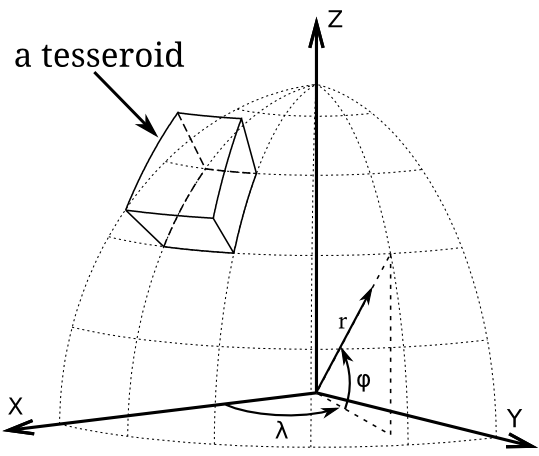
Tesseroids is a collection of command-line tools for modeling the gravitational potential, acceleration, and gradient (Marussi) tensor.
The mass models can be made of right rectangular prisms or tesseroids (spherical prisms). Computation for rectangular prisms can be made in Cartesian or spherical (geocentric) coordinates.
License
Tesseroids is free software made available under the terms of the BSD 3-clause license. See LICENSE.txt.
Citing
Tesseroids is research software made by scientists. If you use it in your research, please cite our Geophysics paper in your publications:
Uieda, L., V. Barbosa, and C. Braitenberg (2016), Tesseroids: Forward-modeling gravitational fields in spherical coordinates, GEOPHYSICS, F41-F48, doi:10.1190/geo2015-0204.1.
You can download a copy of the paper PDF at leouieda.com/papers/paper-tesseroids-2016.html and see all source code used in the paper at the Github repository pinga-lab/paper-tesseroids.
See CITATION.txt or the Citing page of the documentation for more information.
Installing
The easiest way to install is to download the latest compiled binary distribution from:
https://github.com/leouieda/tesseroids/releases/latest
We offer binaries for Windows (32 and 64 bit) and GNU/Linux (32 and 64 bit).
Once downloaded, simply unpack the archive in the desired directory.
The executables will be in the bin folder.
For easier access to the programs, consider
adding the bin folder to your PATH environment
variable.
Getting started
Take a look at the examples in the Cookbook. They contain scripts that run Tesseroids and some Python code to plot the results.
The documentation contains sections on the theory and equations and usage instructions.
Also, all programs accept the -h flag to print the instructions for using
that particular program. For example:
$ tessgrd -h
Usage: tessgrd [PARAMS] [OPTIONS]

Make a regular grid of points.

All units either SI or degrees!

Output:
  Printed to standard output (stdout) in the format:
    lon1    lat1    height
    lon2    lat1    height
    ...     ...     ...
    lonNLON lat1    height
    lon1    lat2    height
    ...     ...     ...
    ...     ...     ...
    lonNLON latNLAT height

  * Comments about the provenance of the data are inserted into
    the top of the output

Parameters:
  -r           W/E/S/N: Bounding region of the grid.
  -b           NLON/NLAT: Number of grid points in the
               longitudinal and latitudinal directions.
  -z           HEIGHT: Height of the grid with respect to the
               mean Earth radius.
  -h           Print instructions.
  --version    Print version and license information.

Options:
  -v           Enable verbose printing to stderr.
  -lFILENAME   Print log messages to file FILENAME.

Part of the Tesseroids package.
Project site: <http://fatiando.org/software/tesseroids>
Report bugs at: <http://code.google.com/p/tesseroids/issues/list>
Getting help
Write an e-mail to Leonardo Uieda, or tweet, or Google Hangout. Even better, submit a bug report/feature request/question to the Github issue tracker.
Compiling from source
If you want to build Tesseroids from source, you'll need:
Setting up SCons
Tesseroids uses the build tool SCons.
A SConstruct file (Makefile equivalent)
is used to define the compilation rules.
The advantage of SCons over Make is that it automatically detects your system
settings.
You will have to download and install SCons
in order to easily compile Tesseroids.
SCons is available for both GNU/Linux and Windows
so compiling should work the same on both platforms.
SCons requires that you have Python installed. Follow the instructions in the SCons website to install it. Python is usually installed by default on most GNU/Linux systems.
Under Windows you will have to put SCons on
your PATH environment variable
in order to use it from the command line.
It is usually located in the Scripts directory of your Python installation.
On GNU/Linux, SCons will generally use the GCC compiler to compile sources. On Windows it will search for an existing compiler. We recommend that you install GCC on Windows using MinGW.
Compiling
Download a source distribution and
unpack the archive anywhere you want
(e.g., ~/tesseroids or C:\tesseroids or whatever).
To compile,
open a terminal (or cmd.exe on Windows)
and go to the directory where you unpacked (use the cd command).
Then, type the following and hit Enter:
scons
If everything goes well, the compiled executables will be placed on a bin
folder.
To clean up the build (delete all generated files), run:
scons -c
If you get any strange errors or the code doesn't compile for some reason,
please submit a bug report.
Don't forget to copy the output of running scons.
Testing the build
After the compilation,
a program called tesstest
will be placed in the directory where you unpacked the source.
This program runs the unit tests
for Tesseroids (sources in the test directory).
To run the test suite, simply execute tesstest with no arguments:
tesstest
or on GNU/Linux:
./tesstest
A summary of all tests (pass or fail) will be printed on the screen.
If all tests pass,
the compilation probably went well.
If any test fail,
please submit a bug report
with the output of running tesstest.
Owner
- Name: Leonardo Uieda
- Login: leouieda
- Kind: user
- Location: São Paulo, Brazil
- Company: Universidade de São Paulo
- Website: https://www.leouieda.com
- Repositories: 116
- Profile: https://github.com/leouieda
Professor of Geophysics • I study the Earth using tiny disturbances in its gravity and magnetic fields, from global 🌎 to microscopic 🔬 scale
Citation (CITATION.txt)
Citing
======

Geophysics paper
----------------

To cite *Tesseroids* in publications, please use our paper published in
*Geophysics*:

    Uieda, L., V. Barbosa, and C. Braitenberg (2016), Tesseroids:
    Forward-modeling gravitational fields in spherical coordinates, GEOPHYSICS,
    F41-F48,
    doi:`10.1190/geo2015-0204.1 <http://dx.doi.org/10.1190/geo2015-0204.1>`__.

You can download a copy of the `paper PDF
<http://www.leouieda.com/papers/paper-tesseroids-2016.html>`__ and see all
source code used in the paper at
`the Github repository <https://github.com/pinga-lab/paper-tesseroids>`__.

Please note that **citing the paper is prefered** over citing the previous
conference proceedings.

If you're a BibTeX user::

    @article{uieda2016,
      title = {Tesseroids: {{Forward}}-modeling gravitational fields in spherical coordinates},
      author = {Uieda, L. and Barbosa, V. and Braitenberg, C.},
      issn = {0016-8033},
      doi = {10.1190/geo2015-0204.1},
      url = {http://library.seg.org/doi/abs/10.1190/geo2015-0204.1},
      journal = {GEOPHYSICS},
      month = jul,
      year = {2016},
      pages = {F41--F48},
    }

Source code
-----------

You can refer to individual versions of Tesseroids through their DOIs.
However, please **also cite the Geophysics paper**.

For example. if you want to mention that you used the 1.1.1 version,
you can go to :ref:`the Releases page <releases>` of the documentation
and get the DOI link for that version.
This link will not be broken, even if I move the site somewhere else.

You can also cite the specific version instead of just providing the link.
If you click of the DOI link for 1.1.1, the Zenodo page will
recommend that you cite it as:

    Uieda, Leonardo. (2015). Tesseroids v1.1.1: Forward modeling of
    gravitational fields in spherical coordinates. Zenodo. 10.5281/zenodo.15800


Conference proceeding
---------------------

The previous way citation for Tesseroids was a conference proceeding from the
2011 GOCE User Workshop:

    Uieda, L., E. P. Bomfim, C. Braitenberg, and E. Molina (2011),
    Optimal forward calculation method of the Marussi tensor
    due to a geologic structure at GOCE height,
    Proceedings of the 4th International GOCE User Workshop.

Download a `PDF version of the proceedings
<http://www.leouieda.com/pdf/goce-2011.pdf>`__.
You can also see the poster and source code at
the `Github repository <https://github.com/leouieda/goce2011>`__.
GitHub Events
Total
- Watch event: 2
Last Year
- Watch event: 2
Committers
Last synced: 10 months ago
Top Committers
| Name | Commits | |
|---|---|---|
| Leonardo Uieda | l****a@g****m | 334 |
| leouieda | n****e@n****e | 48 |
Issues and Pull Requests
Last synced: 10 months ago
All Time
- Total issues: 18
- Total pull requests: 16
- Average time to close issues: 10 months
- Average time to close pull requests: 28 days
- Total issue authors: 6
- Total pull request authors: 1
- Average comments per issue: 1.33
- Average comments per pull request: 0.38
- Merged pull requests: 14
- Bot issues: 0
- Bot pull requests: 0
Past Year
- Issues: 0
- Pull requests: 0
- Average time to close issues: N/A
- Average time to close pull requests: N/A
- Issue authors: 0
- Pull request authors: 0
- Average comments per issue: 0
- Average comments per pull request: 0
- Merged pull requests: 0
- Bot issues: 0
- Bot pull requests: 0
Top Authors
Issue Authors
- leouieda (12)
- zengxianghang (2)
- jmdagert (1)
- breathingwt (1)
- vforyang (1)
- tmglly (1)
Pull Request Authors
- leouieda (16)
Top Labels
Issue Labels
Pull Request Labels
Dependencies
- sphinx_rtd_theme *
- basemap *
- matplotlib *
- numpy *
- scons *
- sphinx *