Science Score: 41.0%
This score indicates how likely this project is to be science-related based on various indicators:
-
✓CITATION.cff file
Found CITATION.cff file -
✓codemeta.json file
Found codemeta.json file -
○.zenodo.json file
-
○DOI references
-
✓Academic publication links
Links to: arxiv.org -
○Academic email domains
-
○Institutional organization owner
-
○JOSS paper metadata
-
○Scientific vocabulary similarity
Low similarity (14.9%) to scientific vocabulary
Repository
Modular and intuitive Hypernetworks in Pytorch
Basic Info
- Host: GitHub
- Owner: JJGO
- License: apache-2.0
- Language: Python
- Default Branch: main
- Size: 214 KB
Statistics
- Stars: 37
- Watchers: 3
- Forks: 3
- Open Issues: 8
- Releases: 0
Metadata Files
README.md
HyperLight
Hypernetworks in Pytorch made easy





TL;DR
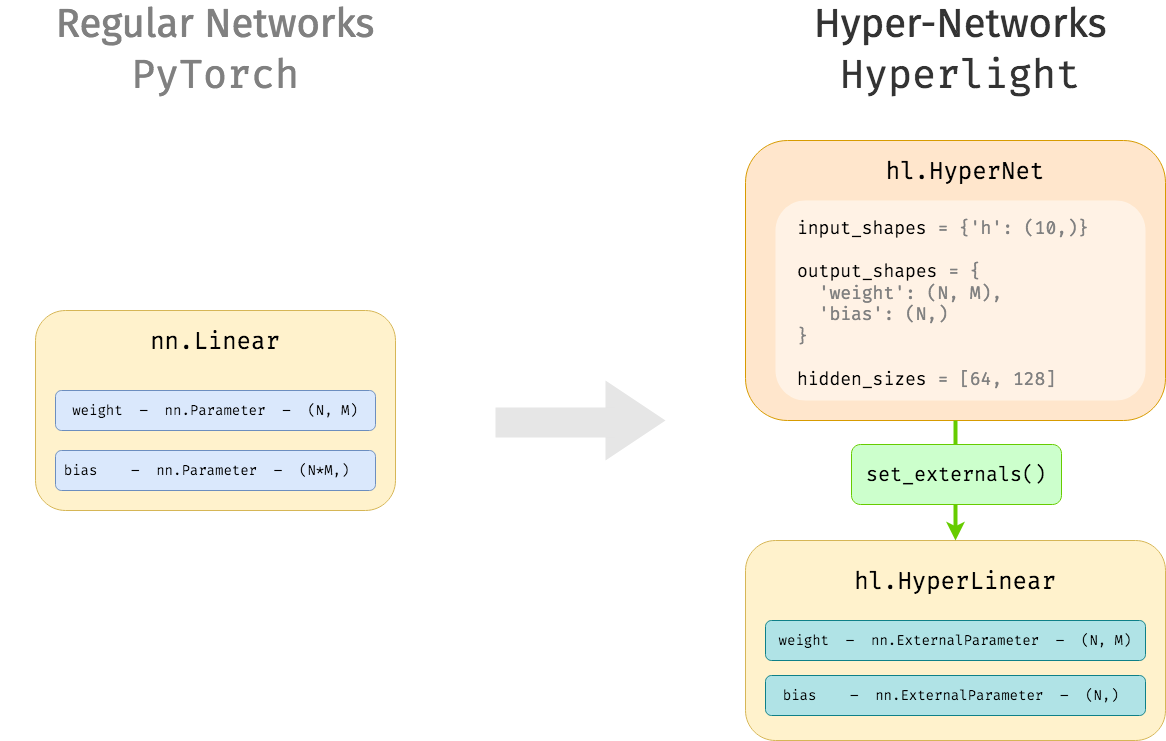
HyperLight is a Pytorch library designed to make implementing hypernetwork models easy and painless. What sets HyperLight apart from other hypernetwork implementations:
- Bring your own architecture – Reuse your existing model code.
- Principled Parametrizations and Initializations – Default networks can have unstable training dynamics, HyperLight has good defaults that lead to improved training [1].
- Work with pretrained models – Use pretrained weights as part of the hypernetwork initialization.
- Seamless Composability – It's hypernets all the way down! Hypernetize hypernet models without issue.
- Pytorch-nic API design – Parameters are treated as an attribute of the layer, preventing the need for rewriting PyTorch modules.
<!-- - Easy weight reuse – Once a model has its weights set, it can be used many times. -->
[1] Magnitude Invariant Parametrizations Improve Hypernetwork Learning
Installation
To install the stable version of HyperLight via pip:
shell
pip install hyperlight
Or for the latest version:
shell
pip install git+https://github.com/JJGO/hyperlight.git
For the manual install:
```shell
clone it
git clone https://github.com/JJGO/hyperlight
install dependencies
python -m pip install -r ./hyperlight/requirements.txt # only dependency is PyTorch
add this to your .bashrc/.zshrc
export PYTHONPATH="$PYTHONPATH:/path/to/hyperlight)" ```
Getting Started
The main advantage of HyperLight is that it allows to easily reuse existing networks without having to redo the model code.
For example, here's a Bayesian Neural Hypernetwork for a simple convnet architecture. We start bt declaring the main architecture without having to worry about hypernetworks
```python import torch from torch import nn, Tensor import torch.nn.functional as F
class ConvNet(nn.Module):
def __init__(self):
    super().__init__()
    self.conv1 = nn.Conv2d(1, 16, 5, 1)
    self.conv2 = nn.Conv2d(16, 32, 3, 1)
    self.conv3 = nn.Conv2d(32, 64, 3, 1)
    self.conv4 = nn.Conv2d(64, 64, 3, 1)
    self.fc = nn.Linear(64, 10)

def forward(self, x):
    x = F.leaky_relu(self.conv1(x))
    x = F.leaky_relu(self.conv2(x))
    x = F.max_pool2d(x, 2, 2)
    x = F.leaky_relu(self.conv3(x))
    x = F.max_pool2d(x, 2, 2)
    x = F.leaky_relu(self.conv4(x))
    x = F.adaptive_avg_pool2d(x, (1, 1))
    x = x.reshape(-1, self.fc.in_features)
    x = self.fc(x)
    return x
```
Now, we use HyperLight to hypernetize the convolutional layers. Hypernetizing a module involes 3 steps:
- Instantiating a regular version of the
nn.Module - Using
hl.hypernetizeto swapnn.Parameterwithhl.ExternalParameterobjects - Creating a
hl.HyperNetnetwork to predict the weights of the primary network.
```python import hyperlight as hl
1. First, instantiate the main network and
mainnet = ConvNet()
2. hypernetize: Replace nn.Parameter objects with ExternalParameters
moduletohypernetize = [ mainnet.conv1, mainnet.conv2, mainnet.conv3, mainnet.conv4 ] mainnet = hl.hypernetize(mainnet, modules=moduletohypernetize)
3. Create a hypernet to preduct the weights
Get the spec of the weights we need to predict
parametershapes = mainnet.externalshapes()
We can predict these shapes any way we want,
but hyperlight provides hypernetwork models
hyperparamshape = {'h': (10,)} # 10-dim input hypernet = hl.HyperNet( inputshapes=hyperparamshape, outputshapes=parametershapes, hiddensizes=[16,64,128], ) ```
We are now ready to use our model, let's define some simple inputs and make a prediction
```python h = torch.zeros((10,)) x = torch.zeros((1,1,28,28))
Now, instead of model(input) we first predict the main network weights
parameters = hypernet(h=h)
and then use the main network
with mainnet.using_externals(parameters): # Within this with block, the weights are accessible prediction = mainnet(x)
After this point, weights are removed, and it will trigger an error
>>> prediction = mainnet(x)
AttributeError: Uninitialized External Parameter, please set the value first
```
We can also wrap this into nn.Module to pair-up the hypernet with the main network and have a more selfcontained API
```python class HyperConvNet(nn.Module):
def __init__(self):
    super().__init__()
    mainnet = ConvNet()
    # HyperLight provides convenience funtions to select relevant modules
    modules = hl.find_modules_of_type(mainnet, [nn.Conv2d])
    self.mainnet = hl.hypernetize(mainnet, modules=modules)
    self.hypernet = hl.HyperNet(
        input_shapes={'h': (10,)},
        output_shapes=parameter_shapes,
        hidden_sizes=[16,64,128],
    )

def forward(self, main_input, hyper_input):
    parameters = self.hypernet(h=hyper_input)

    with self.mainnet.using_externals(parameters):
        prediction = self.mainnet(main_input)

    return prediction
model = HyperConvNet() model(x, h).shape ```
Tutorial
Concepts
HyperLight introduces a few new concepts:
HyperModule– A specializednn.Moduleobject that can hold both regular parameters andExternalParametersto be predicted by an external hypernetwork.ExternalParameter–nn.Parameterreplacement that only stores the required shape of the externalized parameter. Parameter data can be set and reset with the hypernetwork predictions.HyperNetwork–nn.Modulethat predicts a main network parameters for a given input.
Defining a HyperModule with ExternalParameters
Here is an example of how we define a hypernetized Linear layer. We need to make sure to
define the ExternalParameter properties with their correct shapes.
```python import torch.nn.functional as F import hyperlight as hl
class HyperLinear(hl.HyperModule): """Implementation of a nn.Linear layer but with external parameters that will be predicted by an external hypernetwork"""
in_features: int
out_features: int

def __init__(self, in_features: int, out_features: int, bias: bool = True) -> None:
    super().__init__()
    assert isinstance(in_features, int) and isinstance(out_features, int)
    self.in_features = in_features
    self.out_features = out_features
    self.weight = hl.ExternalParameter(shape=(out_features, in_features))
    if bias:
        self.bias = hl.ExternalParameter(shape=(out_features,))
    else:
        self.bias = None

def forward(self, input: Tensor) -> Tensor:
    return F.linear(input, self.weight, self.bias)
```
Once defined, we can make use of this module as follows:
```python layer = HyperLinear(infeatures=8, outfeatures=16) print(layer.external_shapes())
>>> {'weight': (16, 8), 'bias': (16,)}
x = torch.zeros(1, 8)
We need to set the weights before using the layer otherwise we will get an error
Initialize the external weights
layer.set_externals(weight=torch.rand(size=(16,8)), bias=torch.zeros((16,))) print(layer(x).shape)
>>> torch.Size([1, 16])
Once we are done, we reset the external parameter values
layer.reset_externals() ```
Alternatively, we can use the using_externals contextmanager that will set and reset
the parameters accordingly:
```python params = { 'weight': torch.rand(size=(16,8)), 'bias': torch.zeros((16,)) }
with layer.using_externals(params): y = layer(x) ```
Static HyperModules
HyperLight provides implementations of most parametric layers such as hl.HyperLinear or hl.HyperConv2d. We can use this to directly define our primary architecture. Let's revise our earlier example with ConvNet
```python from torch import nn, Tensor import torch.nn.functional as F
We change nn.Module -> hl.HyperModule
class PrimaryConvNet(hl.HyperModule):
def __init__(self):
    super().__init__()
    # we hypernetize the first two conv layers
    self.conv1 = hl.HyperConv2d(1, 16, 5, 1)
    self.conv2 = hl.HyperConv2d(16, 32, 3, 1)
    self.conv3 = nn.Conv2d(32, 64, 3, 1)
    self.conv4 = nn.Conv2d(64, 64, 3, 1)
    # we do not hypernetize the last layer
    self.fc = nn.Linear(64, 10)

def forward(self, x):
    x = F.leaky_relu(self.conv1(x))
    x = F.leaky_relu(self.conv2(x))
    x = F.max_pool2d(x, 2, 2)
    x = F.leaky_relu(self.conv3(x))
    x = F.max_pool2d(x, 2, 2)
    x = F.leaky_relu(self.conv4(x))
    x = F.adaptive_avg_pool2d(x, (1, 1))
    x = x.reshape(-1, self.fc.in_features)
    x = self.fc(x)
    return x
```
```python primary = PrimaryConvNet() print(primary.external_shapes())
>>> {'conv1.bias': (16,),
'conv1.weight': (16, 1, 5, 5),
'conv2.bias': (32,),
'conv2.weight': (32, 16, 3, 3)}
```
Dynamically hypernetizing modules
More practically, HyperLight supports dynamic HyperModule creation using the hypernetize helper.
We need to specify which parameters we want to remove from the module and convert to
ExternalParameter objects:
```python layer = nn.Linear(infeatures=8, outfeatures=16) layer = hl.hypernetize(layer, parameters=[layer.weight, layer.bias]) print(layer)
HypernetizedLinear()
print(layer.external_shapes())
{'weight': (16, 8), 'bias': (16,)}
```
hypernetize is recursive, and supports entire modules being specified:
```python model = ConvNet()
This is equivalent to our earlier static definition
model = hl.hypernetize(model, modules=[model.conv1, model.conv2]) print(model.external_shapes())
{'conv1.bias': (16),
'conv1.weight': (16, 1, 5, 5),
'conv2.bias': (32),
'conv2.weight': (32, 16, 3, 3)}
```
Finding modules and parameters
In addition, HyperLight provides several routines to recursively search for parameters and modules to feed into hypernetize:
find_modules_of_type(model, module_types)– Find modules of a certain type, e.g.nn.Linearornn.Conv2dfind_modules_from_patterns(model, globs=None, regex=None)– Find modules that match specific patterns using globs, e.g.*.conv; or regexes, e.g.layer[1-3].*convfind_parameters_from_patterns(model, globs=None, regex=None)– Find parameters that match specific patterns.
```python model = ConvNet()
Find all convolutions
hl.findmodulesof_type(model, [nn.Conv2d])
{'conv1': Conv2d(1, 16, kernel_size=(5, 5), stride=(1, 1)),
'conv2': Conv2d(16, 32, kernel_size=(3, 3), stride=(1, 1)),
'conv3': Conv2d(32, 64, kernel_size=(3, 3), stride=(1, 1)),
'conv4': Conv2d(64, 64, kernel_size=(3, 3), stride=(1, 1))}
```
```python hl.findmodulesfrom_patterns(model, regex=['conv[1-3]'])
{'conv3': Conv2d(32, 64, kernel_size=(3, 3), stride=(1, 1)),
'conv1': Conv2d(1, 16, kernel_size=(5, 5), stride=(1, 1)),
'conv2': Conv2d(16, 32, kernel_size=(3, 3), stride=(1, 1))}
```
```python hl.findparametersfrom_patterns(model, globs=['conv*.weight']).keys()
dict_keys(['conv3.weight', 'conv2.weight', 'conv1.weight', 'conv4.weight'])
```
Other methods
HyperLight goes beyond hypernetworks and helps implement other Deep Learning techniques related to hypernetworks.
As an example, the following code implements FiLM. Instead of having to modify our entire forward pass to keep track of the $\gamma$ and $\beta$ coefficients, we can have HyperLight handle that for us:
```python
FiLM module
class FiLM(hl.HyperModule): def init( self, nfeatures: int, dims: int = 2, ): super().init() self.nfeatures = nfeatures self.dims = dims extradims = [1 for _ in range(dims)] self.gamma = hl.ExternalParameter((nfeatures, *extradims)) self.beta = hl.ExternalParameter((nfeatures, *extradims))
def forward(self, x):
    return self.gamma * x + self.beta
Primary Network
class FiLM_ConvNet(hl.HyperModule):
def __init__(self):
    super().__init__()
    self.conv1 = nn.Conv2d(1, 16, 5, 1)
    self.film1 = FiLM(16)
    self.conv2 = nn.Conv2d(16, 32, 3, 1)
    self.film2 = FiLM(32)
    self.conv3 = nn.Conv2d(32, 64, 3, 1)
    self.film3 = FiLM(64)
    self.conv4 = nn.Conv2d(64, 64, 3, 1)
    self.film4 = FiLM(64)
    self.fc = nn.Linear(64, 10)

def forward(self, x):
    x = F.leaky_relu(self.conv1(x))
    x = self.film1(x)
    x = F.leaky_relu(self.conv2(x))
    x = self.film2(x)
    x = F.max_pool2d(x, 2, 2)
    x = F.leaky_relu(self.conv3(x))
    x = self.film3(x)
    x = F.max_pool2d(x, 2, 2)
    x = F.leaky_relu(self.conv4(x))
    x = self.film4(x)
    x = F.adaptive_avg_pool2d(x, (1, 1))
    x = x.reshape(-1, self.fc.in_features)
    x = self.fc(x)
    return x
```
```python
Wrapper
class FiLM_Model(nn.Module):
def __init__(self, embedding_size):
    super().__init__()
    self.main = FiLM_ConvNet()
    self.cond = hl.HyperNet(
        input_shapes={'film_input': (embedding_size,)},
        output_shapes=self.main.external_shapes(),
        hidden_sizes=[],
    )

def forward(self, x, conditioning):
    params = self.cond(film_input=conditioning)
    with self.main.using_externals(params):
        return self.main(x)
model = FiLM_Model(7) x = torch.randn((1,1,28,28)) cond = torch.rand(1,7) print(model(x, cond).shape) ```
```python
```
Owner
- Name: Jose Javier
- Login: JJGO
- Kind: user
- Location: Cambridge, MA
- Company: MIT CSAIL
- Website: https://josejg.com
- Repositories: 60
- Profile: https://github.com/JJGO
PhD Student @ MIT CSAIL. Working in Efficient Deep Learning methods via Hypernetworks and In-Context Learning.
Citation (CITATION.bib)
@article{ortiz2023nonproportional,
  title={Non-Proportional Parametrizations for Stable Hypernetwork Learning},
  author={Jose Javier Gonzalez Ortiz and John Guttag and Adrian Dalca},
  year={2023},
  journal={arXiv:2304.07645},
}
GitHub Events
Total
- Issues event: 1
- Watch event: 6
- Issue comment event: 8
- Pull request event: 1
- Fork event: 1
Last Year
- Issues event: 1
- Watch event: 6
- Issue comment event: 8
- Pull request event: 1
- Fork event: 1
Issues and Pull Requests
Last synced: 12 months ago
All Time
- Total issues: 7
- Total pull requests: 3
- Average time to close issues: 5 days
- Average time to close pull requests: 2 minutes
- Total issue authors: 6
- Total pull request authors: 3
- Average comments per issue: 1.86
- Average comments per pull request: 0.33
- Merged pull requests: 1
- Bot issues: 0
- Bot pull requests: 0
Past Year
- Issues: 1
- Pull requests: 1
- Average time to close issues: N/A
- Average time to close pull requests: N/A
- Issue authors: 1
- Pull request authors: 1
- Average comments per issue: 8.0
- Average comments per pull request: 0.0
- Merged pull requests: 0
- Bot issues: 0
- Bot pull requests: 0
Top Authors
Issue Authors
- murataryusei (2)
- Richienb (1)
- WangJYao (1)
- minhquoc0712 (1)
- Ashutosh1995 (1)
- BailiangJ (1)
Pull Request Authors
- Richienb (2)
- lumosan (1)
- BailiangJ (1)
Top Labels
Issue Labels
Pull Request Labels
Packages
- Total packages: 1
-
Total downloads:
- pypi 60 last-month
- Total dependent packages: 0
- Total dependent repositories: 0
- Total versions: 5
- Total maintainers: 1
pypi.org: hyperlight
Hyperlight is a Pytorch hypernetwork framework with a streamlined API
- Homepage: https://github.com/JJGO/hyperlight
- Documentation: https://github.com/JJGO/hyperlight
- License: Apache-2.0
-
Latest release: 0.0.5
published about 3 years ago
Rankings
Maintainers (1)
Dependencies
- torch *
- torch >=1.10,<3