zCurve
zCurve maps multidimensional data to one dimension while preserving locality of the data points.
Science Score: 23.0%
This score indicates how likely this project is to be science-related based on various indicators:
-
○CITATION.cff file
-
○codemeta.json file
-
○.zenodo.json file
-
✓DOI references
Found 1 DOI reference(s) in README -
✓Academic publication links
Links to: zenodo.org -
○Academic email domains
-
○Institutional organization owner
-
○JOSS paper metadata
-
○Scientific vocabulary similarity
Low similarity (10.1%) to scientific vocabulary
Repository
zCurve maps multidimensional data to one dimension while preserving locality of the data points.
Basic Info
Statistics
- Stars: 9
- Watchers: 2
- Forks: 2
- Open Issues: 1
- Releases: 0
Metadata Files
README.md
zCurve

zCurve is a Python module with methods to efficiently map multidimensional data to a single dimension while preserving locality of the data points.
This mapping is commonly known as Z-order, Lebesgue curve, Morton space filling curve, Morton order or Morton code.
 Image by David Eppstein, 2008
The Morton code of a multi-dimensional data point is calculated by bitwise interlacing the binary representations of its coordinate values.
zCurve provides two functions for handling the encoding and decoding of data points with arbitrary dimensionality and arbitrary coordinate size:
python
interlace(*data_point: int, dims: int = None, bits_per_dim: int = None) -> int
python
deinterlace(code_point: int, dims: int = 3) -> List[int]
When handling large multi-dimensional dataset (n > 10.000), zCurve offers some simple but convenient means of parallelizing the Morton encoding and decoding:
python
par_interlace(data_points: List[List[int]], dims: int = None, bits_per_dim: int = None) -> List[int]
python
par_deinterlace(code_points: List[int], dims: int = 3) -> List[List[int]]
Given the Morton codes of a multi-dimensional dataset, we can perform multi-dimensional range search using only a one-dimensional data structure.
For range searching, zCurve offers two functions for calculating the necesaary LITMAX and BIGMIN values:
python
prev_morton(code_point: int, rmin_code: int, rmax_code: int, dims: int = 3) -> int
python
next_morton(code_point: int, rmin_code: int, rmax_code: int, dims: int = 3) -> int
This implementation is based on the following paper
Tropf, Herbert, and Helmut Herzog. "Multidimensional Range Search in Dynamically Balanced Trees." ANGEWANDTE INFO. 2 (1981): 71-77.
and it makes heavy use of the excellent gmpy2 module.
Installation
bash
pip install zCurve
Usage
Basics
python
import zCurve as z
imports the module.
python
code = z.interlace(2,16,8)
interlaces the 3D data point (2,16,8) into Morton code point 10248.
When explicitly specify dimensionality and bits per dimension of your data point
python
code = z.interlace(2,16,8, dims=3, bits_per_dim=5)
performance will benefit substantially.
python
z.deinterlace(4711)
deinterlaces the Morton code point 4711 into the 3D data point (29,1,3).
Parallel interlacing/deinterlacing
Given a potentially large list of n-dimensional data_points
````python
from random import randrange
bitsize = 16
maxval = 2bitsize - 1
nosamples = 106
datapoints = [(randrange(0, maxval), randrange(0, maxval), randrange(0, maxval)) for i in range(nosamples)]
```
we can speed up things by usingparinterlaceandpardeinterlace
``python
mortoncodes = z.parinterlace(datapoints, dims=3, bitsperdim=16)
datapoints == z.pardeinterlaces(morton_codes, dims=3)
````
Range searching
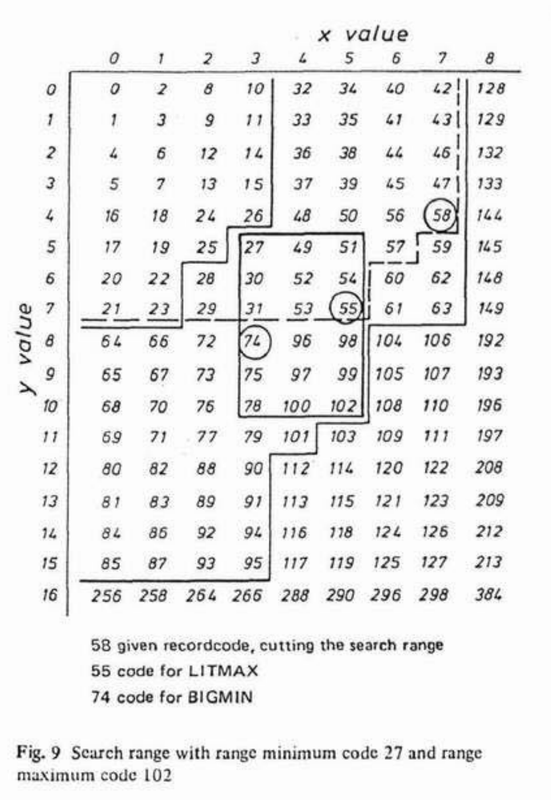 Image by Tropf and Herzog, 1981
When range searching, we can prune the search space by calculating BIGMIN (aka "GetNextZ-address") and LITMAX (aka "GetPrevZ-address") values.
```python
point = z.interlace(6, 3, dims=2) # => 30
rmin = z.interlace(5, 3, dims=2) # => 27
rmax = z.interlace(10, 5, dims=2) # => 102
BIGMIN = z.nextmorton(point, rmin, rmax, dims=2) # => 31
LITMAX = z.prevmorton(point, rmin, rmax, dims=2) # => 27
In addition, we can easily check if a given Morton code point is within a specified range
python
z.inrange(58,27,102, dims=2) # => False
z.inrange(49,27,102, dims=2) # => True
```
Citation
bibtex
@misc{rmrschub_2021_zCurve,
    author       = {René Schubotz},
    title        = {{zCurve: Multi-dimensional indexing using Morton space filling curves.}},
    month        = may,
    year         = 2021,
    doi          = {10.5281/zenodo.4777584},
    version      = {0.0.4},
    publisher    = {Zenodo},
    url          = {https://github.com/rmrschub/zCurve}
    }
License

This work is licensed under a Creative Commons Attribution-NonCommercial-ShareAlike 4.0 International License.
Owner
- Login: resc2801
- Kind: user
- Location: Germany
- Repositories: 1
- Profile: https://github.com/resc2801
GitHub Events
Total
- Watch event: 1
- Pull request event: 1
- Fork event: 1
Last Year
- Watch event: 1
- Pull request event: 1
- Fork event: 1
Dependencies
- gmpy2 *
- typing *