saxpy
Symbolic Aggregate approXimation, HOT-SAX, and SAX-VSM implementation in Python
Science Score: 33.0%
This score indicates how likely this project is to be science-related based on various indicators:
-
○CITATION.cff file
-
○codemeta.json file
-
○.zenodo.json file
-
✓DOI references
Found 1 DOI reference(s) in README -
✓Academic publication links
Links to: springer.com, ieee.org -
✓Committers with academic emails
1 of 5 committers (20.0%) from academic institutions -
○Institutional organization owner
-
○JOSS paper metadata
-
○Scientific vocabulary similarity
Low similarity (10.5%) to scientific vocabulary
Repository
Symbolic Aggregate approXimation, HOT-SAX, and SAX-VSM implementation in Python
Basic Info
Statistics
- Stars: 213
- Watchers: 6
- Forks: 49
- Open Issues: 10
- Releases: 0
Metadata Files
README.md
Time series symbolic discretization with SAX




This code is released under GPL v.2.0 and implements in Python: * Symbolic Aggregate approXimation (SAX) (with z-normalization and PAA) [1] * EMMA -- an algorithm for time series motif discovery [2] * HOT-SAX - a time series anomaly (discord) discovery algorithm [3] * SAX-ZSCORE - an extension to SAX for multi-dimensional time-series SAX that modifies the z-normalization to multi-dimensional sequences and PAA aggregation with the average along data-dimensions. [4] * SAX-REPEAT - an extension to SAX for multi-dimensional time-series that performs standard SAX on individual dimensions, then clusters to map multi-dimensional words into strings from the required alphabet size. [4]
Note that all of the library's functionality is also available in R and Java.
References
[1] Lin, J., Keogh, E., Patel, P., and Lonardi, S.,
Finding Motifs in Time Series,
The 2nd Workshop on Temporal Data Mining, the 8th ACM Int'l Conference on KDD (2002)
[2] Patel, P., Keogh, E., Lin, J., Lonardi, S.,
Mining Motifs in Massive Time Series Databases,
In Proc. ICDM (2002)
[3] Keogh, E., Lin, J., Fu, A.,
HOT SAX: Efficiently finding the most unusual time series subsequence,
In Proc. ICDM (2005)
[4] Mohammad, Y., Nishida T.,
Robust learning from demonstrations using multidimensional SAX,
2014 14th International Conference on Control, Automation and Systems (ICCAS 2014)
Citing this work
If you are using this implementation for you academic work, please cite our Grammarviz 2.0 paper:
[Citation] Senin, P., Lin, J., Wang, X., Oates, T., Gandhi, S., Boedihardjo, A.P., Chen, C., Frankenstein, S., Lerner, M., GrammarViz 2.0: a tool for grammar-based pattern discovery in time series, ECML/PKDD Conference, 2014.
SAX in a nutshell
SAX is used to transform a sequence of rational numbers (i.e., a time series) into a sequence of letters (i.e., a string). An illustration of a time series of 128 points converted into the word of 8 letters:
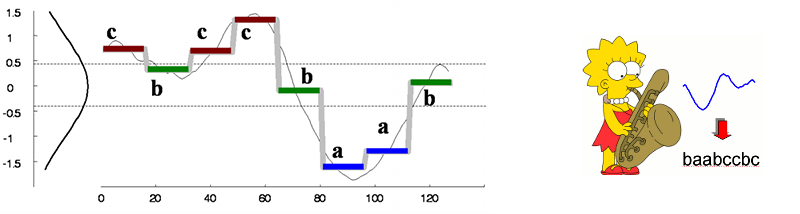
As discretization is probably the most used transformation in data mining, SAX has been widely used throughout the field. Find more information about SAX at its authors pages: SAX overview by Jessica Lin, Eamonn Keogh's SAX page, or at sax-vsm wiki page.
Building
The code is written in Python and hosted on PyPi, so use pip to install it. This is what happens in my clean test environment:
$ pip install saxpy
Collecting saxpy
Downloading saxpy-1.0.0.dev154.tar.gz (180kB)
    100% |████████████████████████████████| 184kB 778kB/s
Requirement already satisfied: numpy in /home/psenin/anaconda3/lib/python3.6/site-packages (from saxpy)
Requirement already satisfied: pytest in /home/psenin/anaconda3/lib/python3.6/site-packages (from saxpy)
...
Installing collected packages: coverage, pytest-cov, codecov, saxpy
Successfully installed codecov-2.0.15 coverage-4.5.1 pytest-cov-2.5.1 saxpy-1.0.0.dev154
Simple time series to SAX conversion
To convert a time series of an arbitrary length to SAX we need to define the alphabet cuts. Saxpy retrieves cuts for a normal alphabet (we use size 3 here) via cuts_for_asize function:
from saxpy.alphabet import cuts_for_asize
cuts_for_asize(3)
which yields an array:
array([ -inf, -0.4307273, 0.4307273])
To convert a time series to letters with SAX we use ts_to_string function but not forgetting to z-normalize the input time series (we use Normal alphabet):
import numpy as np
from saxpy.znorm import znorm
from saxpy.sax import ts_to_string
ts_to_string(znorm(np.array([-2, 0, 2, 0, -1])), cuts_for_asize(3))
this produces a string:
'abcba'
Time series to SAX conversion with PAA aggregation (by "chunking")
In order to reduce dimensionality further, the PAA (Piecewise Aggregate Approximation) is usually applied prior to SAX:
import numpy as np
from saxpy.znorm import znorm
from saxpy.paa import paa
from saxpy.sax import ts_to_string

dat = np.array([-2, 0, 2, 0, -1])
dat_znorm = znorm(dat)
dat_paa_3 = paa(dat_znorm, 3)

ts_to_string(dat_paa_3, cuts_for_asize(3))
and a string with three letters is produced:
'acb'
Time series to SAX conversion via sliding window
Typically, in order to investigate the input time series structure in order to discover anomalous (i.e., discords) and recurrent (i.e., motifs) patterns we employ time series to SAX conversion via sliding window. Saxpy implements this workflow:
import numpy as np
from saxpy.sax import sax_via_window

dat = np.array([0., 0., 0., 0., 0., -0.270340178359072, -0.367828308500142,
            0.666980581124872, 1.87088147328446, 2.14548907684624,
            -0.480859313143032, -0.72911654245842, -0.490308602315934,
            -0.66152028906509, -0.221049033806403, 0.367003418871239,
            0.631073992586373, 0.0487728723414486, 0.762655178750436,
            0.78574757843331, 0.338239686422963, 0.784206454089066,
            -2.14265084073625, 2.11325193044223, 0.186018356196443,
            0., 0., 0., 0., 0., 0., 0., 0., 0., 0., 0.519132472499234,
            -2.604783141655, -0.244519550114012, -1.6570790528784,
            3.34184602886343, 2.10361226260999, 1.9796808733979,
            -0.822247322003058, 1.06850578033292, -0.678811824405992,
            0.804225748913681, 0.57363964388698, 0.437113583759113,
            0.437208643628268, 0.989892093383503, 1.76545983424176,
            0.119483882364649, -0.222311941138971, -0.74669456611669,
            -0.0663660879732063, 0., 0., 0., 0., 0.,])

sax_none = sax_via_window(dat, win_size=6, paa_size=3, alphabet_size=3, nr_strategy=None, znorm_threshold=0.01)

sax1
the result is represented as a data structure of resulting words and their respective positions on time series:
defaultdict(list,
        {'aac': [4, 10, 11, 30, 35],
         'abc': [12, 14, 36, 44],
         'acb': [5, 16, 21, 37, 43],
         'acc': [13, 52, 53],
         'bac': [3, 19, 34, 45, 51],
         'bba': [31],
         'bbb': [15, 18, 20, 22, 25, 26, 27, 28, 29, 41, 42, 46],
         'bbc': [2],
         'bca': [6, 17, 32, 38, 47, 48],
         'caa': [8, 23, 24, 40],
         'cab': [9, 50],
         'cba': [7, 39, 49],
         'cbb': [33],
         'cca': [0, 1]})
sax_via_window is parameterised with a sliding window size, desired PAA aggregation, alphabet size, a numerosity reduction strategy, z-normalization threshold, and a SAX type ('unidim' for unidimensional SAX (default), 'zscore' for SAX-ZSCORE, 'repeat' for SAX-REPEAT):
def sax_via_window(series, win_size, paa_size, alphabet_size=3,
               nr_strategy='exact', z_threshold=0.01, sax_type='unidim')
Time series discord discovery with HOT-SAX
Saxpy implements HOT-SAX discord discovery algorithm in find_discords_hotsax function which can be used as follows:
import numpy as np
from saxpy.hotsax import find_discords_hotsax
from numpy import genfromtxt
dd = genfromtxt("data/ecg0606_1.csv", delimiter=',')
discords = find_discords_hotsax(dd)
discords
and discovers anomalies easily:
[(430, 5.2790800061718386), (318, 4.1757563573086953)]
The function has a similar parameterization: sliding window size, PAA and alphabet sizes, z-normalization threshold, and a parameter specifying how many discords are desired to be found:
def find_discords_hotsax(series, win_size=100, num_discords=2, a_size=3,
                     paa_size=3, z_threshold=0.01)
Saxpy also provides a brute-force implementation of the discord search if you'd like to verify discords or evaluate the speed-up:
find_discords_brute_force(series, win_size, num_discords=2,
                          z_threshold=0.01)
which can be called as follows:
discords = find_discords_brute_force(dd[100:500], 100, 4)
discords

[(73, 6.198555329625453), (219, 5.5636923991016136)]
Time series motif discovery with EMMA
ToDo...
Made with Aloha!

Owner
- Name: Pavel Senin
- Login: seninp
- Kind: user
- Website: http://seninp.github.io/
- Repositories: 3
- Profile: https://github.com/seninp
Z80codes|BASIC .. algol|pl/m|fortran .. asm|pascal|smalltalk .. c|c++ .. java|R|Perl|Python|SQL .. JavaScript
GitHub Events
Total
- Issues event: 1
- Watch event: 3
- Push event: 4
- Pull request event: 4
- Fork event: 3
- Create event: 1
Last Year
- Issues event: 1
- Watch event: 3
- Push event: 4
- Pull request event: 4
- Fork event: 3
- Create event: 1
Committers
Last synced: over 2 years ago
Top Committers
| Name | Commits | |
|---|---|---|
| Pavel Senin | s****p@g****m | 186 |
| Ameya Daigavane | a****e@j****v | 65 |
| Ameya Daigavane | a****8@g****m | 3 |
| Pavel Senin | P****n@s****m | 2 |
| Pavel Senin | p****5@c****m | 1 |
Committer Domains (Top 20 + Academic)
Issues and Pull Requests
Last synced: 10 months ago
All Time
- Total issues: 9
- Total pull requests: 11
- Average time to close issues: about 1 month
- Average time to close pull requests: 4 months
- Total issue authors: 9
- Total pull request authors: 7
- Average comments per issue: 0.33
- Average comments per pull request: 1.0
- Merged pull requests: 3
- Bot issues: 0
- Bot pull requests: 0
Past Year
- Issues: 1
- Pull requests: 4
- Average time to close issues: N/A
- Average time to close pull requests: less than a minute
- Issue authors: 1
- Pull request authors: 2
- Average comments per issue: 0.0
- Average comments per pull request: 0.0
- Merged pull requests: 1
- Bot issues: 0
- Bot pull requests: 0
Top Authors
Issue Authors
- pyetrotype (1)
- jhon353 (1)
- FWDekker (1)
- MrSampson (1)
- MarkusThill (1)
- thewchan (1)
- LucaCerina (1)
- sirdawar (1)
- lebedov (1)
Pull Request Authors
- seninp (3)
- psenin-sanofi (2)
- marclagies (2)
- sw241395 (1)
- rhsimplex (1)
- ameya98 (1)
- misilva73 (1)
Top Labels
Issue Labels
Pull Request Labels
Packages
- Total packages: 1
-
Total downloads:
- pypi 334 last-month
- Total dependent packages: 1
- Total dependent repositories: 14
- Total versions: 1
- Total maintainers: 1
pypi.org: saxpy
SAX, HOTSAX, EMMA implementations for Python
- Homepage: https://github.com/seninp/saxpy.git
- Documentation: https://saxpy.readthedocs.io/
- License: GPL2
-
Latest release: 1.0.1.dev167
published over 8 years ago
Rankings
Maintainers (1)
Dependencies
- codecov *
- numpy *
- pytest *
- pytest-cov *
- scipy *
- sklearn *