PyDynamic
Python library for the analysis of dynamic measurements
Science Score: 36.0%
This score indicates how likely this project is to be science-related based on various indicators:
-
○CITATION.cff file
-
✓codemeta.json file
Found codemeta.json file -
○.zenodo.json file
-
✓DOI references
Found 8 DOI reference(s) in README -
✓Academic publication links
Links to: zenodo.org -
○Committers with academic emails
-
○Institutional organization owner
-
○JOSS paper metadata
-
○Scientific vocabulary similarity
Low similarity (14.1%) to scientific vocabulary
Keywords
Keywords from Contributors
Repository
Python library for the analysis of dynamic measurements
Basic Info
- Host: GitHub
- Owner: PTBresearch
- License: lgpl-3.0
- Language: Jupyter Notebook
- Default Branch: main
- Homepage: https://ptb-m4d.github.io/PyDynamic/
- Size: 72 MB
Statistics
- Stars: 29
- Watchers: 10
- Forks: 12
- Open Issues: 33
- Releases: 37
Topics
Metadata Files
README.md

<!-- CircleCI Tests -->
 <!-- ReadTheDocs Documentation -->
<!-- CodeCov(erage) -->
 <!-- Codacy -->
<!-- PyPI Version -->
 <!-- PyPI Python versions -->



Python library for the analysis of dynamic measurements
Archived
This project is archived since May 2024. It will not receive any security related or other patches anymore and we cannot guarantee any form of support in the future.
Original description
The goal of this library is to provide a starting point for users in metrology and related areas who deal with time-dependent i.e., dynamic, measurements. The initial version of this software was developed as part of a joint research project of the national metrology institutes from Germany and the UK, i.e. Physikalisch-Technische Bundesanstalt and the National Physical Laboratory.
Further development and explicit use of PyDynamic was part of the European research project EMPIR 17IND12 Met4FoF and the German research project FAMOUS. Since the end of these two projects, development of PyDynamic continues mostly based on feature requests and smaller collaborations.
Table of content
- Quickstart
- Features
- Module diagram
- Documentation
- Installation
- Contributing
- Examples
- Citation
- Acknowledgement
- Disclaimer
- License
Quickstart
To dive right into it, install PyDynamic and execute one of the examples:
shell
(my_PyDynamice_venv) $ pip install PyDynamic
Collecting PyDynamic
[...]
Successfully installed PyDynamic-[...]
(my_PyDynamice_venv) $ python
Python 3.9.7 (default, Aug 31 2021, 13:28:12)
[GCC 11.1.0] on linux
Type "help", "copyright", "credits" or "license" for more information.
```python
from PyDynamic.examples.uncertaintyfordft.deconv_DFT import DftDeconvolutionExample DftDeconvolutionExample() Propagating uncertainty associated with measurement through DFT Propagating uncertainty associated with calibration data to real and imag part Propagating uncertainty through the inverse system Propagating uncertainty through the low-pass filter Propagating uncertainty associated with the estimate back to time domain ```
You will see a couple of plots opening up to observe the results. For further information just read on and visit our tutorial section.
Features
PyDynamic offers propagation of uncertainties for
- application of the discrete Fourier transform and its inverse
- filtering with an FIR or IIR filter with uncertain coefficients
- design of a FIR filter as the inverse of a frequency response with uncertain coefficients
- design on an IIR filter as the inverse of a frequency response with uncertain coefficients
- deconvolution in the frequency domain by division
- multiplication in the frequency domain
- transformation from amplitude and phase to a representation by real and imaginary parts
- 1-dimensional interpolation
For the validation of the propagation of uncertainties, the Monte-Carlo method can be applied using a memory-efficient implementation of Monte-Carlo for digital filtering.
Module diagram
The fundamental structure of PyDynamic is shown in the following figure.
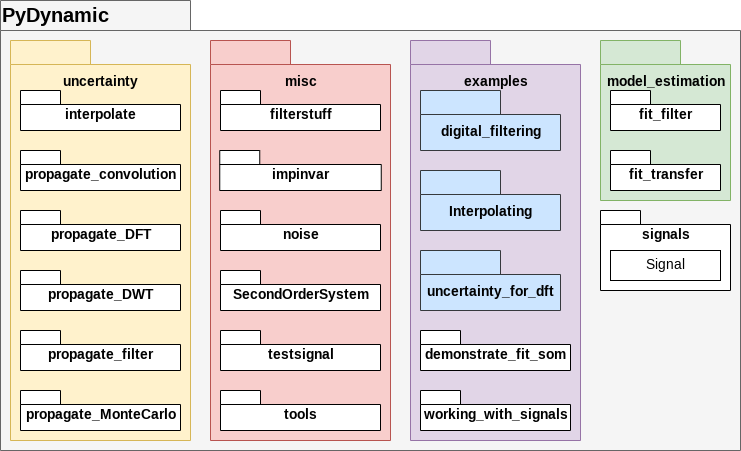
However, imports should generally be possible without explicitly naming all packages and modules in the path, so that for example the following import statements are all equivalent.
python
from PyDynamic.uncertainty.propagate_filter import FIRuncFilter
from PyDynamic.uncertainty import FIRuncFilter
from PyDynamic import FIRuncFilter
Documentation
The documentation for PyDynamic can be found on ReadTheDocs
Installation
The installation of PyDynamic is as straightforward as the Python ecosystem suggests. Detailed instructions on different options to install PyDynamic you can find in the installation section of the docs.
Contributing
Whenever you are involved with PyDynamic, please respect our Code of Conduct . If you want to contribute back to the project, after reading our Code of Conduct, take a look at our open developments in the project board , pull requests and search the issues . If you find something similar to your ideas or troubles, let us know by leaving a comment or remark. If you have something new to tell us, feel free to open a feature request or bug report in the issues. If you want to contribute code or improve our documentation, please check our contribution advices and tips.
If you have downloaded this software, we would be very thankful for letting us know. You may, for instance, drop an email to one of the authors (e.g. Sascha Eichstädt, Björn Ludwig or Maximilian Gruber )
Examples
We have collected extended material for an easier introduction to PyDynamic in the package examples. Detailed assistance on getting started you can find in the corresponding sections of the docs:
In various Jupyter Notebooks and scripts we demonstrate the use of the provided methods to aid the first steps in PyDynamic. New features are introduced with an example from the beginning if feasible. We are currently moving this supporting collection to an external repository on GitHub. They will be available at github.com/PTB-M4D/PyDynamic_tutorials in the near future.
Citation
If you publish results obtained with the help of PyDynamic, please use the above linked Zenodo DOI for the code itself or cite
Sascha Eichstädt, Clemens Elster, Ian M. Smith, and Trevor J. Esward Evaluation of dynamic measurement uncertainty – an open-source software package to bridge theory and practice J. Sens. Sens. Syst., 6, 97-105, 2017, DOI: 10.5194/jsss-6-97-2017
Acknowledgement
Part of this work is developed as part of the Joint Research Project 17IND12 Met4FoF of the European Metrology Programme for Innovation and Research (EMPIR).
This work was part of the Joint Support for Impact project 14SIP08 of the European Metrology Programme for Innovation and Research (EMPIR). The EMPIR is jointly funded by the EMPIR participating countries within EURAMET and the European Union.
Disclaimer
This software is developed at Physikalisch-Technische Bundesanstalt (PTB). The software is made available "as is" free of cost. PTB assumes no responsibility whatsoever for its use by other parties, and makes no guarantees, expressed or implied, about its quality, reliability, safety, suitability or any other characteristic. In no event will PTB be liable for any direct, indirect or consequential damage arising in connection with the use of this software.
License
PyDynamic is distributed under the LGPLv3 license
except for the module impinvar.py
in the package misc
,
which is distributed under the GPLv3 license
.
Owner
- Name: Physikalisch-Technische Bundesanstalt, PTB
- Login: PTBresearch
- Kind: organization
- Location: Germany
- Website: https://www.ptb.de/
- Repositories: 1
- Profile: https://github.com/PTBresearch
Nationales Metrologieinstitut / National Metrology Institute
GitHub Events
Total
- Fork event: 1
Last Year
- Fork event: 1
Committers
Last synced: 12 months ago
Top Committers
| Name | Commits | |
|---|---|---|
| Bjoern Ludwig | b****g@p****e | 2,045 |
| Maximilian Gruber | m****r@p****e | 388 |
| plkrusePTB | 4****B | 173 |
| eichstaedtPTB | s****t@p****e | 92 |
| semantic-release | s****e | 35 |
| Maximilian Gruber | g****4@p****e | 16 |
| Ma-Weber | w****6@g****m | 3 |
| Michael Sieberer | m****r@i****m | 2 |
| bruns01 | t****s@p****e | 1 |
| amp | a****p | 1 |
Committer Domains (Top 20 + Academic)
Dependencies
- pip
- python 3.10.*
- 142 dependencies
- 141 dependencies
- 144 dependencies
- 143 dependencies
- black * development
- hypothesis * development
- ipykernel * development
- ipython * development
- nbsphinx * development
- pytest * development
- pytest-cov * development
- pytest-custom-exit-code * development
- python-semantic-release * development
- recommonmark * development
- sphinx * development
- sphinx-rtd-theme * development
- tox * development
- tweepy * development
- cycler ==0.11.0
- fonttools ==4.33.3
- future ==0.18.2
- kiwisolver ==1.4.2
- matplotlib ==3.5.1
- mpmath ==1.2.1
- numpy ==1.22.3
- packaging ==21.3
- pandas ==1.4.2
- pillow ==9.1.0
- pyparsing ==3.0.8
- python-dateutil ==2.8.2
- pytz ==2022.1
- pywavelets ==1.3.0
- scipy ==1.8.0
- six ==1.16.0
- sympy ==1.10.1
- time-series-buffer ==0.1.4b0
- uncertainties ==3.1.6
- cycler ==0.11.0
- fonttools ==4.33.3
- future ==0.18.2
- kiwisolver ==1.4.2
- matplotlib ==3.5.1
- mpmath ==1.2.1
- numpy ==1.21.6
- packaging ==21.3
- pandas ==1.3.5
- pillow ==9.1.0
- pyparsing ==3.0.8
- python-dateutil ==2.8.2
- pytz ==2022.1
- pywavelets ==1.3.0
- scipy ==1.7.3
- six ==1.16.0
- sympy ==1.10.1
- time-series-buffer ==0.1.4b0
- typing-extensions ==4.2.0
- uncertainties ==3.1.6
- cycler ==0.11.0
- fonttools ==4.33.3
- future ==0.18.2
- kiwisolver ==1.4.2
- matplotlib ==3.5.1
- mpmath ==1.2.1
- numpy ==1.22.3
- packaging ==21.3
- pandas ==1.4.2
- pillow ==9.1.0
- pyparsing ==3.0.8
- python-dateutil ==2.8.2
- pytz ==2022.1
- pywavelets ==1.3.0
- scipy ==1.8.0
- six ==1.16.0
- sympy ==1.10.1
- time-series-buffer ==0.1.4b0
- uncertainties ==3.1.6
- cycler ==0.11.0
- fonttools ==4.33.3
- future ==0.18.2
- kiwisolver ==1.4.2
- matplotlib ==3.5.1
- mpmath ==1.2.1
- numpy ==1.22.3
- packaging ==21.3
- pandas ==1.4.2
- pillow ==9.1.0
- pyparsing ==3.0.8
- python-dateutil ==2.8.2
- pytz ==2022.1
- pywavelets ==1.3.0
- scipy ==1.8.0
- six ==1.16.0
- sympy ==1.10.1
- time-series-buffer ==0.1.4b0
- uncertainties ==3.1.6
- PyWavelets *
- matplotlib *
- numpy *
- pandas *
- scipy *
- sympy *
- time-series-buffer *