Thresholdmann
Thresholdmann: A Web tool for interactively creating adaptive thresholds to segment MRI data. - Published in JOSS (2024)
Science Score: 98.0%
This score indicates how likely this project is to be science-related based on various indicators:
-
✓CITATION.cff file
Found CITATION.cff file -
✓codemeta.json file
Found codemeta.json file -
✓.zenodo.json file
Found .zenodo.json file -
✓DOI references
Found 5 DOI reference(s) in README and JOSS metadata -
✓Academic publication links
Links to: sciencedirect.com, nature.com, joss.theoj.org, zenodo.org -
○Committers with academic emails
-
○Institutional organization owner
-
✓JOSS paper metadata
Published in Journal of Open Source Software
Keywords
Repository
A tool to apply a smoothly varying threshold to a nifti image
Basic Info
- Host: GitHub
- Owner: neuroanatomy
- License: isc
- Language: JavaScript
- Default Branch: master
- Homepage: https://neuroanatomy.github.io/thresholdmann/index.html
- Size: 36 MB
Statistics
- Stars: 3
- Watchers: 4
- Forks: 2
- Open Issues: 4
- Releases: 1
Topics
Metadata Files
ReadMe.md
Thresholdmann
A Web tool for interactively creating adaptive thresholds to segment MRI data.
Katja Heuer, Nicolas Traut & Roberto Toro, November 2023



Simply drag & drop your MRI file for display in an interactive stereotaxic viewer. Move and add a control point and grow or shrink your selection from there.
You can later re-select and adjust control points or delete them. Once you are happy with your selection, you can download the control points (json) and you can download the mask (.nii.gz).
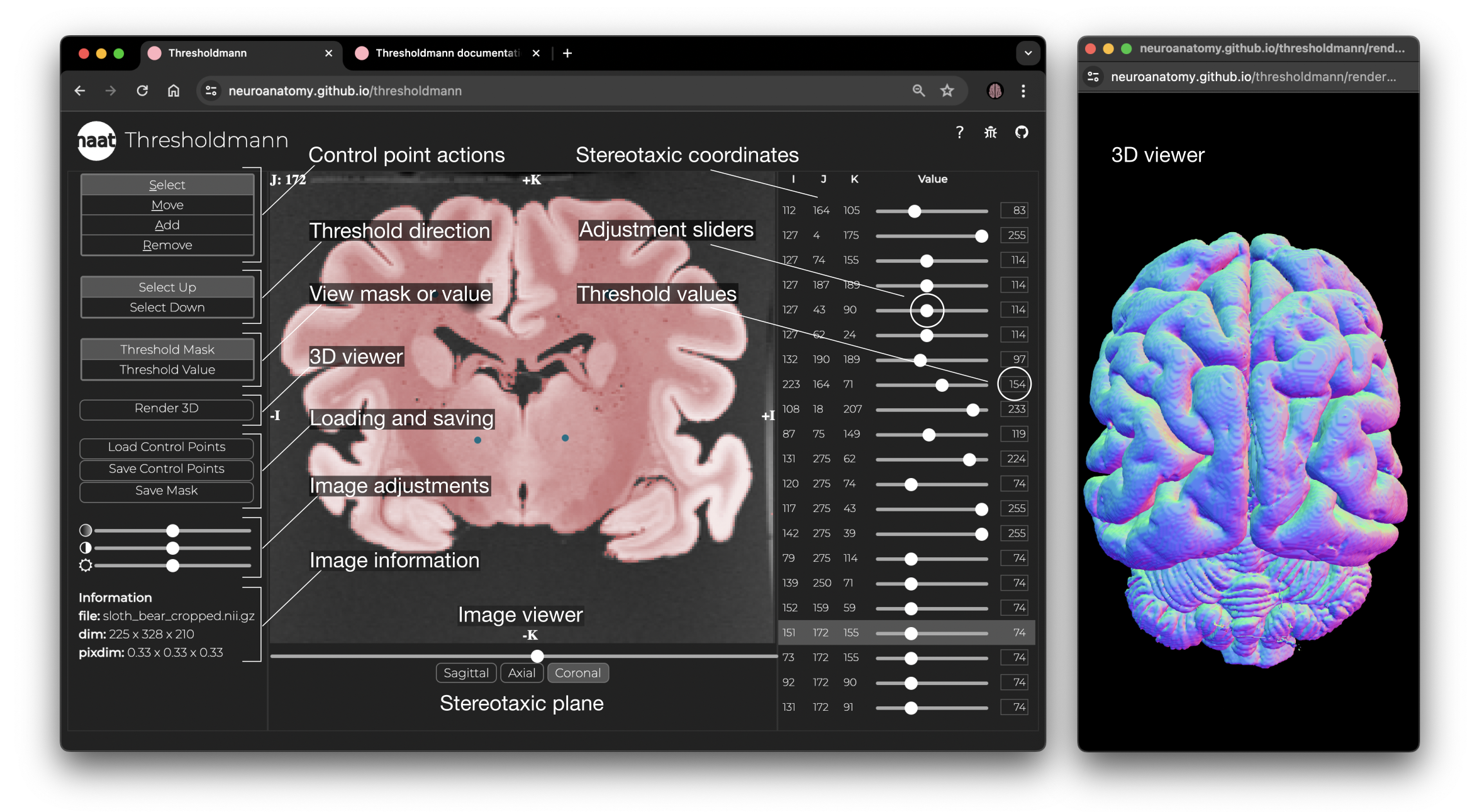
Brain extraction and segmentation are required for most analyses of neuroimaging data. Obtaining appropriate masks can be particularly difficult in non-human brain imaging, as standard automatic tools struggle with the surrounding muscle tissue, skull, and strong luminosity gradients. A simple interactive threshold is intuitive and fast to apply, and can often provide a rather good initial guess. However, because of luminosity gradients, the threshold that works for one brain region is likely to fail in another.
Thresholdmann is an open source Web tool for the interactive application of space-varying thresholds to Nifti volumes. No download or installation are required and all processing is done on the user’s computer. Nifti volumes are dragged and dropped onto the Web app and become available for visual exploration in a stereotaxic viewer. A space-varying threshold is then created by setting control points, each with their own local threshold. Each point can be repositioned or removed, and each local threshold can be adjusted in real time using sliders or entering their values numerically. The threshold direction can be switched to allow segmentation of the structure of interest in different imaging modalities, such as T1 and T2 weighted contrasts. The opacity of the mask and the brightness and contrast of the MRI image can be adjusted via sliders. A 3D model of the thresholded mask can be computed to inspect the result in an interactive 3D render. Finally, the thresholded mask, the space varying threshold and the list of control points can be saved for later use in scripted workflows, able to reproduce the thresholded volume from the original data.
Thresholdmann complements the variety of existing brain segmentation tools, providing an easy interface to manually control the segmentation on a local scale across different brain imaging modalities and image contrast gradients. The masks produced by Thresholdmann can serve as a starting point for more detailed manual editing using tools such as BrainBox or ITK Snap. This interactive approach is especially valuable for non-human brain imaging data, where automatic approaches often require extensive manual adjustment anyway. We have used Thresholdmann successfully to create initial brain masks for a variety of vertebrate brains – including many non-human primate datasets (Heuer et al. 2019, Magielse et al. 2023) – as well as developmental data. Small Web tools, such as Thresholdmann or Reorient (https://neuroanatomy.github.io/reorient), focused on solving a single problem, can become helpful additions to the methodological toolbox of neuroimagers.
Documentation
A description of a typical workflow can be found in the doc.
Owner
- Name: Neuroanatomy
- Login: neuroanatomy
- Kind: organization
- Website: http://neuroanatomy.github.io
- Repositories: 16
- Profile: https://github.com/neuroanatomy
Group of neuroanatomy
JOSS Publication
Thresholdmann: A Web tool for interactively creating adaptive thresholds to segment MRI data.
Authors

Institut Pasteur, Université Paris Cité, Unité de Neuroanatomie Appliquée et Théorique, F-75015 Paris, France
Institut Pasteur, Université Paris Cité, Unité de Neuroanatomie Appliquée et Théorique, F-75015 Paris, France
Institut Pasteur, Université Paris Cité, Unité de Neuroanatomie Appliquée et Théorique, F-75015 Paris, France
Editor
Adam Tyson
Tags
Neuroscience Neuroanatomy Neuroimaging Nifti Web toolCitation (CITATION.cff)
cff-version: "1.2.0"
authors:
- family-names: Heuer
  given-names: Katja
  orcid: "https://orcid.org/0000-0002-7237-0196"
- family-names: Traut
  given-names: Nicolas
  orcid: "https://orcid.org/0000-0003-3277-6316"
- family-names: Toro
  given-names: Roberto
  orcid: "https://orcid.org/0000-0002-6671-858X"
doi: 10.5281/zenodo.11080336
message: If you use this software, please cite our article in the
  Journal of Open Source Software.
preferred-citation:
  authors:
  - family-names: Heuer
    given-names: Katja
    orcid: "https://orcid.org/0000-0002-7237-0196"
  - family-names: Traut
    given-names: Nicolas
    orcid: "https://orcid.org/0000-0003-3277-6316"
  - family-names: Toro
    given-names: Roberto
    orcid: "https://orcid.org/0000-0002-6671-858X"
  date-published: 2024-05-03
  doi: 10.21105/joss.06336
  issn: 2475-9066
  issue: 97
  journal: Journal of Open Source Software
  publisher:
    name: Open Journals
  start: 6336
  title: "Thresholdmann: A Web tool for interactively creating adaptive
    thresholds to segment MRI data."
  type: article
  url: "https://joss.theoj.org/papers/10.21105/joss.06336"
  volume: 9
title: "Thresholdmann: A Web tool for interactively creating adaptive
  thresholds to segment MRI data."
GitHub Events
Total
- Watch event: 2
Last Year
- Watch event: 2
Committers
Last synced: 12 months ago
Top Committers
| Name | Commits | |
|---|---|---|
| katjaq | k****r@g****m | 61 |
| roberto | r****o@g****m | 32 |
| nicolas | n****9@g****m | 12 |
| sneakers-the-rat | s****t@p****m | 5 |
Issues and Pull Requests
Last synced: 11 months ago
All Time
- Total issues: 21
- Total pull requests: 19
- Average time to close issues: 4 months
- Average time to close pull requests: 2 months
- Total issue authors: 4
- Total pull request authors: 4
- Average comments per issue: 1.81
- Average comments per pull request: 0.53
- Merged pull requests: 16
- Bot issues: 0
- Bot pull requests: 0
Past Year
- Issues: 0
- Pull requests: 0
- Average time to close issues: N/A
- Average time to close pull requests: N/A
- Issue authors: 0
- Pull request authors: 0
- Average comments per issue: 0
- Average comments per pull request: 0
- Merged pull requests: 0
- Bot issues: 0
- Bot pull requests: 0
Top Authors
Issue Authors
- sneakers-the-rat (10)
- anibalsolon (6)
- katjaq (3)
- r03ert0 (2)
Pull Request Authors
- ntraut (10)
- sneakers-the-rat (8)
- katjaq (5)
- r03ert0 (3)
Top Labels
Issue Labels
Pull Request Labels
Dependencies
- 251 dependencies
- @playwright/test ^1.41.2 development
- mocha ^10.2.0 development
- eslint-config-naat github:neuroanatomy/eslint-config-naat
- http-server ^14.1.1