doped
doped: Python toolkit for robust and repeatable charged defect supercell calculations - Published in JOSS (2024)
Science Score: 95.0%
This score indicates how likely this project is to be science-related based on various indicators:
-
○CITATION.cff file
-
✓codemeta.json file
Found codemeta.json file -
✓.zenodo.json file
Found .zenodo.json file -
✓DOI references
Found 98 DOI reference(s) in README and JOSS metadata -
✓Academic publication links
Links to: arxiv.org, wiley.com, nature.com, aps.org, acs.org, joss.theoj.org -
✓Committers with academic emails
3 of 10 committers (30.0%) from academic institutions -
○Institutional organization owner
-
✓JOSS paper metadata
Published in Journal of Open Source Software
Keywords
Keywords from Contributors
Repository
doped is a Python software for the generation, pre-/post-processing and analysis of defect supercell calculations, implementing the defect simulation workflow in an efficient, reproducible, user-friendly yet powerful and fully-customisable manner.
Basic Info
- Host: GitHub
- Owner: SMTG-Bham
- License: mit
- Language: Python
- Default Branch: main
- Homepage: https://doped.readthedocs.io
- Size: 745 MB
Statistics
- Stars: 207
- Watchers: 14
- Forks: 36
- Open Issues: 6
- Releases: 27
Topics
Metadata Files
README.md





doped is a Python software for the generation, pre-/post-processing and analysis of defect supercell calculations, implementing the defect simulation workflow in an efficient, reproducible, user-friendly yet powerful and fully-customisable manner.
Tutorials showing the code functionality and usage are provided on the docs site, and an overview of the key advances of the package is given in the JOSS paper.
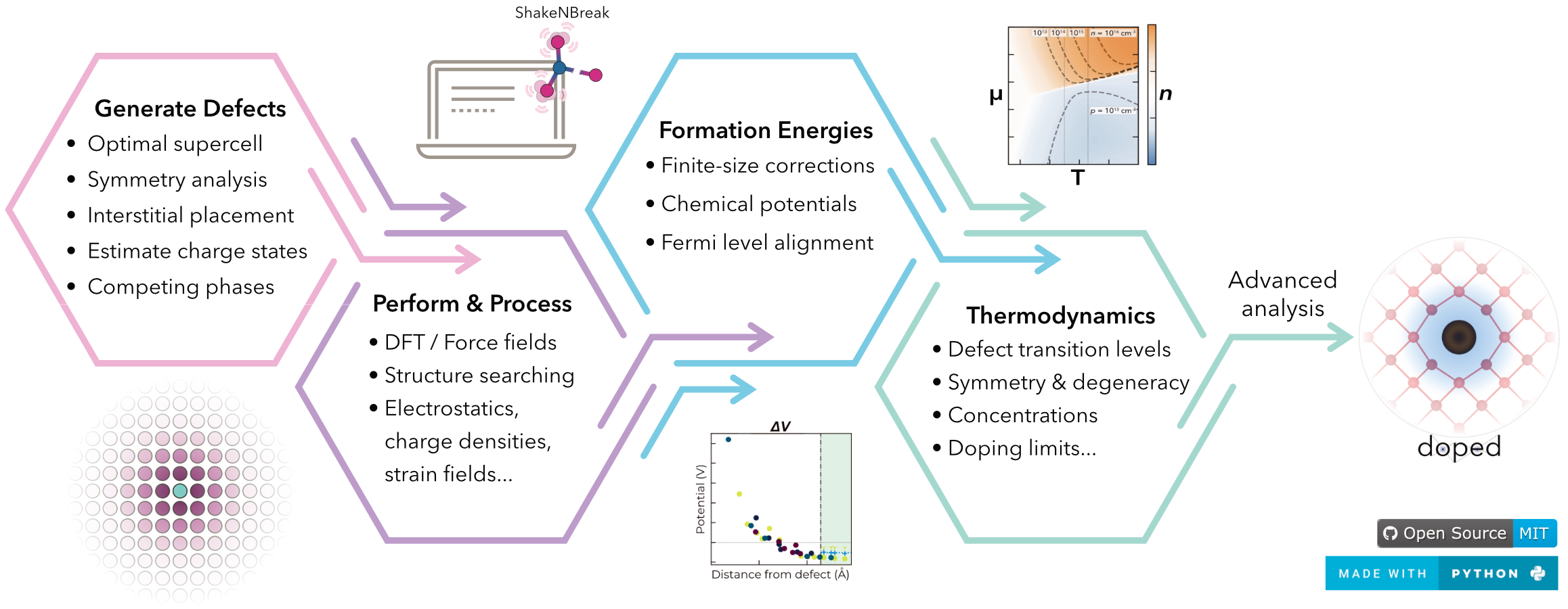
Key Features
All features and functionality are fully-customisable:
- Supercell Generation: Generate an optimal supercell, maximising periodic image separation for the minimum number of atoms (computational cost).
- Defect Generation: Generate defect supercells and guess likely charge states based on chemical intuition.
- Calculation I/O: Automatically write inputs and parse calculations (VASP & other DFT/force-field codes).
- Chemical Potentials: Determine relevant competing phases for chemical potential limits, with automated calculation setup, parsing and analysis.
- Defect Analysis: Automatically parse calculation outputs to compute defect formation energies, finite-size corrections (FNV & eFNV), symmetries, degeneracies, transition levels, etc.
- Thermodynamic Analysis: Compute (non-)equilibrium Fermi levels, defect/carrier concentrations etc. as functions of annealing/cooling temperature, chemical potentials etc.
- Plotting: Generate publication-quality plots of defect formation energies, chemical potential limits, defect/carrier concentrations, Fermi levels, charge corrections, etc.
- Python Interface: Fully-customisable, modular Python API. Plug-and-play w/ShakeNBreak defect structure-searching, easyunfold band unfolding, CarrierCapture.jl/nonrad non-radiative recombination etc.
- Reproducibility, tabulation, automated compatibility/sanity checking, strain/displacement analysis, shallow defect analysis, high-throughput compatibility, Wyckoff analysis...
Performance and Example Outputs
 (a) Optimal supercell generation comparison. (b) Charge state estimation comparison. Example (c) Kumagai-Oba (eFNV) finite-size correction plot, (d) defect formation energy diagram, (e) chemical potential / stability region, (f) Fermi level vs. annealing temperature, (g) defect/carrier concentrations vs. annealing temperature and (h) Fermi level / carrier concentration heatmap plots from
 doped. Automated plots of (i,j) single-particle eigenvalues and (k) site
displacements from DFT supercell calculations. See the JOSS paper for more details.
Installation
bash
pip install doped  # install doped and dependencies
Alternatively if desired, doped can also be installed from conda with:
bash
  conda install -c conda-forge doped
  pip install pydefect  # pydefect not available on conda, so needs to be installed with pip or otherwise, if using the eFNV correction
See the Installation docs if you encounter any issues (e.g. known issue with phonopy CMake build).
If you haven't done so already, you will need to set up your VASP POTCAR files and Materials Project API with pymatgen using the .pmgrc.yaml file, in order for doped to automatically generate VASP input files for defect calculations and determine competing phases for chemical potentials.
See the docs Installation page for details on this.
Citation
If you use doped in your research, please cite:
- S. R. Kavanagh et al. doped: Python toolkit for robust and repeatable charged defect supercell calculations. Journal of Open Source Software 9 (96), 6433, 2024
Literature
The following literature contain useful discussions of various aspects of defect calculations: - Quick-Start Guide on Defect Calculations Kim et al. - Large Review on Defect Calculations Freysoldt et al. - Guide to Understanding Formation Energy / Transition Level Diagrams Gorai - Defect Structure Searching Mosquera-Lois et al. - Free Energies of Defects Mosquera-Lois et al. <!--- TODO: Squires perspective when ready --->
ShakeNBreak
As shown in the doped tutorials, it is highly recommended to use the ShakeNBreak approach when calculating point defects in solids, to ensure you have identified the groundstate structures of your defects. As detailed in the theory paper, skipping this step can result in drastically incorrect formation energies, transition levels, carrier capture (basically any property associated with defects). This approach is followed in the doped defect generation tutorial, with a more in-depth explanation and tutorial given on the ShakeNBreak website.

Studies using doped, so far
- C. Lpez et al. Chalcogen Vacancies Rule Charge Recombination in Pnictogen Chalcohalide Solar-Cell Absorbers arXiv 2025
- K. Ogawa et al. Defect Tolerance via External Passivation in the Photocatalyst SrTiO3:Al ChemRxiv 2025
- M. S. Islam et al. Diffusion Characteristics of Ru and Oxygen Vacancies in Ta2O5 for Resistive Random Access Memory Devices: A Density Functional Theory Investigation Advanced Electronic Materials 2025
- J. Tu et al. Giant switchable ferroelectric photovoltage in double-perovskite epitaxial films through chemical negative strain Science Advances 2025
- Y. Fu & H. Lohan et al. Factors Enabling Delocalized Charge-Carriers in Pnictogen-Based Solar Absorbers: In-depth Investigation into CuSbSe2 Nature Communications 2025
- S. R. Kavanagh Identifying Split Vacancies with Foundation Models and Electrostatics arXiv 2025
- S. R. Kavanagh et al. Intrinsic point defect tolerance in selenium for indoor and tandem photovoltaics Energy & Environmental Science 2025
- J. Hu et al. Enabling ionic transport in Li3AlP2 the roles of defects and disorder Journal of Materials Chemistry A 2025
- X. Jiang et al. Carrier lifetime killer in 4H-SiC: carrier capture path via carbon vacancies Journal of Materials Chemistry C 2025
- M. R. Khan et al. Interplay between intrinsic defects and optoelectronic properties of semi-Heusler gapped metals Physical Chemistry Chemical Physics 2025
- R. Chinnappan First-principles study of defect energetics and magnetic properties of Cr, Ru and Rh doped AlN Physica Scripta 2025
- R. Desai et al. Exploring the Defect Landscape and Dopability of Chalcogenide Perovskite BaZrS3 Journal of Physical Chemistry C 2025
- C. Kaewmeechai, J. Strand & A. Shluger Structure and Migration Mechanisms of Oxygen Interstitial Defects in -Ga2O3 Physica Status Solidi B 2025 <!-- though didn't cite properly SnB or doped code papers... -->
- W. Gierlotka et al. Thermodynamics of point defects in the AlSb phase and its influence on phase equilibrium Computational Materials Science 2025 <!-- didn't cite SnB code paper... -->
- X. Wang et al. Sulfur Vacancies Limit the Open-circuit Voltage of Sb2S3 Solar Cells ACS Energy Letters 2024
- A. Zhang et al. Optimizing the n-type carrier concentration of an InVO4 photocatalyst by codoing with donors and intrinsic defects Physical Review Applied 2024
- M-L. Wang et al. Impact of sulfur doping on copper-substituted lead apatite Physical Review B 2024
- S. Quadir et al. Low-Temperature Synthesis of Stable CaZn2P2 Zintl Phosphide Thin Films as Candidate Top Absorbers Advanced Energy Materials 2024
- M. Elgaml et al. Controlling the Superconductivity of Nb2PdxS5 via Reversible Li Intercalation Inorganic Chemistry 2024
- Z. Yuan & G. Hautier First-principles study of defects and doping limits in CaO Applied Physics Letters 2024
- B. E. Murdock et al. Li-Site Defects Induce Formation of Li-Rich Impurity Phases: Implications for Charge Distribution and Performance of LiNi0.5-xMxMn1.5O4 Cathodes (M = Fe and Mg; x = 0.050.2) Advanced Materials 2024
- A. G. Squires et al. Oxygen dimerization as a defect-driven process in bulk LiNiO22 ACS Energy Letters 2024
- X. Wang et al. Upper efficiency limit of Sb2Se3 solar cells Joule 2024
- I. Mosquera-Lois et al. Machine-learning structural reconstructions for accelerated point defect calculations npj Computational Materials 2024
- W. Dou et al. Band Degeneracy and Anisotropy Enhances Thermoelectric Performance from Sb2Si2Te6 to Sc2Si2Te6 Journal of the American Chemical Society 2024
- K. Li et al. Computational Prediction of an Antimony-based n-type Transparent Conducting Oxide: F-doped Sb2O5 Chemistry of Materials 2024
- S. Hachmioune et al. Exploring the Thermoelectric Potential of MgB4: Electronic Band Structure, Transport Properties, and Defect Chemistry Chemistry of Materials 2024
- Y. Zeng et al. Role of carbon in -Al2O3:C crystals investigated with first-principles calculations and experiment Ceramics International 2024
- X. Wang et al. Four-electron negative-U vacancy defects in antimony selenide Physical Review B 2023
- Y. Kumagai et al. Alkali Mono-Pnictides: A New Class of Photovoltaic Materials by Element Mutation PRX Energy 2023
- S. M. Liga & S. R. Kavanagh, A. Walsh, D. O. Scanlon, G. Konstantatos Mixed-Cation Vacancy-Ordered Perovskites (Cs2Ti1xSnxX6; X = I or Br): Low-Temperature Miscibility, Additivity, and Tunable Stability Journal of Physical Chemistry C 2023
- A. T. J. Nicolson et al. Cu2SiSe3 as a promising solar absorber: harnessing cation dissimilarity to avoid killer antisites Journal of Materials Chemistry A 2023
- Y. W. Woo, Z. Li, Y-K. Jung, J-S. Park, A. Walsh Inhomogeneous Defect Distribution in Mixed-Polytype Metal Halide Perovskites ACS Energy Letters 2023
- P. A. Hyde et al. Lithium Intercalation into the Excitonic Insulator Candidate Ta2NiSe5 Inorganic Chemistry 2023
- J. Willis, K. B. Spooner, D. O. Scanlon On the possibility of p-type doping in barium stannate Applied Physics Letters 2023
- J. Cen et al. Cation disorder dominates the defect chemistry of high-voltage LiMn1.5Ni0.5O4 (LMNO) spinel cathodes Journal of Materials Chemistry A 2023
- J. Willis & R. Claes et al. Limits to Hole Mobility and Doping in Copper Iodide Chemistry of Materials 2023
- I. Mosquera-Lois & S. R. Kavanagh, A. Walsh, D. O. Scanlon Identifying the ground state structures of point defects in solids npj Computational Materials 2023
- Y. T. Huang & S. R. Kavanagh et al. Strong absorption and ultrafast localisation in NaBiS2 nanocrystals with slow charge-carrier recombination Nature Communications 2022
- S. R. Kavanagh, D. O. Scanlon, A. Walsh, C. Freysoldt Impact of metastable defect structures on carrier recombination in solar cells Faraday Discussions 2022
- Y-S. Choi et al. Intrinsic Defects and Their Role in the Phase Transition of Na-Ion Anode Na2Ti3O7 ACS Applied Energy Materials 2022
- S. R. Kavanagh, D. O. Scanlon, A. Walsh Rapid Recombination by Cadmium Vacancies in CdTe ACS Energy Letters 2021
- C. J. Krajewska et al. Enhanced visible light absorption in layered Cs3Bi2Br9 through mixed-valence Sn(II)/Sn(IV) doping Chemical Science 2021
Acknowledgments
doped (ne DefectsWithTheBoys) has benefitted from feedback from many users, in particular
members of the Scanlon and Walsh research groups who have used / are using it in their work. Direct contributors are listed in the Contributors sidebar above; including Sen Kavanagh, Alex Squires, Adair Nicolson, Irea Mosquera-Lois, Alex Ganose, Bonan Zhu, Katarina Brlec, Sabrine Hachmioune and Savya Aggarwal.
doped was originally based on the excellent PyCDT (no longer maintained), but transformed and morphed over time as more and more functionality was added. After breaking changes in pymatgen, the package was entirely refactored and rewritten, to work with the new
pymatgen-analysis-defects package.
Thanks to Chaoqun Zhang for uploading the YouTube tutorials with Chinese subtitles to Bilibili!
Owner
- Name: Scanlon Materials Theory Group
- Login: SMTG-Bham
- Kind: organization
- Location: UCL, UK
- Website: http://davidscanlon.com
- Repositories: 1
- Profile: https://github.com/SMTG-Bham
JOSS Publication
doped: Python toolkit for robust and repeatable charged defect supercell calculations
Authors

Thomas Young Centre and Department of Materials, Imperial College London, United Kingdom, Thomas Young Centre and Department of Chemistry, University College London, United Kingdom
School of Chemistry, University of Birmingham, Birmingham, United Kingdom
Thomas Young Centre and Department of Chemistry, University College London, United Kingdom
Thomas Young Centre and Department of Materials, Imperial College London, United Kingdom
Department of Chemistry, Imperial College London, London, United Kingdom
Thomas Young Centre and Department of Chemistry, University College London, United Kingdom
Thomas Young Centre and Department of Chemistry, University College London, United Kingdom
Thomas Young Centre and Department of Materials, Imperial College London, United Kingdom
School of Chemistry, University of Birmingham, Birmingham, United Kingdom
Editor
Rachel Kurchin
Tags
materials modelling materials physics materials chemistry thermodynamics point defects DFT VASP pymatgen semiconductors ab initio structure searching materials science finite-size corrections supercell calculationsGitHub Events
Total
- Create event: 4
- Release event: 2
- Issues event: 73
- Watch event: 66
- Delete event: 3
- Issue comment event: 173
- Push event: 122
- Pull request review event: 20
- Pull request review comment event: 51
- Pull request event: 7
- Fork event: 3
Last Year
- Create event: 4
- Release event: 2
- Issues event: 73
- Watch event: 66
- Delete event: 3
- Issue comment event: 173
- Push event: 122
- Pull request review event: 20
- Pull request review comment event: 51
- Pull request event: 7
- Fork event: 3
Committers
Last synced: over 1 year ago
Top Committers
| Name | Commits | |
|---|---|---|
| Sean Kavanagh | s****9@i****k | 1,846 |
| alexsquires | a****s@g****m | 50 |
| adair-nicolson | 5****n | 45 |
| ireaml | i****8@g****m | 27 |
| brlec | z****l@u****k | 27 |
| Teruya Nagafuji | t****2@g****m | 10 |
| Bonan Zhu | z****n@o****m | 8 |
| Sabrine Hachmioune | 6****8 | 2 |
| Aron Walsh | a****h@g****m | 2 |
| savya10 | s****8@i****k | 2 |
Committer Domains (Top 20 + Academic)
Issues and Pull Requests
Last synced: 11 months ago
All Time
- Total issues: 68
- Total pull requests: 72
- Average time to close issues: 17 days
- Average time to close pull requests: 6 days
- Total issue authors: 35
- Total pull request authors: 8
- Average comments per issue: 2.65
- Average comments per pull request: 2.69
- Merged pull requests: 47
- Bot issues: 0
- Bot pull requests: 9
Past Year
- Issues: 43
- Pull requests: 6
- Average time to close issues: 1 day
- Average time to close pull requests: 10 days
- Issue authors: 21
- Pull request authors: 2
- Average comments per issue: 2.7
- Average comments per pull request: 0.67
- Merged pull requests: 2
- Bot issues: 0
- Bot pull requests: 0
Top Authors
Issue Authors
- kuazhangge (8)
- kavanase (5)
- ravichinnappanphd (5)
- zhangweiteng (5)
- rushikd27 (3)
- msehabibur (3)
- xujialongshidashuaige (3)
- zhubonan (3)
- Walser52 (3)
- Atefeh-Yadegarifard (2)
- lzhang0797 (2)
- WangSimin123456 (2)
- similt (2)
- wojtekgier (1)
- EmilJaffal (1)
Pull Request Authors
- kavanase (44)
- dependabot[bot] (9)
- alexsquires (5)
- adair-nicolson (4)
- teruya7 (4)
- zhubonan (3)
- Andrew-S-Rosen (2)
- Walser52 (1)
Top Labels
Issue Labels
Pull Request Labels
Packages
- Total packages: 1
-
Total downloads:
- pypi 3,377 last-month
- Total dependent packages: 1
- Total dependent repositories: 1
- Total versions: 41
- Total maintainers: 1
pypi.org: doped
Python package to setup, process and analyse solid-state defect calculations with VASP
- Homepage: https://doped.readthedocs.io/en/latest/
- Documentation: https://doped.readthedocs.io/en/latest/
- License: MIT License Copyright (c) 2021 Seán Kavanagh Permission is hereby granted, free of charge, to any person obtaining a copy of this software and associated documentation files (the "Software"), to deal in the Software without restriction, including without limitation the rights to use, copy, modify, merge, publish, distribute, sublicense, and/or sell copies of the Software, and to permit persons to whom the Software is furnished to do so, subject to the following conditions: The above copyright notice and this permission notice shall be included in all copies or substantial portions of the Software. THE SOFTWARE IS PROVIDED "AS IS", WITHOUT WARRANTY OF ANY KIND, EXPRESS OR IMPLIED, INCLUDING BUT NOT LIMITED TO THE WARRANTIES OF MERCHANTABILITY, FITNESS FOR A PARTICULAR PURPOSE AND NONINFRINGEMENT. IN NO EVENT SHALL THE AUTHORS OR COPYRIGHT HOLDERS BE LIABLE FOR ANY CLAIM, DAMAGES OR OTHER LIABILITY, WHETHER IN AN ACTION OF CONTRACT, TORT OR OTHERWISE, ARISING FROM, OUT OF OR IN CONNECTION WITH THE SOFTWARE OR THE USE OR OTHER DEALINGS IN THE SOFTWARE.
-
Latest release: 3.1.0
published about 1 year ago
Rankings
Maintainers (1)
Dependencies
- actions/checkout v2 composite
- actions/setup-python v2 composite