https://github.com/andrewtavis/causeinfer
Machine learning based causal inference/uplift in Python
Science Score: 36.0%
This score indicates how likely this project is to be science-related based on various indicators:
-
○CITATION.cff file
-
✓codemeta.json file
Found codemeta.json file -
○.zenodo.json file
-
✓DOI references
Found 6 DOI reference(s) in README -
✓Academic publication links
Links to: wiley.com -
○Committers with academic emails
-
○Institutional organization owner
-
○JOSS paper metadata
-
○Scientific vocabulary similarity
Low similarity (16.0%) to scientific vocabulary
Keywords
Keywords from Contributors
Repository
Machine learning based causal inference/uplift in Python
Basic Info
Statistics
- Stars: 60
- Watchers: 6
- Forks: 11
- Open Issues: 5
- Releases: 4
Topics
Metadata Files
README.md











Machine learning based causal inference/uplift in Python
causeinfer is a Python package for estimating average and conditional average treatment effects using machine learning. The goal is to compile causal inference models both standard and advanced, as well as demonstrate their usage and efficacy - all this with the overarching ambition to help people learn causal inference techniques across business, medical, and socioeconomic fields. See the documentation for a full outline of the package including the available models and datasets.
Contents
Installation ⇧
causeinfer can be downloaded from PyPI via pip or sourced directly from this repository:
bash
pip install causeinfer
bash
git clone https://github.com/andrewtavis/causeinfer.git
cd causeinfer
python setup.py install
python
import causeinfer
Application ⇧
Standard Algorithms
Two Model Approach
Separate models for treatment and control groups are trained and combined to derive average treatment effects (Hansotia, 2002). ```python from causeinfer.standard_algorithms.two_model import TwoModel from sklearn.ensemble import RandomForestClassifier, RandomForestRegressor tm_pred = TwoModel( treatment_model=RandomForestRegressor(**kwargs), control_model=RandomForestRegressor(**kwargs), ) tm_pred.fit(X=X_train, y=y_train, w=w_train) # An array of predictions given a treatment and control model tm_preds = tm_pred.predict(X=X_test) tm_proba = TwoModel( treatment_model=RandomForestClassifier(**kwargs), control_model=RandomForestClassifier(**kwargs), ) tm_proba.fit(X=X_train, y=y_train, w=w_train) # An array of predicted treatment class probabilities given models tm_probas = tm.predict_proba(X=X_test) ```Interaction Term Approach
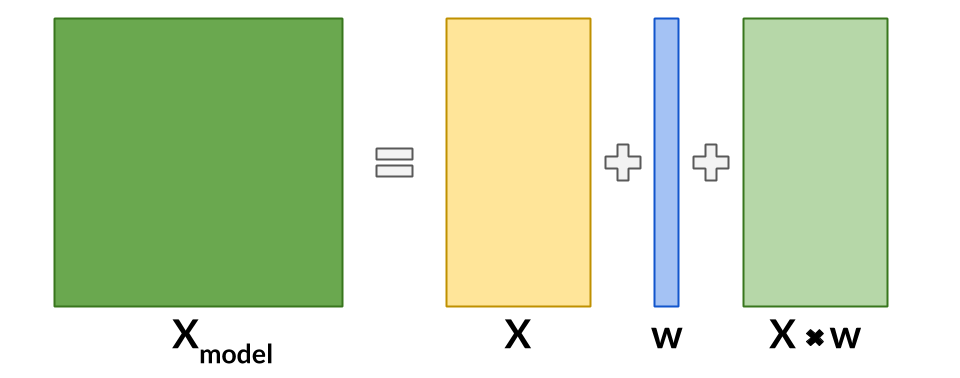
An interaction term between treatment and covariates is added to the data to allow for a basic single model application (Lo, 2002).
Class Transformation Approaches
Units are categorized into two or four classes to derive treatment effects from favorable class attributes (Lai, 2006; Kane, et al, 2014; Shaar, et al, 2016).

Reflective and Pessimistic Uplift
Weighted versions of the binary class transformation approach that are meant to dampen the original model's inherently noisy results (Shaar, et al, 2016). ```python # Reflective Uplift Transformation from causeinfer.standard_algorithms.reflective import ReflectiveUplift from sklearn.ensemble import RandomForestClassifier ru = ReflectiveUplift(model=RandomForestClassifier(**kwargs)) ru.fit(X=X_train, y=y_train, w=w_train) # An array of predicted probabilities (P(Favorable Class), P(Unfavorable Class)) ru_probas = ru.predict_proba(X=X_test) ``` ```python # Pessimistic Uplift Transformation from causeinfer.standard_algorithms.pessimistic import PessimisticUplift from sklearn.ensemble import RandomForestClassifier pu = PessimisticUplift(model=RandomForestClassifier(**kwargs)) pu.fit(X=X_train, y=y_train, w=w_train) # An array of predicted probabilities (P(Favorable Class), P(Unfavorable Class)) pu_probas = pu.predict_proba(X=X_test) ```
Advanced Algorithms
Models to Consider
- Under consideration for inclusion in causeinfer: - Generalized Random Forest via the R/C++ [grf](https://github.com/grf-labs/grf) - Athey, Tibshirani, and Wager (2019) - The X-Learner - Kunzel, et al (2019) - The R-Learner - Nie and Wager (2017) - Double Machine Learning - Chernozhukov, et al (2018) - Information Theory Trees/Forests - Soltys, et al (2015)
Evaluation Methods ⇧
Visualization Metrics and Coefficients
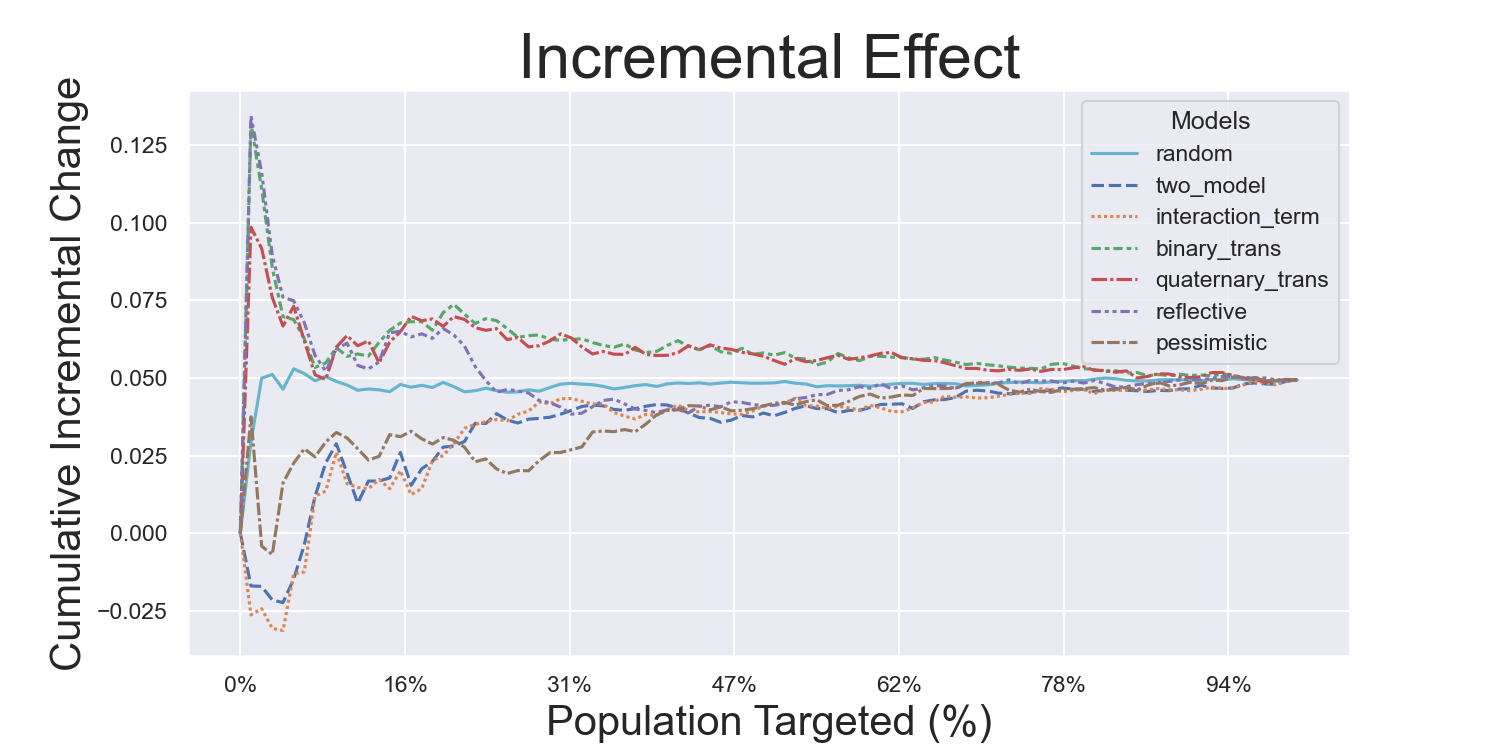
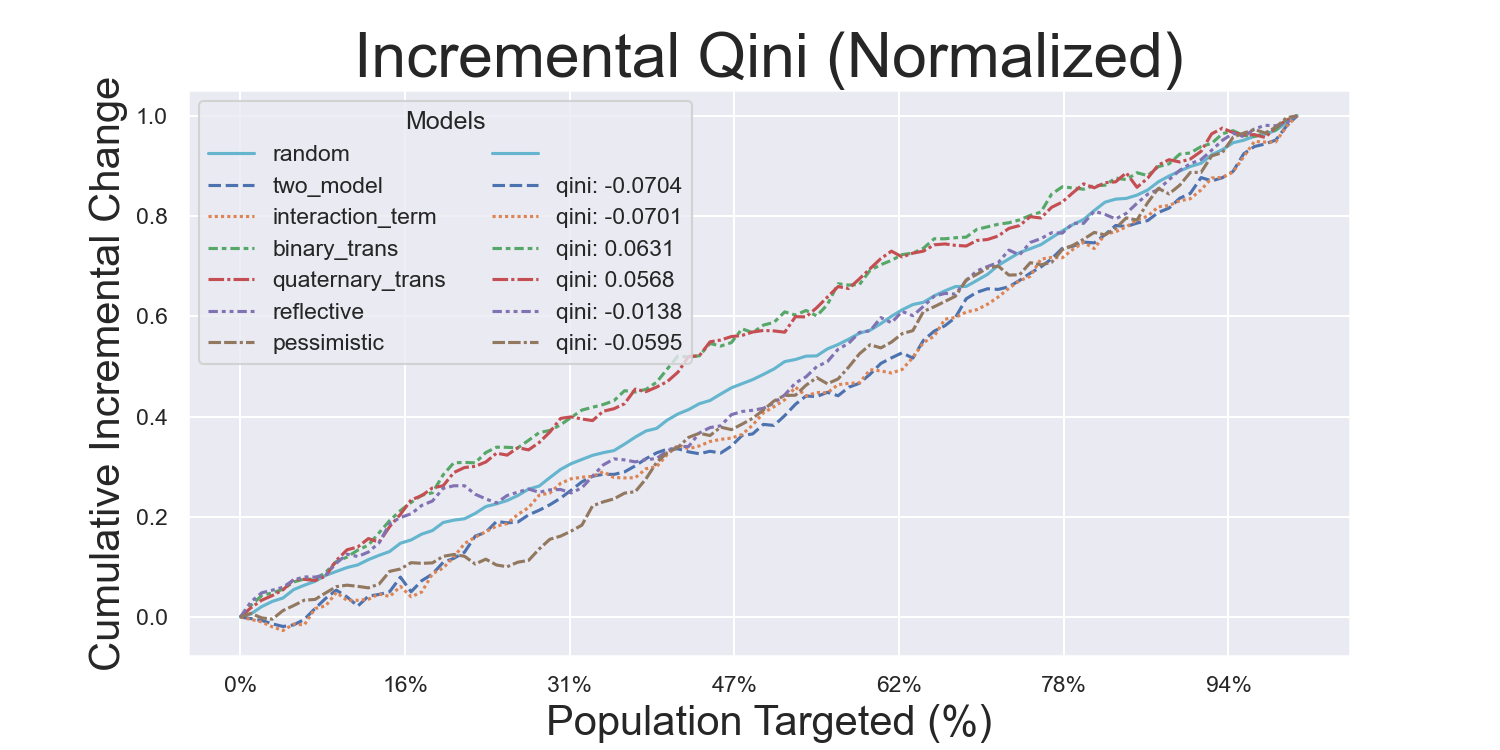
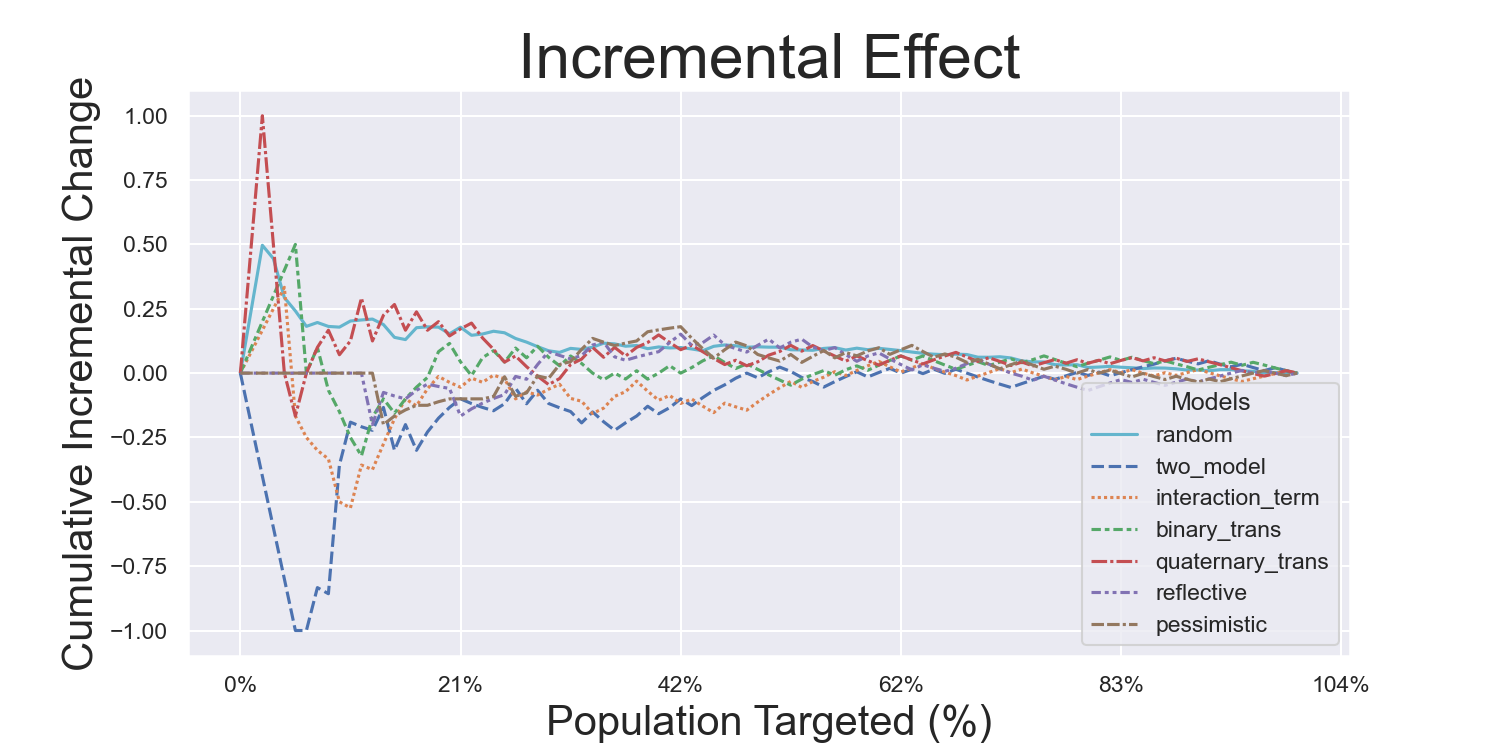
Comparisons across stratified, ordered treatment response groups are used to derive model efficiency. ```python from causeinfer.evaluation import plot_cum_gain, plot_qini visual_eval_dict = { "y_test": y_test, "w_test": w_test, "two_model": tm_effects, "interaction_term": it_effects, "binary_trans": bt_effects, "quaternary_trans": qt_effects, } df_visual_eval = pd.DataFrame(visual_eval_dict, columns=visual_eval_dict.keys()) model_pred_cols = [ col for col in visual_eval_dict.keys() if col not in ["y_test", "w_test"] ] ``` ```python fig, (ax1, ax2) = plt.subplots(ncols=2, sharey=False, figsize=(20, 5)) plot_cum_effect( df=df_visual_eval, n=100, models=models, percent_of_pop=True, outcome_col="y_test", treatment_col="w_test", normalize=True, random_seed=42, axis=ax1, legend_metrics=True, ) plot_qini( # or plot_cum_gain df=df_visual_eval, n=100, models=models, percent_of_pop=True, outcome_col="y_test", treatment_col="w_test", normalize=True, random_seed=42, axis=ax2, legend_metrics=True, ) ``` Hillstrom Metrics
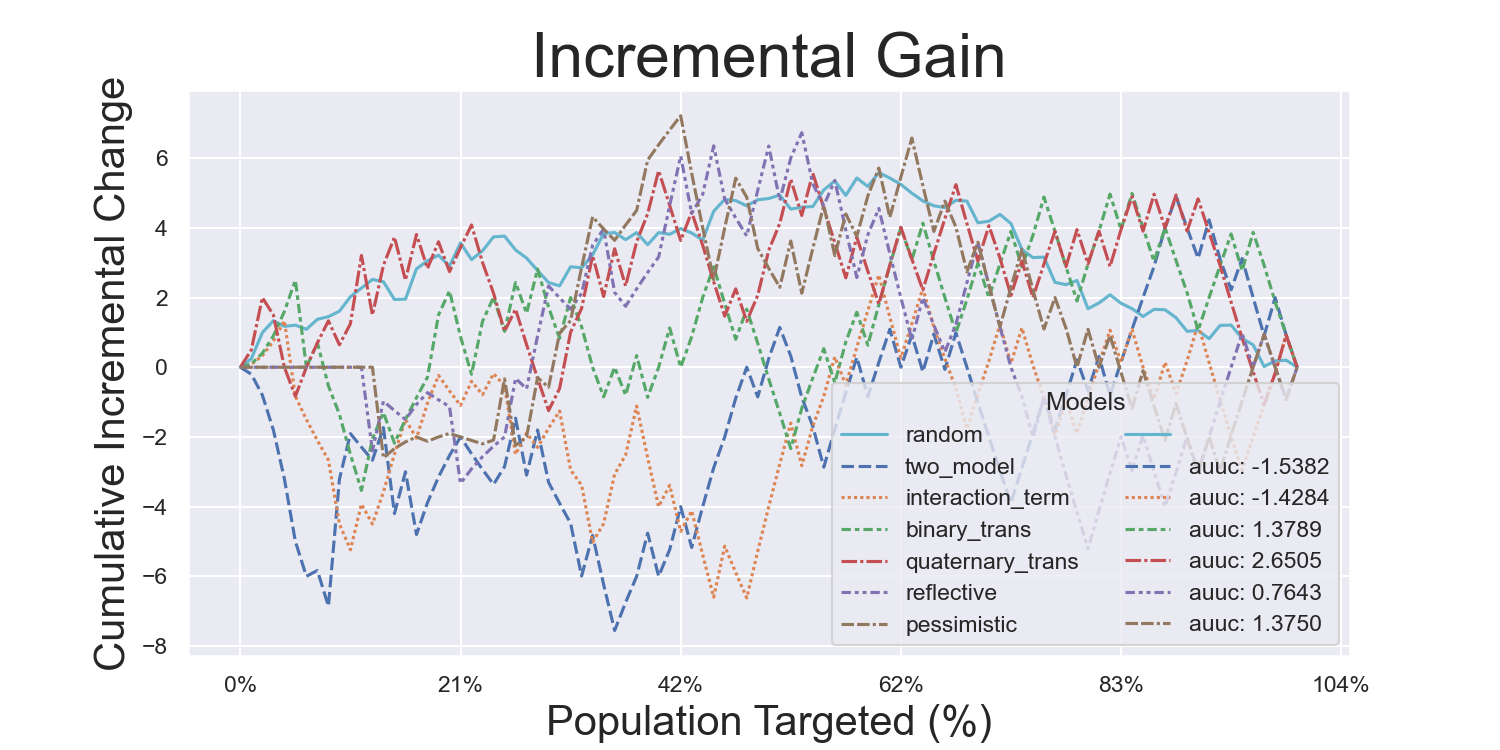
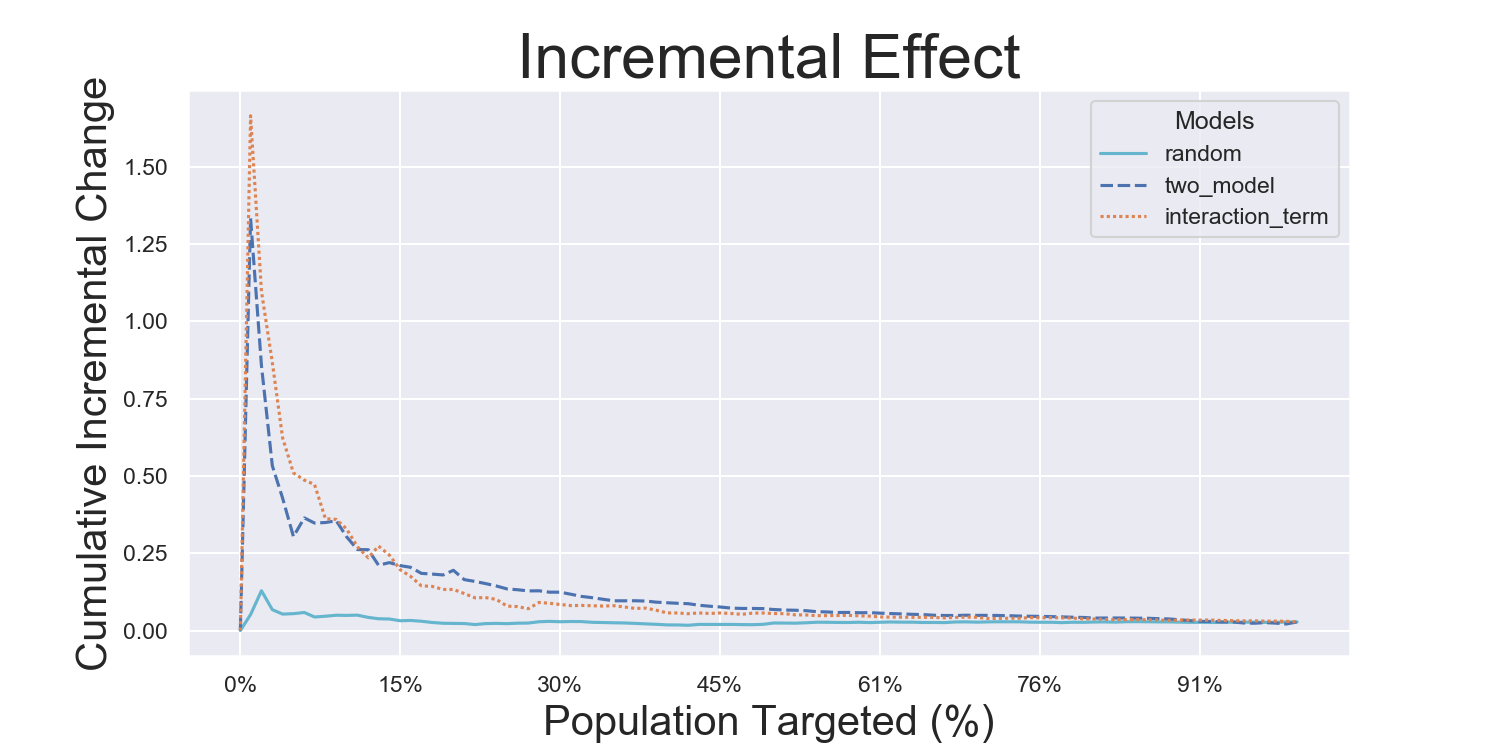
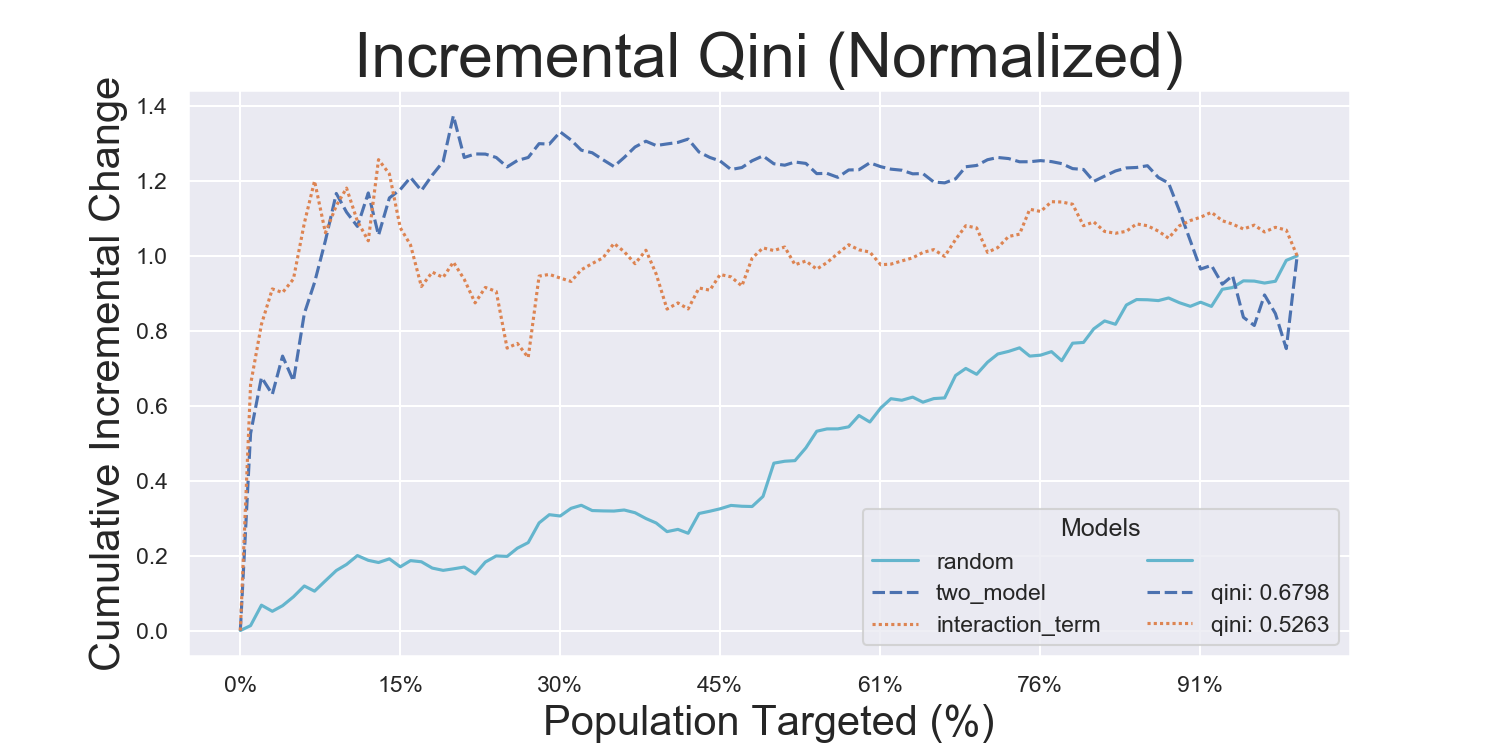
Iterated Model Variance Analysis
Easily iterate models to derive their average effects and prediction variances. See a full example across all datasets and models in [examples/model_iteration](https://github.com/andrewtavis/causeinfer/blob/main/examples/model_iteration.ipynb), with the results being shown below: | | TwoModel | InteractionTerm | BinaryTransformation | QuaternaryTransformation | ReflectiveUplift | PessimisticUplift | | :--------------- | :--------------------- | :-------------------- | :--------------------- | :----------------------- | :----------------------- | :----------------------- | | Hillstrom | -5.4762 ± 13.589\*\*\* | -5.047 ± 15.417\*\*\* | 0.5178 ± 15.7252\*\*\* | 0.7397 ± 14.7509\*\*\* | 4.4872 ± 18.5918\*\*\*\* | -6.0052 ± 17.936\*\*\*\* | | Mayo PBC | -0.145 ± 0.29 | -0.1335 ± 0.4471 | 0.5542 ± 0.4268 | 0.5315 ± 0.4424 | -0.8774 ± 0.233 | 0.1392 ± 0.3587 | | CMF Microfinance | 18.7289 ± 5.9138\*\* | 17.0616 ± 6.6993\*\* | nan | nan | nan | nan |
Data and Examples ⇧
Business Analytics
- [Hillstrom Email Marketing](https://blog.minethatdata.com/2008/03/minethatdata-e-mail-analytics-and-data.html) - Is directly downloaded and formatted with causeinfer (see [causeinfer.data.hillstrom](https://github.com/andrewtavis/causeinfer/blob/main/src/causeinfer/data/hillstrom.py)) - How to use this dataset is shown in [examples/business_hillstrom](https://github.com/andrewtavis/causeinfer/blob/main/examples/business_hillstrom.ipynb) and below ```python from causeinfer.data import hillstrom hillstrom.download_hillstrom() data_hillstrom = hillstrom.load_hillstrom( user_file_path="datasets/hillstrom.csv", format_covariates=True, normalize=True ) df = pd.DataFrame( data_hillstrom["dataset_full"], columns=data_hillstrom["dataset_full_names"] ) ``` - [Criteo Uplift](https://ailab.criteo.com/criteo-uplift-prediction-dataset/) - Needed [(see issue)](https://github.com/andrewtavis/causeinfer/issues/18): - Download and formatting script - Example notebook - Tests - Documentation
Medical Trials
- [Mayo Clinic PBC](https://www.mayo.edu/research/documents/pbchtml/DOC-10027635) - Is directly downloaded and formatted with causeinfer (see [causeinfer.data.mayo_pbc](https://github.com/andrewtavis/causeinfer/blob/main/src/causeinfer/data/mayo_pbc.py)) - Also included in the [datasets directory](https://github.com/andrewtavis/causeinfer/blob/main/src/causeinfer/data/datasets) for direct download - How to use this dataset is shown in [examples/medical_mayo_pbc](https://github.com/andrewtavis/causeinfer/blob/main/examples/medical_mayo_pbc.ipynb) and below ```python from causeinfer.data import mayo_pbc mayo_pbc.download_mayo_pbc() data_mayo_pbc = mayo_pbc.load_mayo_pbc( user_file_path="datasets/mayo_pbc.text", format_covariates=True, normalize=True ) df = pd.DataFrame( data_mayo_pbc["dataset_full"], columns=data_mayo_pbc["dataset_full_names"] ) ``` - [Pintilie Tamoxifen](https://onlinelibrary.wiley.com/doi/book/10.1002/9780470870709) - Accompanied the linked text, but is now unavailable, so it is included in the [datasets directory](https://github.com/andrewtavis/causeinfer/blob/main/src/causeinfer/data/datasets) for direct download - Needed [(see issue)](https://github.com/andrewtavis/causeinfer/issues/19): - Formatting script - Example notebook - Tests - Documentation
Socioeconomic Analysis
- [CMF Microfinance](https://www.aeaweb.org/articles?id=10.1257/app.20130533) - Accompanied the linked text, but is now unavailable. It is included in the [datasets directory](https://github.com/andrewtavis/causeinfer/blob/main/src/causeinfer/data/datasets) for direct download - Is formatted with causeinfer (see [causeinfer.data.cmf_micro](https://github.com/andrewtavis/causeinfer/blob/main/src/causeinfer/data/cmf_micro.py)) - How to use this dataset is shown in [examples/socioeconomic_cmf_micro](https://github.com/andrewtavis/causeinfer/blob/main/examples/socioeconomic_cmf_micro.ipynb) and below ```python from causeinfer.data import cmf_micro data_cmf_micro = cmf_micro.load_cmf_micro( user_file_path="datasets/cmf_micro", format_covariates=True, normalize=True ) df = pd.DataFrame( data_cmf_micro["dataset_full"], columns=data_cmf_micro["dataset_full_names"] ) ``` - [Lalonde Job Training](https://users.nber.org/~rdehejia/data/.nswdata2.html) - Needed [(see issue)](https://github.com/andrewtavis/causeinfer/issues/20): - Download and formatting script - Example notebook - Tests - Documentation
To-Do ⇧
Please see the contribution guidelines if you are interested in contributing to this project. Work that is in progress or could be implemented includes:
Adding more baseline models and datasets (see issues)
Converting GRF files to Python and connecting them to the C++ boiler plate
Adding a data simulator (see issue)
Finding more causal inference datasets to be added (see issue)
Adding a
predictmethod to binary_transformation and quaternary_transformationUpdating and refining the documentation
Improving tests for greater code coverage
Improving code quality by refactoring large functions and checking conventions
Similar Projects
Similar packages and modules to causeinfer
Python - https://github.com/uber/causalml - https://github.com/Minyus/causallift - https://github.com/maks-sh/scikit-uplift - https://github.com/duketemon/pyuplift - https://github.com/microsoft/EconML - https://github.com/Microsoft/dowhy - https://github.com/wayfair/pylift/ - https://github.com/jszymon/uplift_sklearn Other Languages - https://github.com/grf-labs/grf (R/C++) - [https://github.com/soerenkuenzel/causalToolbox/X-Learner](https://github.com/soerenkuenzel/causalToolbox/blob/a06d81d74f4d575a8b34dc6b718db2778cfa0be9/R/XRF.R) (R/C++) - https://github.com/xnie/rlearner (R) Data and Misc - https://github.com/rguo12/awesome-causality-data - https://github.com/rguo12/awesome-causality-algorithms - https://github.com/zhaoxiliang/causalinference
References ⇧
List of referenced codes
- [pyuplift](https://github.com/duketemon/pyuplift) by [duketemon](https://github.com/duketemon) ([License](https://github.com/duketemon/pyuplift/blob/master/LICENSE)) - [Causal ML](https://github.com/uber/causalml) by [Uber](https://github.com/uber) ([License](https://github.com/uber/causalml/blob/master/LICENSE))
List of theoretical references
Big Data and Machine Learning - Athey, S. (2017). Beyond prediction: Using big data for policy problems. Science, Vol. 355, No. 6324, February 3, 2017, pp. 483-485. - Athey, S. & Imbens, G. (2015). Machine Learning Methods for Estimating Heterogeneous Causal Effects. Draft version submitted April 5th, 2015, arXiv:1504.01132v1, pp. 1-25. - Athey, S. & Imbens, G. (2019). Machine Learning Methods That Economists Should Know About. Annual Review of Economics, Vol. 11, August 2019, pp. 685-725. - Chernozhukov, V. et al. (2018). Double/debiased machine learning for treatment and structural parameters. The Econometrics Journal, Vol. 21, No. 1, February 1, 2018, pp. C1–C68. - Mullainathan, S. & Spiess, J. (2017). Machine Learning: An Applied Econometric Approach. Journal of Economic Perspectives, Vol. 31, No. 2, Spring 2017, pp. 87-106. Causal Inference - Athey, S. & Imbens, G. (2017). The State of Applied Econometrics: Causality and Policy Evaluation. Journal of Economic Perspectives, Vol. 31, No. 2, Spring 2017, pp. 3-32. - Athey, S., Tibshirani, J. & Wager, S. (2019) Generalized random forests. The Annals of Statistics, Vol. 47, No. 2 (2019), pp. 1148-1178. - Athey, S. & Wager, S. (2019). Efficient Policy Learning. Draft version submitted on 9 Feb 2017, last revised 16 Sep 2019, arXiv:1702.02896v5, pp. 1-10. - Banerjee, A, et al. (2015) The Miracle of Microfinance? Evidence from a Randomized Evaluation. American Economic Journal: Applied Economics, Vol. 7, No. 1, January 1, 2015, pp. 22-53. - Ding, P. & Li, F. (2018). Causal Inference: A Missing Data Perspective. Statistical Science, Vol. 33, No. 2, 2018, pp. 214-237. - Farrell, M., Liang, T. & Misra S. (2018). Deep Neural Networks for Estimation and Inference: Application to Causal Effects and Other Semiparametric Estimands. Draft version submitted December 2018, arXiv:1809.09953, pp. 1-54. - Gutierrez, P. & Gérardy, JY. (2016). Causal Inference and Uplift Modeling: A review of the literature. JMLR: Workshop and Conference Proceedings 67, 2016, pp. 1–14. - Hitsch, G J. & Misra, S. (2018). Heterogeneous Treatment Effects and Optimal Targeting Policy Evaluation. January 28, 2018, Available at SSRN: ssrn.com/abstract=3111957 or dx.doi.org/10.2139/ssrn.3111957, pp. 1-64. - Powers, S. et al. (2018). Some methods for heterogeneous treatment effect estimation in high dimensions. Statistics in Medicine, Vol. 37, No. 11, May 20, 2018, pp. 1767-1787. - Rosenbaum, P. & Rubin, D. (1983). The central role of the propensity score in observational studies for causal effects. Biometrika, Vol. 70, pp. 41-55. - Sekhon, J. (2007). The Neyman-Rubin Model of Causal Inference and Estimation via Matching Methods. The Oxford Handbook of Political Methodology, Winter 2017, pp. 1-46. - Wager, S. & Athey, S. (2018). Estimation and Inference of Heterogeneous Treatment Effects using Random Forests. Journal of the American Statistical Association, Vol. 113, 2018 - Issue 523, pp. 1228-1242. Uplift - Devriendt, F. et al. (2018). A Literature Survey and Experimental Evaluation of the State-of-the-Art in Uplift Modeling: A Stepping Stone Toward the Development of Prescriptive Analytics. Big Data, Vol. 6, No. 1, March 1, 2018, pp. 1-29. Codes found at: data-lab.be/downloads.php. - Hansotia, B. & Rukstales, B. (2002). Incremental value modeling. Journal of Interactive Marketing, Vol. 16, No. 3, Summer 2002, pp. 35-46. - Haupt, J., Jacob, D., Gubela, R. & Lessmann, S. (2019). Affordable Uplift: Supervised Randomization in Controlled Experiments. Draft version submitted on October 1, 2019, arXiv:1910.00393v1, pp. 1-15. - Jaroszewicz, S. & Rzepakowski, P. (2014). Uplift modeling with survival data. Workshop on Health Informatics (HI-KDD) New York City, August 2014, pp. 1-8. - Jaśkowski, M. & Jaroszewicz, S. (2012). Uplift modeling for clinical trial data. In: ICML, 2012, Workshop on machine learning for clinical data analysis. Edinburgh, Scotland, June 2012, 1-8. - Kane, K., Lo, VSY. & Zheng, J. (2014). Mining for the truly responsive customers and prospects using true-lift modeling: Comparison of new and existing methods. Journal of Marketing Analytics, Vol. 2, No. 4, December 2014, pp 218–238. - Lai, L.Y.-T. (2006). Influential marketing: A new direct marketing strategy addressing the existence of voluntary buyers. Master of Science thesis, Simon Fraser University School of Computing Science, Burnaby, BC, Canada, pp. 1-68. - Lo, VSY. (2002). The true lift model: a novel data mining approach to response modeling in database marketing. SIGKDD Explor 4(2), pp. 78–86. - Lo, VSY. & Pachamanova, D. (2016). From predictive uplift modeling to prescriptive uplift analytics: A practical approach to treatment optimization while accounting for estimation risk. Journal of Marketing Analytics Vol. 3, No. 2, pp. 79–95. - Radcliffe N.J. & Surry, P.D. (1999). Differential response analysis: Modeling true response by isolating the effect of a single action. In Proceedings of Credit Scoring and Credit Control VI. Credit Research Centre, University of Edinburgh Management School. - Radcliffe N.J. & Surry, P.D. (2011). Real-World Uplift Modelling with Significance-Based Uplift Trees. Technical Report TR-2011-1, Stochastic Solutions, 2011, pp. 1-33. - Rzepakowski, P. & Jaroszewicz, S. (2012). Decision trees for uplift modeling with single and multiple treatments. Knowledge and Information Systems, Vol. 32, pp. 303–327. - Rzepakowski, P. & Jaroszewicz, S. (2012). Uplift modeling in direct marketing. Journal of Telecommunications and Information Technology, Vol. 2, 2012, pp. 43–50. - Rudaś, K. & Jaroszewicz, S. (2018). Linear regression for uplift modeling. Data Mining and Knowledge Discovery, Vol. 32, No. 5, September 2018, pp. 1275–1305. - Shaar, A., Abdessalem, T. and Segard, O (2016). “Pessimistic Uplift Modeling”. ACM SIGKDD, August 2016, San Francisco, California, USA. - Sołtys, M., Jaroszewicz, S. & Rzepakowski, P. (2015). Ensemble methods for uplift modeling. Data Mining and Knowledge Discovery, Vol. 29, No. 6, November 2015, pp. 1531–1559.
List of data references
- Banerjee, A., Duflo, E., Glennerster, R., and Kinnan, C (2015). "The Miracle of Microfinance? Evidence from a Randomized Evaluation." American Economic Journal: Applied Economics, 7 (1), pp. 22-53. URL: https://www.aeaweb.org/articles?id=10.1257/app.20130533. - K. Hillstrom. “The MineThatData E-Mail Analytics And Data Mining Challenge”. 2008. URL: https://blog.minethatdata.com/2008/03/minethatdata-e-mail-analytics-and-data.html. - Mayo Clinic. “Primary Biliary Cirrhosis”. 1991. URL: https://www.mayo.edu/research/documents/pbchtml/DOC-10027635.
Owner
- Name: Andrew Tavis McAllister
- Login: andrewtavis
- Kind: user
- Location: Berlin, Germany
- Company: @activist-org, @scribe-org
- Repositories: 15
- Profile: https://github.com/andrewtavis
Data, development and design. Initiator @activist-org and @scribe-org.
GitHub Events
Total
- Watch event: 6
Last Year
- Watch event: 6
Committers
Last synced: over 3 years ago
All Time
- Total Commits: 284
- Total Committers: 5
- Avg Commits per committer: 56.8
- Development Distribution Score (DDS): 0.458
Top Committers
| Name | Commits | |
|---|---|---|
| Andrew Tavis | a****r@g****m | 154 |
| Andrew McAllister | a****r@A****l | 83 |
| Andrew McAllister | a****r@A****l | 43 |
| dependabot[bot] | 4****]@u****m | 2 |
| ImgBotApp | I****p@g****m | 2 |
Issues and Pull Requests
Last synced: about 1 year ago
All Time
- Total issues: 8
- Total pull requests: 22
- Average time to close issues: 10 days
- Average time to close pull requests: about 2 hours
- Total issue authors: 2
- Total pull request authors: 3
- Average comments per issue: 0.75
- Average comments per pull request: 0.95
- Merged pull requests: 18
- Bot issues: 0
- Bot pull requests: 8
Past Year
- Issues: 0
- Pull requests: 0
- Average time to close issues: N/A
- Average time to close pull requests: N/A
- Issue authors: 0
- Pull request authors: 0
- Average comments per issue: 0
- Average comments per pull request: 0
- Merged pull requests: 0
- Bot issues: 0
- Bot pull requests: 0
Top Authors
Issue Authors
- andrewtavis (7)
- jwodder (1)
Pull Request Authors
- andrewtavis (14)
- dependabot[bot] (6)
- imgbot[bot] (2)
Top Labels
Issue Labels
Pull Request Labels
Dependencies
- m2r2 *
- numpydoc *
- black >=19.10b0
- certifi >=2020.12.5
- matplotlib >=3.3.4
- numpy >=1.19.2
- packaging >=20.9
- pandas >=1.2.3
- pytest >=6.2.3
- pytest-cov >=2.11.1
- requests >=2.25.1
- scikit-learn >=0.24.1
- seaborn >=0.11.1
- tqdm >=4.59.0
- actions/checkout v2 composite
- actions/setup-python main composite
- codecov/codecov-action v2 composite
- conda-incubator/setup-miniconda v2 composite