Science Score: 54.0%
This score indicates how likely this project is to be science-related based on various indicators:
-
✓CITATION.cff file
Found CITATION.cff file -
✓codemeta.json file
Found codemeta.json file -
✓.zenodo.json file
Found .zenodo.json file -
○DOI references
-
✓Academic publication links
Links to: arxiv.org -
○Academic email domains
-
○Institutional organization owner
-
○JOSS paper metadata
-
○Scientific vocabulary similarity
Low similarity (11.8%) to scientific vocabulary
Keywords
Repository
Modular neural networks from scratch, in Rust.
Basic Info
- Host: GitHub
- Owner: hallvardnmbu
- License: gpl-3.0
- Language: Rust
- Default Branch: main
- Homepage: https://crates.io/crates/neurons
- Size: 38.1 MB
Statistics
- Stars: 7
- Watchers: 1
- Forks: 2
- Open Issues: 2
- Releases: 33
Topics
Metadata Files
README.md
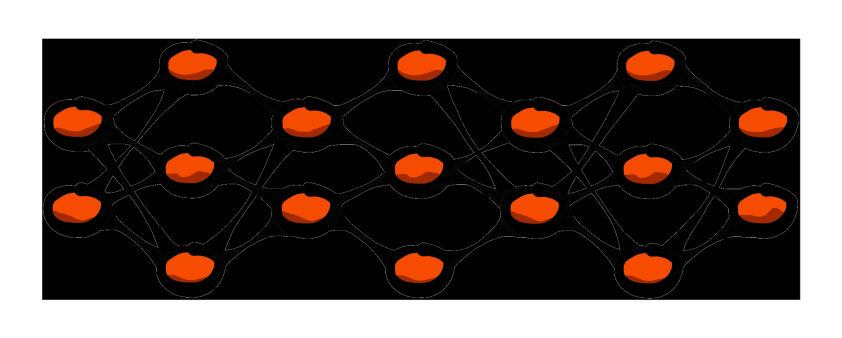



neurons is a neural network library written from scratch in Rust. It provides a flexible and efficient way to build, train, and evaluate neural networks. The library is designed to be modular, allowing for easy customization of network architectures, activation functions, objective functions, and optimization techniques.
Jump to
Features
Modular design
- Ready-to-use dense, convolutional and maxpool layers.
- Inferred input shapes when adding layers.
- Easily specify activation functions, biases, and dropout.
- Customizable objective functions and optimization techniques.
- Feedback loops and -blocks for more advanced architectures.
- Skip connections with simple accumulation specification.
- Much more!
Fast
- Leveraging Rust's performance and parallelization capabilities.
Everything built from scratch
- Only dependencies are
rayonandplotters.
Whereplottersonly is used through some of the examples (thus optional).Various examples showcasing the capabilities
- Located in the
examples/directory. With subdirectories for various tasks, showcasing the different architectures and techniques.
The package
The package is divided into separate modules, each containing different parts of the library, everything being connected through the network.rs module.
Core
tensor.rs
Describes the custom tensor struct and its operations.
A tensor is here divided into four main types: *Single: One-dimensional data (Vec<_>). *Double: Two-dimensional data (Vec<Vec<_>>). *Triple: Three-dimensional data (Vec<Vec<Vec<_>>>). *Quadruple: Four-dimensional data (Vec<Vec<Vec<Vec<_>>>>).And further into two additional helper-types: *
Quintuple: Five-dimensional data (Vec<Vec<Vec<Vec<Vec<(usize, usize)>>>>>). Used to hold maxpool indices. *Nested: A nested tensor (Vec<Tensor>). Used through feedback blocks.Each shape following the same pattern of operations, but with increasing dimensions.
Thus, every tensor contains information about its shape and data.
The reason for wrapping the data in this way is to easily allow for dynamic shapes and types in the network.random.rs
Functionality for random number generation.
Used when initializing the weights of the network.network.rs
Describes the network struct and its operations.
The network contains a vector of layers, an optimizer, and an objective function.
The network is built layer by layer, and then trained using thelearnfunction.
See quickstart or theexamples/directory for more information.
Layers
dense.rs
Describes the dense layer and its operations.
convolution.rs
Describes the convolutional layer and its operations.
If the input is a tensor of shapeSingle, the layer will automatically reshape it into aTripletensor.deconvolution.rs
Describes the deconvolutional layer and its operations.
If the input is a tensor of shapeSingle, the layer will automatically reshape it into aTripletensor.maxpool.rs
Describes the maxpool layer and its operations.
If the input is a tensor of shapeSingle, the layer will automatically reshape it into aTripletensor.feedback.rs
Describe the feedback block and its operations.
Functions
activation.rs
Contains all the possible activation functions to be used.
objective.rs
Contains all the possible objective functions to be used.
optimizer.rs
Contains all the possible optimization techniques to be used.
Examples
plot.rs
Contains the plotting functionality for the examples.
Quickstart
```rust use neurons::{activation, network, objective, optimizer, tensor};
fn main() {
// New feedforward network with input shape (1, 28, 28) let mut network = network::Network::new(tensor::Shape::Triple(1, 28, 28));
// Convolution(filters, kernel, stride, padding, dilation, activation, Some(dropout)) network.convolution(5, (3, 3), (1, 1), (1, 1), (1, 1), activation::Activation::ReLU, None);
// Maxpool(kernel, stride) network.maxpool((2, 2), (2, 2));
// Dense(outputs, activation, bias, Some(dropout)) network.dense(100, activation::Activation::ReLU, false, None);
// Dense(outputs, activation, bias, Some(dropout)) network.dense(10, activation::Activation::Softmax, false, None);
network.setoptimizer(optimizer::RMSprop::create( 0.001, // Learning rate 0.0, // Alpha 1e-8, // Epsilon Some(0.01), // Decay Some(0.01), // Momentum true, // Centered )); network.setobjective( objective::Objective::MSE, // Objective function Some((-1f32, 1f32)) // Gradient clipping );
println!("{}", network); // Display the network
let (x, y) = { }; // Add your data here let validation = ( xval, // Validation data yval, // Validation labels 5 // Stop if val loss decreases for 5 epochs ); let batch = 32; // Minibatch size let epochs = 100; // Number of epochs let print = Some(10); // Print every 10th epoch let (trainloss, valloss, val_acc) = network.learn(x, y, validation, batch, epochs, print); } ```
Releases
v2.6.2 Fixed-size vectors and reduced redundant cloning.
Use fixed-size vectors where possible to increase performance.Modify `tensor` operations to both utilise parallelisation and reduce redundant cloning.
Reduce general redundant cloning in the network etc.
Benchmarking `benches/benchmark.rs` (mnist version): * v2.6.2: 19.826974433s (1.92x speedup from v2.6.1) * v2.6.1: 38.140101795s (2.31x slowdown from v2.0.1) * v2.0.1: 16.504570304s Note: v2.0.1 is massively outdated wrt. modularity etc., reflected through benchmarking.
v2.6.1 Bugs and visualisation.
* Fix bugs concerning expanded feedback approach 1. * Improved results visualisation.v2.6.0 Feedback approach 1.
* Improved implementation of approach 1 feedback connections. * Add possibility of selecting iteration count. * Improve averaging; now takes a vector of tensors.v2.5.5 Comparison and timing.
* Added timing functionality. * Improve comparison functionality.v2.5.4 Bugs and examples.
* Fix a typo in `Adam` and `AdamW` optimizers. * Updated examples. * Updated comparisons.v2.5.3 Architecture comparison.
Added examples comparing the performance off different architectures. Probes the final network by turning of skips and feedbacks, etc. * `examples/compare/*` Corresponding plotting functionality. * `documentation/comparison.py`v2.5.2 Bug extermination and expanded examples.
* Fix bug related to skip connections. * Fix bug related to validation forward pass. * Expanded examples. * Improve feedback block.v2.5.1 Convolution dilation.
Add dilation to the convolution layer.v2.5.0 Deconvolution layer.
Initial implementation of the deconvolution layer. Created with the good help of the GitHub Copilot. Validated against corresponding PyTorch implementation; * `documentation/validation/deconvolution.py`v2.4.1 Bug-fixes.
Minor bug-fixes and example expansion.v2.4.0 Feedback blocks.
Thorough expansion of the feedback module. Feedback blocks automatically handle weight coupling and skip connections. When defining a feedback block in the network's layers, the following syntax is used: ```rs network.feedback( vec![feedback::Layer::Convolution( 1, activation::Activation::ReLU, (3, 3), (1, 1), (1, 1), None, )], 2, true, feedback::Accumulation::Mean, ); ```v2.3.0 Skip connection.
Add possibility of skip connections. Limitations: * Only works between equal shapes. * Backward pass assumes an identity mapping (gradients are simply added).v2.2.0 Selectable scaling wrt. loopbacks.
Add possibility of selecting the scaling function. * `tensor::Scale` * `feedback::Accumulation` See implementations of the above for more information.v2.1.0 Maxpool tensor consistency.
Update maxpool logic to ensure consistency wrt. other layers. Maxpool layers now return a `tensor::Tensor` (of shape `tensor::Shape::Quintuple`), instead of nested `Vec`s. This will lead to consistency when implementing maxpool for `feedback` blocks.v2.0.5 Bug fixes and renaming.
Minor bug fixes to feedback connections. Rename simple feedback connections to `loopback` connections for consistency.v2.0.4 Initial feedback block structure.
Add skeleton for feedback block structure. Missing correct handling of backward pass. How should the optimizer be handled (wrt. buffer, etc.)?v2.0.3 - Improved optimizer creation.
Before: ```rs network.set_optimizer( optimizer::Optimizer::AdamW( optimizer::AdamW { learning_rate: 0.001, beta1: 0.9, beta2: 0.999, epsilon: 1e-8, decay: 0.01, // To be filled by the network: momentum: vec![], velocity: vec![], } ) ); ``` Now: ```rs network.set_optimizer(optimizer::RMSprop::create( 0.001, // Learning rate 0.0, // Alpha 1e-8, // Epsilon Some(0.01), // Decay Some(0.01), // Momentum true, // Centered )); ```v2.0.2 Improved compatability of differing layers.
Layers now automatically reshape input tensors to the correct shape. I.e., your network could be conv->dense->conv etc. Earlier versions only allowed conv/maxpool->dense connections. Note: While this is now possible, some testing proved this to be suboptimal in terms of performance.v2.0.1 Optimized optimizer step.
Combines operations to single-loop instead of repeadedly iterating over the `tensor::Tensor`'s. Benchmarking `benches/benchmark.rs` (mnist version): * v2.0.1: 16.504570304s (1.05x speedup) * v2.0.0: 17.268632412sv2.0.0 Fix batched weight updates.
Weight updates are now batched correctly. See `network::Network::learn` for details. Benchmarking examples/example_benchmark.rs (mnist version): * batched (128): 17.268632412s (4.82x speedup) * unbatched (1): 83.347593292sv1.1.0 Improved optimizer step.
Optimizer step more intuitive and easy to read. Using `tensor::Tensor` instead of manually handing vectors.v1.0.0 Fully working integrated network.
Network of convolutional and dense layers works.v0.3.0 Batched training; parallelization.
Batched training (`network::Network::learn`). Parallelization of batches (`rayon`). Benchmarking `examples/example_benchmark.rs` (iris version): * v0.3.0: 0.318811179s (6.95x speedup) * v0.2.2: 2.218362758sv0.2.2 Convolution.
Convolutional layer. Improved documentation.v0.2.0 Feedback.
Initial feedback connection implementation.v0.1.5 Improved documentation.
Improved documentation.v0.1.1 Custom tensor struct.
Custom tensor struct. Unit tests.v0.1.0 Dense.
Dense feedforward network. Activation functions. Objective functions. Optimization techniques.Progress
Layer types
- [x] Dense - [x] Convolution - [x] Forward pass - [x] Padding - [x] Stride - [x] Dilation - [x] Backward pass - [x] Padding - [x] Stride - [x] Dilation - [x] Deconvolution (#22) - [x] Forward pass - [x] Padding - [x] Stride - [ ] Dilation - [x] Backward pass - [x] Padding - [x] Stride - [ ] Dilation - [x] Max pooling - [x] FeedbackActivation functions
- [x] Linear - [x] Sigmoid - [x] Tanh - [x] ReLU - [x] LeakyReLU - [x] SoftmaxObjective functions
- [x] AE - [x] MAE - [x] MSE - [x] RMSE - [x] CrossEntropy - [x] BinaryCrossEntropy - [x] KLDivergenceOptimization techniques
- [x] SGD - [x] SGDM - [x] Adam - [x] AdamW - [x] RMSprop - [x] MinibatchArchitecture
- [x] Feedforward (dubbed `Network`) - [x] Feedback loops - [x] Skip connections - [x] Feedback blocks - [ ] RecurrentFeedback
- [x] Feedback connection - [x] Selectable gradient scaling - [x] Selectable gradient accumulation - [x] Feedback block - [x] Selectable weight couplingRegularization
- [x] Dropout - [x] Early stopping - [ ] Batch normalizationParallelization
- [x] Parallelization of batches - [ ] Other parallelization? - NOTE: Slowdown when parallelizing _everything_ (commit: 1f94cea56630a46d40755af5da20714bc0357146).Testing
- [x] Unit tests - [x] Thorough testing of activation functions - [x] Thorough testing of objective functions - [x] Thorough testing of optimization techniques - [x] Thorough testing of feedback blocks - [x] Integration tests - [x] Network forward pass - [x] Network backward pass - [x] Network training (i.e., weight updates)Examples
- [x] XOR - [x] Iris - [x] FTIR - [x] MLP - [x] Plain - [x] Skip - [x] Looping - [x] Feedback - [x] CNN - [x] Plain - [x] Skip - [x] Looping - [x] Feedback - [x] MNIST - [x] CNN - [x] CNN + Skip - [x] CNN + Looping - [x] CNN + Feedback - [x] Fashion-MNIST - [x] CNN - [x] CNN + Skip - [x] CNN + Looping - [x] CNN + Feedback - [ ] CIFAR-10 - [ ] CNN - [ ] CNN + Skip - [ ] CNN + Looping - [ ] CNN + FeedbackOther
- [x] Documentation - [x] Custom random weight initialization - [x] Custom tensor type - [x] Plotting - [x] Data from file - [ ] General data loading functionality - [x] Custom icon/image for documentation - [x] Custom stylesheet for documentation - [x] Add number of parameters when displaying `Network` - [ ] Network type specification (e.g. f32, f64) - [ ] Serialisation (saving and loading) - [ ] Single layer weights - [ ] Entire network weights - [ ] Custom (binary) file format, with header explaining contents - [ ] LoggingResources
Sources
- backpropagation
- softmax
- momentum
- Adam
- AdamW
- RMSprop
- convolution 1
- convolution 2
- convolution 3
- skip connection
- feedback 1
- feedback 2
- transposed convolution
Tools used
Profiling
To profile, install flamegraph: `cargo install flamegraph` and include ```toml [profile.release] debug = true ``` in the `Cargo.toml` file. Then run the following command: `sudo cargo flamegraph --example {{ EXAMPLE }} --release` with `{{ EXAMPLE }}` being the name of the example you want to profile (e.g., `benchmark`).Inspiration
Owner
- Name: Hallvard Høyland Lavik
- Login: hallvardnmbu
- Kind: user
- Location: Norway
- Repositories: 1
- Profile: https://github.com/hallvardnmbu
Citation (CITATION.cff)
cff-version: 1.2.0
title: neurons
message: 'Modular neural networks from scratch, in Rust.'
type: software
authors:
  - given-names: Hallvard Høyland
    family-names: Lavik
    email: hallvardlavik@outlook.com
repository-code: 'https://github.com/hallvardnmbu/neurons'
url: 'https://docs.rs/neurons/latest/neurons/'
abstract: >-
  NEURONS is a neural network library written from scratch
  in Rust. It provides a flexible and efficient way to
  build, train, and evaluate neural networks. The library is
  designed to be modular, allowing for easy customization of
  network architectures, activation functions, objective
  functions, and optimization techniques.
keywords:
  - Rust
  - Neural network
  - Deep learning
license: AGPL-3.0
version: 2.6.2
date-released: '2024-11-23'
GitHub Events
Total
- Create event: 8
- Issues event: 4
- Release event: 6
- Watch event: 2
- Delete event: 2
- Issue comment event: 4
- Push event: 58
- Fork event: 1
Last Year
- Create event: 8
- Issues event: 4
- Release event: 6
- Watch event: 2
- Delete event: 2
- Issue comment event: 4
- Push event: 58
- Fork event: 1
Packages
- Total packages: 1
-
Total downloads:
- cargo 20,655 total
- Total dependent packages: 0
- Total dependent repositories: 0
- Total versions: 36
- Total maintainers: 1
crates.io: neurons
Neural networks from scratch, in Rust.
- Homepage: https://github.com/hallvardnmbu/neurons
- Documentation: https://docs.rs/neurons/
- License: GPL-3.0
-
Latest release: 2.6.2
published over 1 year ago