https://github.com/sourestdeeds/firefly
Firefly (pip install firefly-tess) is a self-contained python EDA pipeline which uses TransitFit to fit TESS lightcurves (time-series data), capable of fully automating the data retrieval required.
Science Score: 36.0%
This score indicates how likely this project is to be science-related based on various indicators:
-
○CITATION.cff file
-
✓codemeta.json file
Found codemeta.json file -
✓.zenodo.json file
Found .zenodo.json file -
○DOI references
-
○Academic publication links
-
✓Committers with academic emails
1 of 2 committers (50.0%) from academic institutions -
○Institutional organization owner
-
○JOSS paper metadata
-
○Scientific vocabulary similarity
Low similarity (12.0%) to scientific vocabulary
Keywords
Repository
Firefly (pip install firefly-tess) is a self-contained python EDA pipeline which uses TransitFit to fit TESS lightcurves (time-series data), capable of fully automating the data retrieval required.
Basic Info
- Host: GitHub
- Owner: sourestdeeds
- License: gpl-3.0
- Language: Python
- Default Branch: main
- Homepage: https://sourestdeeds.github.io/firefly/
- Size: 131 MB
Statistics
- Stars: 1
- Watchers: 2
- Forks: 2
- Open Issues: 0
- Releases: 2
Topics
Metadata Files
README.md
🛰 Firefly
A target selector for use with TransitFit to fit TESS lightcurves.
The focus of this investigation is Transit Photometry, which was first suggested as a method of exoplanet discovery by Struve (1952), and expanded upon by Rosenblatt (1971). HD 209458 b was the first to be found via the transit method (Charbonneau et al., 2000), which was previously confirmed via Radial Velocity measurements (Mazeh et al., 2000). Combined detections such as these allow both the minimum planet mass and radius to be measured, which can then be compared with planetary evolution predictions (Guillot, 2005; Baraffe et al., 2008) to infer the majority of planetary ephemera. For this reason, confirmed exoplanets detected via multiple detection methods, provide a more complete and accurate constraints on the parameters.
The Transiting Exoplanet Survey Satellite (Ricker et al., 2014) (TESS) is an all-sky transit survey, whose primary goal is to detect Earth-sized planets orbiting bright stars, allowing follow-up observations to determine planet masses and atmospheric compositions. TESS has an 85% sky coverage, of which each sector is continuously observed for 4 weeks. For higher ecliptic lattitudes, the sectors overlap creating photometric time series for durations up to a year. The upper and lower ecliptic poles are called the continuous viewing zones (CVZ), and are constantly observed in a yearly rotation between the two poles regardless of sector. Such multi-sector photometry allows for a steady stream of transits to be observed, which lends itself well to probe for transit timing variations (TTV’s). Increasing the accuracy of known parameters through the use of lightcurve fitting programs also benefits from a consistent single source of observations, as the systematic variance between sectors is minimal. TESS aims for 50 ppm photometric precision on stars with a TESS magnitude of 9-15.
In this work, I make use of a novel transit fitting program, TransitFit (Hayes et al., 2021a), which is capable of using information about the host and planet parameters, alongside the observation filters to couple stellar limb-darkening coefficients across wavelengths. It was primarily designed for use with transmission spectroscopy studies, and employs transit observations at various wavelengths from different telescopes to simultaneously fit transit parameters using nested sampling retrieval.

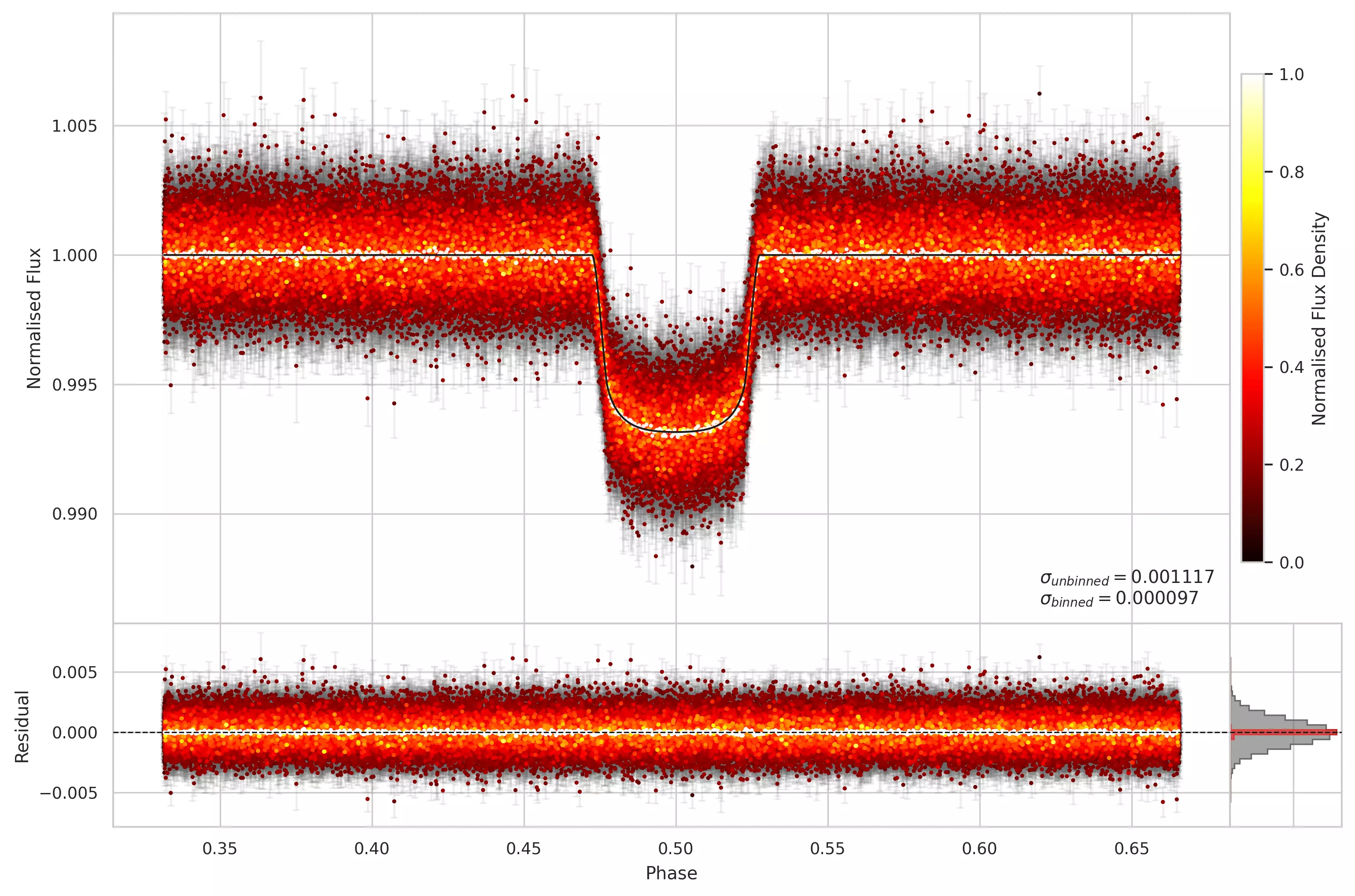
Installation
bash
pip install firefly-tess
or
bash
python setup.py install
Dependancies
transitfit
tabulate
python-Levenshtein
fuzzywuzzy
numpy
pandas
astroquery
natsorted
- Targets passed are corrected for basic user input. 'wasp43b' is interpreted as 'WASP-43 b'. List must be of the form given in the example below.
- Initial checks for targets from the exoplanet archive are then taken to ascertain whether the prior data extracted has entries in all columns. If there are missing entries for a given target in the list, the user will be asked whether to proceed.
- All available split curves are fitted with TransitFit, then the results are then zipped up and time stamped. Optionally sends an email upon an error or full completion of a target.
Background tasks for feeding data to TransitFit include: - Set the filter path to the TESS Filter. - Download EU/NASA/ORG/OEC exoplanet archive data every 2 days (checks the file age). - Download MAST lightcurve data for target TESS Sectors. - Split the lightcurves into seperate transits or epochs. - Create the data paths to each seperate epoch. - Run TransitFit. - Delete all downloaded data and inputs. - Zip up and timestamp the output.
```python from firefly import firefly
firefly('wasp43b')
python
Target search chose WASP-43 b.
Priors generated from the EU Archive for WASP-43 b (TIC 36734222).
+-------------+----------------+----------------+---------------+----------+ | Parameter | Distribution | Input A | Input B | Filter | |-------------+----------------+----------------+---------------+----------| | P | gaussian | 0.813478 | 8.13478e-05 | | | t0 | gaussian | 2.45573e+06 | 0.007 | | | a | gaussian | 0.01526 | 0.0001526 | | | inc | gaussian | 82.33 | 0.8233 | | | w | gaussian | 328 | 20 | | | ecc | gaussian | 0.0035 | 0.00175 | | | rp | uniform | 0.143652 | 0.175575 | 0 | | hostT | fixed | 4520 | 90.4 | | | hostz | fixed | -0.01 | 0.012 | | | hostr | fixed | 0.667 | 0.03335 | | | hostlogg | fixed | 4.64544 | 0.00971112 | | +-------------+----------------+----------------+---------------+----------+
Splitting the lightcurve into seperate epochs using the following parameters.
+-------------+--------------+ | Parameter | Value | |-------------+--------------| | t0 | 2.45573e+06 | | P | 0.813478 | | t14 | 87.89 | +-------------+--------------+
Searching MAST for WASP-43 b (TIC 36734222).
Query from MAST returned 1 data products for WASP-43 b (TIC 36734222).
+-------------------------------------------------+----------+-----------+--------+-----------+ | Product | TIC ID | Cadence | HLSP | Mission | |-------------------------------------------------+----------+-----------+--------+-----------| | tess2019058134432-s0009-0000000036734222-0139-s | 36734222 | 120 | SPOC | TESS | +-------------------------------------------------+----------+-----------+--------+-----------+
```
Mast
The Mikulski Archive for Space Telescopes (MAST) is a NASA-funded project to support, and provide to the public, a variety of astronomical archives, with a primary focus on space-based telescopes operating in the optical, ultraviolet, and near-infrared parts of the spectrum.
The time series photometry (Tenenbaum and Jenkins, 2018) captured by TESS was mainly at 120 second cadence for its primary mission, with baselines ranging from approximately 27 days to a year depending on sector overlapping. The entirety of CCD’s are known as Full-Frame Images (FFI). Groups of pixels are downloaded at shorter cadence to obtain a faster cadence for a subset of targets, known as Target Pixel (TP) files. Pixels around the star are stored as arrays in the TP, one image per stamp. Aperture photometry is then performed on each image which creates an array of fluxes known as Light Curve (LC) files.
Lightcurves contain flux time series derived from calibrated two minute and twenty second target pixels. Two photometry types are available, Simple Aperture Photometry (SAP) and Pre-Search Data Conditioning SAP (PDCSAP). PDCSAP is a flux time series which has common instrumental systematics removed using the Cotrending Basis Vectors (CBV). The CBV’s represent a set of systematic trends present in the lightcurve data for each CCD. ```python from firefly import mast
mast('wasp43b')
python
Searching MAST for WASP-43 b (TIC 36734222).
Query from MAST returned 3 data products for WASP-43 b (TIC 36734222).
+----------------------------------------------------------------+----------+-----------+----------+-----------+ | Product | TIC ID | Cadence | HLSP | Mission | |----------------------------------------------------------------+----------+-----------+----------+-----------| | hlspdiamantetesslightcurvetic-0000000036734222tessv1llc | 36734222 | 1800 | DIAMANTE | TESS | | hlspqlptessffis0009-0000000036734222tessv01llc | 36734222 | 1800 | QLP | TESS | | tess2019058134432-s0009-0000000036734222-0139-s | 36734222 | 120 | SPOC | TESS | +----------------------------------------------------------------+----------+-----------+----------+-----------+ ```
Priors
To establish a priority list two conditions must be considered. The minimum ephemera required for retrieval consist of the period P, transit mid-point t0, semi-major axis a, inclination i and the ratio of the planet to its host star rp. The additional values of eccentricity ecc and periastron w are optional, and taken into account if they exist. Otherwise default values of ecc 0 and w 90 are used. A viable candidate should satisfy both the existence of a full set of ephemera and a light curve data product. In lieu of this, each archive was tested to ascertain which provided the most candidates with full prior information, comprising of the Extrasolar Planets Encyclopedia (Schneider et al., 2011), the NASA Exoplanet Archive (Akeson et al., 2013), and the Exoplanet Orbit Database (Wright et al., 2011).
```python from firefly import priors
priors('wasp190b', 'spearnet')
python
Priors generated from the SPEARNET Archive for WASP-190 b (TIC 116156517).
+-------------+----------------+---------------+---------------------+----------+ | Parameter | Distribution | Input A | Input B | Filter | |-------------+----------------+---------------+---------------------+----------| | P | fixed | 5.36773 | | | | t0 | gaussian | 2.4578e+06 | 0.007 | | | a | gaussian | 0.0643173 | 0.0032913001497495 | | | inc | gaussian | 86.5471 | 0.1529545135471545 | | | w | fixed | 90 | | | | ecc | fixed | 0 | | | | rp | uniform | 0.0730344 | 0.08926423524371321 | 0 | | t14 | | 286.121 | | | | hostT | | 6400 | 128.0 | | | hostz | | -0.02 | 0.05 | | | hostr | | 1.6 | 0.08000000000000002 | | | hostlogg | | 4.17 | 0.0834 | | +-------------+----------------+---------------+---------------------+----------+ ```
Citing Firefly
@misc{firefly,
  author = {Stephen Charles and Joshua Hayes and Eamonn Kerins},
  title = {Firefly - A target selector for use with TransitFit to fit TESS lightcurves.},
  year = {2020},
  publisher = {GitHub},
  journal = {GitHub repository},
  howpublished = {\url{https://github.com/sourestdeeds/firefly}},
}
In instances, when the correct target is not found by Firefly, you can download and extract lightcurves from ExoMast by using the following code snippet:
```python from firefly._utils import _fits import os
exoplanetname = "WASP-91 b" ticid="238176110"
exofolder = f"{exoplanetname}" os.makedirs(exofolder, existok=True)
csvindir, sectorlist = _fits( exoplanetname, exofolder=exofolder, cache=False, hlsp=["SPOC"], cadence=120, bitmask="default", ticid=ticid, )
print(f"CSV files saved in {csvindir}") ``` These lightcurves can be split into epochs using transitfit.splitlightcurvefile.
Owner
- Name: Stephen Charles
- Login: sourestdeeds
- Kind: user
- Location: Cambridge, UK
- Website: https://sourestdeeds.github.io
- Repositories: 26
- Profile: https://github.com/sourestdeeds
Data Scientist with an interest in applying solutions to astrophysics problems.
GitHub Events
Total
- Delete event: 2
- Issue comment event: 4
- Push event: 6
- Pull request event: 4
- Fork event: 1
Last Year
- Delete event: 2
- Issue comment event: 4
- Push event: 6
- Pull request event: 4
- Fork event: 1
Committers
Last synced: 12 months ago
Top Committers
| Name | Commits | |
|---|---|---|
| Steven Charles-Mindoza | s****a@g****m | 1,157 |
| Akshay Priyadarshi | a****i@m****k | 19 |
Committer Domains (Top 20 + Academic)
Issues and Pull Requests
Last synced: 12 months ago
All Time
- Total issues: 0
- Total pull requests: 12
- Average time to close issues: N/A
- Average time to close pull requests: 9 minutes
- Total issue authors: 0
- Total pull request authors: 2
- Average comments per issue: 0
- Average comments per pull request: 0.17
- Merged pull requests: 12
- Bot issues: 0
- Bot pull requests: 0
Past Year
- Issues: 0
- Pull requests: 2
- Average time to close issues: N/A
- Average time to close pull requests: about 1 hour
- Issue authors: 0
- Pull request authors: 1
- Average comments per issue: 0
- Average comments per pull request: 1.0
- Merged pull requests: 2
- Bot issues: 0
- Bot pull requests: 0
Top Authors
Issue Authors
Pull Request Authors
- sourestdeeds (10)
- PriyadarshiAkshay (4)
Top Labels
Issue Labels
Pull Request Labels
Packages
- Total packages: 1
-
Total downloads:
- pypi 37 last-month
- Total dependent packages: 0
- Total dependent repositories: 1
- Total versions: 2
- Total maintainers: 1
pypi.org: firefly-tess
A pipeline to use with TransitFit to fit TESS lightcurves.
- Documentation: https://firefly-tess.readthedocs.io/
- License: gpl-3.0
-
Latest release: 0.9.3
published about 1 year ago
Rankings
Maintainers (1)
Dependencies
- astropy *
- astroquery *
- fuzzywuzzy *
- lightkurve *
- natsort *
- numpy *
- pandas *
- pyastronomy *
- python-Levenshtein *
- rich *
- seaborn *
- tabulate *
- tqdm *
- transitfit *
- astropy *
- astroquery *
- lightkurve *
- natsort *
- numpy *
- pandas *
- pyastronomy *
- python-Levenshtein *
- rich *
- seaborn *
- tabulate *
- thefuzz *
- tqdm *
- transitfit *