https://github.com/noble-lab/sceptic
Pseudotime analysis for time-series single-cell sequencing and imaging data
Science Score: 39.0%
This score indicates how likely this project is to be science-related based on various indicators:
-
○CITATION.cff file
-
✓codemeta.json file
Found codemeta.json file -
✓.zenodo.json file
Found .zenodo.json file -
✓DOI references
Found 3 DOI reference(s) in README -
○Academic publication links
-
○Academic email domains
-
○Institutional organization owner
-
○JOSS paper metadata
-
○Scientific vocabulary similarity
Low similarity (14.3%) to scientific vocabulary
Keywords
Repository
Pseudotime analysis for time-series single-cell sequencing and imaging data
Basic Info
Statistics
- Stars: 11
- Watchers: 2
- Forks: 1
- Open Issues: 0
- Releases: 1
Topics
Metadata Files
README.md
Sceptic
Installation | Enviroment | Example | Input | Output | Parameter | Citation | Contact
Sceptic can perform pseudotime analysis on various types of single-cell/single-nucleus data. The model takes as input a collection of single-cell/single-nucleus data and then learns the relationship between the observed data and the associated time stamps, and finally uses the trained model to assign to each cell a real-valued pseudotime. Ideally, the pseudotimes assigned by Sceptic reflect each cell's progression along a notion of time---developmental, cell cycle, disease progression, aging---that is appropriate to the given data. Ideally, the pseudotimes assigned by Sceptic reflect each cell's progression along a notion of time---developmental, cell cycle, disease progression, aging---that is appropriate to the given data.
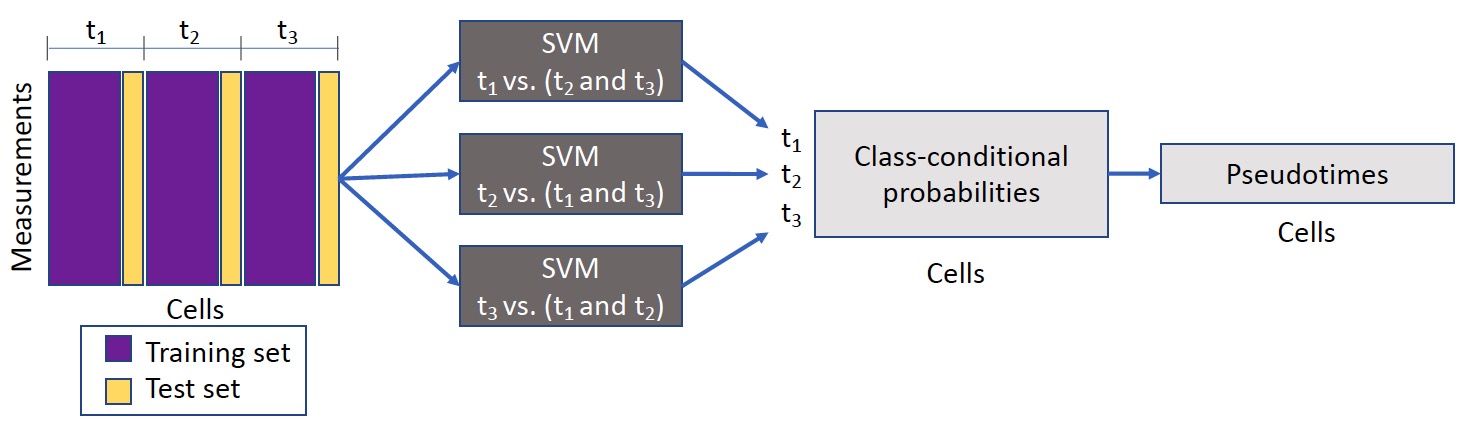
Installation
Sceptic software is available on the Python package index (PyPI), latest version 0.3.3. To install it using pip, simply type:
bash
$ pip install sceptic
Enviroment
Sceptic is associated with the following packages.
- python >= 3.7.7
- numpy >= 1.19.5
- pandas >= 1.3.5
- sklearn >= 1.0.2
Example (python script)
We downloaded the processed scGEM dataset from UnionCom’s GitHub page.
bash
$ python test/scGEM/scGEM.py
The script will generate 4 outputs from Sceptic described in the section above and save it at: test/scGEM/.
Parameters of Sceptic
The list of parameters is given below:
eFold: # of folds for external cross-validation (default=3).iFold: # of folds for internal cross-validation (default=4).
For SVM implementation:
kernel: The kernel function for sceptic SVM classfier (default=('linear', 'rbf')). Sklearn supports four kinds of kernels: linear, polynomial, rbf, sigmoid.C: The C parameter for rbf kernel (default=[0.1, 1, 10]). The C parameter trades off correct classification of training examples against maximization of the decision function’s margin. See more details here.
For XGboost implementation:
max_depth: Maximum depth of a tree (default=[3, 5]). Increasing this value will make the model more complex and more likely to overfit. 0 indicates no limit on depth. Beware that XGBoost aggressively consumes memory when training a deep tree. See more details here.learning_rate: Step size shrinkage used in update to prevent overfitting (default=[0.1, 0.3]). After each boosting step, we can directly get the weights of new features, and eta shrinks the feature weights to make the boosting process more conservative. See more details here.
Input
In case the user is providing the input data:
- data_concat: the input cell by measurement matrix. (# of cells by # of measurements)
- label: processed cell time label. (# of cells by 1)
- label_list: unique list of possible cell time labels. (# of time points by 1)
- parameters: Sceptic parameter dictionary. (SVM default={'kernel': ('linear', 'rbf'), 'C': [0.1, 1, 10]}; XGboost default= {"maxdepth": [3, 5], "learningrate": [0.1, 0.3],
"nestimators": [100], "subsample": [0.8]})
- method: "svm" or "xgboost" implementation. For large dataset, we recommend "xgboost" implementation.
- `usegpu`: Only applies if method="xgboost".
Output
When one uses sceptic.runscepticandevaluate function, several outputs are generated:
- cm: the confusion matrix for Sceptic's nested cross-validation. (# of timepoints by # of time points)
- label_predicted: Sceptic's predicted discrete label for each cell. (# of cells by 1)
- pseudotime: Sceptic's predicted pseudotime (continuous) for each cell. (# of cells by 1)
- sceptic_prob: the class-proabilities for each cell. (# of cells by # of time points)
Contact
In case you have questions, reach out to gangliuw@uw.edu.
Citation
Pseudotime analysis for time-series single-cell sequencing and imaging data
If you have found our work useful, please consider citing us:
Li, G., Kim, HJ., Pendyala, S. et al. Sceptic: pseudotime analysis for time-series single-cell sequencing and imaging data. Genome Biol 26, 209 (2025). https://doi.org/10.1186/s13059-025-03679-3
@article{li2025sceptic,
  title={Sceptic: pseudotime analysis for time-series single-cell sequencing and imaging data},
  author={Li, Gang and Kim, Hyeon-Jin and Pendyala, Sriram and Zhang, Ran and Vert, Jean-Philippe and Disteche, Christine M and Deng, Xinxian and Fowler, Douglas M and Noble, William Stafford},
  journal={Genome Biology},
  volume={26},
  pages={209},
  year={2025}
}
Owner
- Name: Noble Lab Department of Genome Sciences UW
- Login: Noble-Lab
- Kind: organization
- Website: https://noble.gs.washington.edu
- Repositories: 11
- Profile: https://github.com/Noble-Lab
GitHub Events
Total
- Release event: 1
- Watch event: 4
- Push event: 2
- Create event: 1
Last Year
- Release event: 1
- Watch event: 4
- Push event: 2
- Create event: 1
Packages
- Total packages: 1
-
Total downloads:
- pypi 45 last-month
- Total dependent packages: 0
- Total dependent repositories: 0
- Total versions: 3
- Total maintainers: 1
pypi.org: sceptic
Pseudotime analysis for time-series single-cell sequencing and imaging data
- Homepage: https://github.com/Noble-Lab/Sceptic
- Documentation: https://sceptic.readthedocs.io/
- License: MIT License
-
Latest release: 0.3.3
published over 1 year ago