https://github.com/robert-forrest/metallurgy
Calculates approximate properties of alloy compositions
Science Score: 10.0%
This score indicates how likely this project is to be science-related based on various indicators:
-
○CITATION.cff file
-
○codemeta.json file
-
○.zenodo.json file
-
○DOI references
-
✓Academic publication links
Links to: rsc.org -
○Committers with academic emails
-
○Institutional organization owner
-
○JOSS paper metadata
-
○Scientific vocabulary similarity
Low similarity (10.1%) to scientific vocabulary
Keywords
Repository
Calculates approximate properties of alloy compositions
Basic Info
- Host: GitHub
- Owner: Robert-Forrest
- License: bsd-3-clause
- Language: Python
- Default Branch: main
- Homepage: https://metallurgy.readthedocs.io/en/latest/
- Size: 498 KB
Statistics
- Stars: 13
- Watchers: 3
- Forks: 0
- Open Issues: 0
- Releases: 0
Topics
Metadata Files
README.md
Metallurgy

The Metallurgy package enables calculation of approximate properties of alloy mixtures, based on the linear mixture of elemental properties.
Installation
The metallurgy package can be installed from pypi using pip:
pip install metallurgy
Usage
Alloys
Most of the features of metallurgy are based on the concept of an alloy, a mixture of elements:
```python import metallurgy as mg
Bronze = mg.Alloy("Cu88Sn12") ```
An alloy can be defined in several ways:
```pycon
mg.Alloy("Cu50Zr50") Cu50Zr50
mg.Alloy("CuZr") Cu50Zr50
mg.Alloy("CuZrFeCo") Cu25Zr25Fe25Co25
mg.Alloy("(Fe70Co30)50Ni50") Ni50Fe35Co15
mg.Alloy("(FeCo)50Ni50") Ni50Fe25Co25
mg.Alloy({"Pt": 30, "Al": 45, "Ag": 25}) Al45Pt30Ag25 ```
While formally, an alloy is defined as "a mixture of chemical elements of which at least one is a metal", no such limitation is enforced in this package -- you can create any mixture you want.
An Alloy object has access to properties containing the percentage values of the composition, the elements in the composition, and has helper functions which can convert the composition to a simple string or even a LaTeX formatted string:
```pycon
Bronze.composition {'Cu': 0.88, 'Sn': 0.12}
Bronze.elements ['Cu', 'Sn']
Bronze.to_string() 'Cu88Sn12'
Bronze.toprettystring() 'Cu${88}$Sn${12}$' ```
Calculating alloy properties
Properties of alloys may be approximated from the properties of their constituent elements via the linear mixture rule:
$$\Sigma A = \sum{i=1}^{N} ci A_i $$
where $\Sigma A$ is the approximate mixed value of a property $A$ for an alloy that contains $N$ elements with percentages $c_i$. Similarly, the deviation of these elemental property values for the elements present in an alloy can be calculated:
$$\delta A = \sqrt{\sum{i=1}^{N} ci \left(1 - \frac{A_i}{\Sigma A}\right)^2} $$
The metallurgy package can be used to calculate a variety of approximate alloy properties:
```pycon Bronze = mg.Alloy("Cu88Sn12")
mg.linear_mixture(Bronze, "mass") 70.16568
mg.linear_mixture(Bronze, "density") 8.7566
mg.linear_mixture(Bronze, "valence") 2.24
mg.deviation(Bronze, "mass") 17.926178182133523
mg.deviation(Bronze, "density") 0.5508098038343185
mg.deviation(Bronze, "valence") 0.6499230723708769
```
Elemental data is provided by the elementy package. Metallurgy can calculate a variety of other alloy properties that are more complex than simple linear mixture or deviations of elemental properties:
```pycon
mg.enthalpy.mixingGibbsfree_energy(Bronze) -2039.0961905675026
mg.entropy.ideal_entropy(Bronze) 0.3669249912727096
mg.density.theoretical_density(Bronze) 8.554783679490685
mg.valence.d_valence(Bronze) 0.8661417322834646 ```
See our June 2022 paper "Machine-learning improves understanding of glass formation in metallic systems" that used code which later became the metallurgy package for definitions of these alloy properties.
Generating alloy datasets
Metallurgy can also be used to generate collections of alloys, either randomly or across a composition-space.
```pycon
mg.generate.binary(["Fe", "Co"], step=10) [Fe100, Fe90Co10, Fe80Co20, Fe70Co30, Fe60Co40, Fe50Co50, Co60Fe40, Co70Fe30, Co80Fe20, Co90Fe10, Co100]
mg.generate.ternary(["Fe", "Co", "Al"], step=20) [Fe100, Fe80Co20, Fe80Al20, Fe60Co40, Fe60Co20Al20, Fe60Al40, Co60Fe40, Fe40Co40Al20, Fe40Al40Co20, Al60Fe40, Co80Fe20, Co60Fe20Al20, Co40Al40Fe20, Al60Fe20Co20, Al80Fe20, Co100, Co80Al20, Co60Al40, Al60Co40, Al80Co20, Al100]
mg.generate.random_alloy() Cs28.9Db25.4Hs12Ce11.9La10.6Cu9.6Kr1.6
mg.generate.random_alloy() Ba94.5Y5.5 ```
We can apply constraints to the randomly generated alloy, such as limits on the maximum and minimum number of constituent elements, requirements on the percentage range that particular elements must be within, and whitelists of allowed elements:
```pycon
mg.generate.randomalloy(minelements=2, max_elements=3) Au50.7Hf36.3Ru13
mg.generate.randomalloy(minelements=2, maxelements=3, percentageconstraints={"Cu":{"min":0.3, "max":0.8}}) Cu63.9Sr23.9Be12.2
mg.generate.randomalloy(minelements=2, maxelements=3, percentageconstraints={"Cu":{"min":0.3, "max":0.8}}, allowed_elements=["Fe", "Cu", "Co", "Ni", "Yb"]) Yb64.8Cu30Ni5.2 ```
The process of generating random alloys can be performed in bulk to create datasets of random alloys:
```pycon
mg.generate.randomalloys(10, minelements=2, max_elements=3) [Fl94.6Xe5.4, Po64.2Tl23.3Np12.5, Tb61.6Ta38.4, Lu50.8Ho38.1In11.1, Rn69Es31, S70.4Ts29.6, Pr79.3He13.4Cm7.3, As84.3V15.7, Ge45.3Xe41.2Na13.5, Ra70.4He29.6] ```
Plotting alloy information
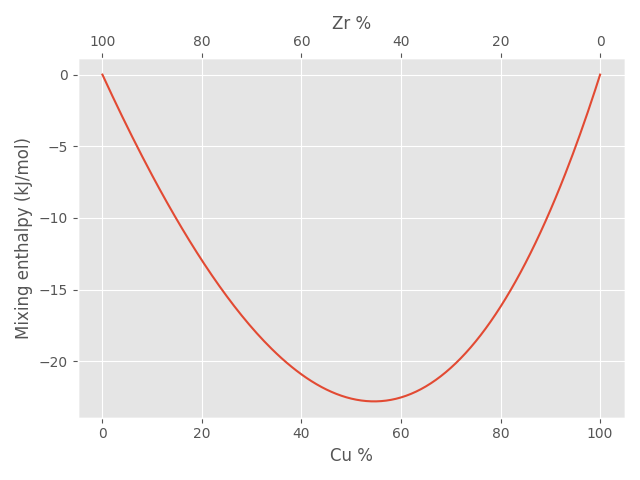
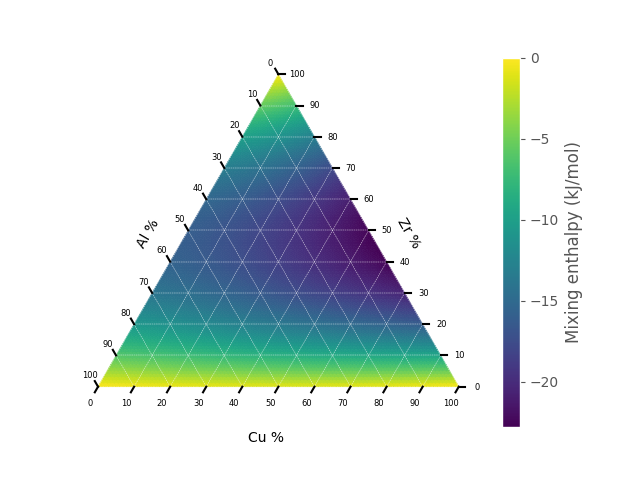
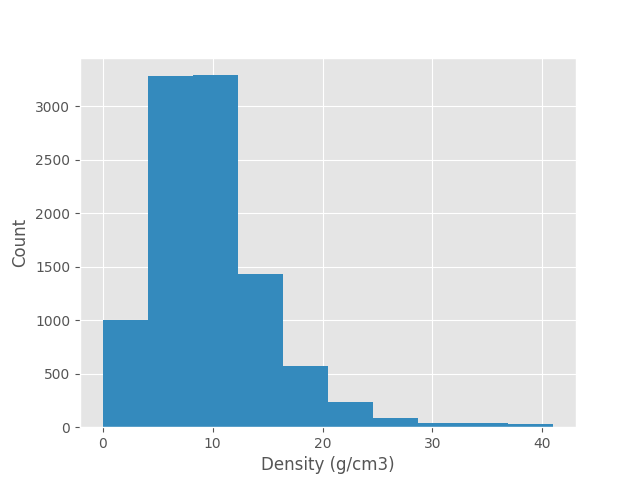
Once you have created a dataset of alloys, you may wish to view graphically a particular material property on a population level:
```pycon
binary, percentages = mg.generate.binary(["Cu", "Zr"]) mixingenthalpies = mg.enthalpy.mixingenthalpy(binary) mg.plots.binary(binary, mixing_enthalpies, ylabel="Mixing enthalpy (kJ/mol)") ```
```pycon
ternary, percentages = mg.generate.ternary(["Cu", "Zr", "Al"]) mixingenthalpies = mg.enthalpy.mixingenthalpy(ternary) mg.plots.ternary(ternary, mixing_enthalpies, label="Mixing enthalpy (kJ/mol)") ```
```pycon
import matplotlib.pyplot as plt alloys = mg.generate.randomalloys(10000) plt.hist(mg.linearmixture(alloys, "density")) ```
Documentation
Documentation is available here.
Owner
- Name: Robert Forrest
- Login: Robert-Forrest
- Kind: user
- Location: UK
- Repositories: 7
- Profile: https://github.com/Robert-Forrest
Full-stack Engineering. Computational Materials Science + ML
GitHub Events
Total
- Watch event: 1
Last Year
- Watch event: 1
Committers
Last synced: over 3 years ago
All Time
- Total Commits: 281
- Total Committers: 1
- Avg Commits per committer: 281.0
- Development Distribution Score (DDS): 0.0
Top Committers
| Name | Commits | |
|---|---|---|
| Robert Forrest | r****t@l****m | 281 |
Issues and Pull Requests
Last synced: 10 months ago
All Time
- Total issues: 0
- Total pull requests: 0
- Average time to close issues: N/A
- Average time to close pull requests: N/A
- Total issue authors: 0
- Total pull request authors: 0
- Average comments per issue: 0
- Average comments per pull request: 0
- Merged pull requests: 0
- Bot issues: 0
- Bot pull requests: 0
Past Year
- Issues: 0
- Pull requests: 0
- Average time to close issues: N/A
- Average time to close pull requests: N/A
- Issue authors: 0
- Pull request authors: 0
- Average comments per issue: 0
- Average comments per pull request: 0
- Merged pull requests: 0
- Bot issues: 0
- Bot pull requests: 0
Top Authors
Issue Authors
Pull Request Authors
Top Labels
Issue Labels
Pull Request Labels
Packages
- Total packages: 1
-
Total downloads:
- pypi 172 last-month
- Total dependent packages: 2
- Total dependent repositories: 1
- Total versions: 31
- Total maintainers: 1
pypi.org: metallurgy
Calculates approximate properties of alloy compositions.
- Homepage: https://github.com/Robert-Forrest/metallurgy
- Documentation: https://metallurgy.readthedocs.io/
- License: BSD 3-Clause License
-
Latest release: 0.0.33
published about 3 years ago
Rankings
Maintainers (1)
Dependencies
- sphinx *
- sphinx-autoapi *
- actions/checkout v2 composite
- actions/setup-python v2 composite
- pypa/gh-action-pypi-publish release/v1 composite
- actions/checkout v2 composite
- actions/setup-python v2 composite