https://github.com/610265158/efficientnet-pytorch
A PyTorch implementation of EfficientNet
Science Score: 10.0%
This score indicates how likely this project is to be science-related based on various indicators:
-
○CITATION.cff file
-
○codemeta.json file
-
○.zenodo.json file
-
○DOI references
-
✓Academic publication links
Links to: arxiv.org -
○Academic email domains
-
○Institutional organization owner
-
○JOSS paper metadata
-
○Scientific vocabulary similarity
Low similarity (10.3%) to scientific vocabulary
Last synced: 10 months ago
·
JSON representation
Repository
A PyTorch implementation of EfficientNet
Basic Info
- Host: GitHub
- Owner: 610265158
- License: apache-2.0
- Default Branch: master
- Size: 1.06 MB
Statistics
- Stars: 0
- Watchers: 2
- Forks: 0
- Open Issues: 0
- Releases: 0
Fork of lukemelas/EfficientNet-PyTorch
Created about 6 years ago
· Last pushed about 6 years ago
https://github.com/610265158/EfficientNet-PyTorch/blob/master/
# EfficientNet PyTorch

### Quickstart

Install with `pip install efficientnet_pytorch` and load a pretrained EfficientNet with:
```python
from efficientnet_pytorch import EfficientNet
model = EfficientNet.from_pretrained('efficientnet-b0')
```

### Updates

#### Update (May 14, 2020)

This update adds comprehensive comments and documentation (thanks to @workingcoder).

#### Update (January 23, 2020)

This update adds a new category of pre-trained model based on adversarial training, called _advprop_. It is important to note that the preprocessing required for the advprop pretrained models is slightly different from normal ImageNet preprocessing. As a result, by default, advprop models are not used. To load a model with advprop, use:
```
model = EfficientNet.from_pretrained("efficientnet-b0", advprop=True)
```
There is also a new, large `efficientnet-b8` pretrained model that is only available in advprop form. When using these models, replace ImageNet preprocessing code as follows:
```
if advprop:  # for models using advprop pretrained weights
    normalize = transforms.Lambda(lambda img: img * 2.0 - 1.0)
else:
    normalize = transforms.Normalize(mean=[0.485, 0.456, 0.406],
                                     std=[0.229, 0.224, 0.225])

```
This update also addresses multiple other issues ([#115](https://github.com/lukemelas/EfficientNet-PyTorch/issues/115), [#128](https://github.com/lukemelas/EfficientNet-PyTorch/issues/128)).

#### Update (October 15, 2019)

This update allows you to choose whether to use a memory-efficient Swish activation. The memory-efficient version is chosen by default, but it cannot be used when exporting using PyTorch JIT. For this purpose, we have also included a standard (export-friendly) swish activation function. To switch to the export-friendly version, simply call `model.set_swish(memory_efficient=False)` after loading your desired model. This update addresses issues [#88](https://github.com/lukemelas/EfficientNet-PyTorch/pull/88) and [#89](https://github.com/lukemelas/EfficientNet-PyTorch/pull/89).

#### Update (October 12, 2019)

This update makes the Swish activation function more memory-efficient. It also addresses pull requests [#72](https://github.com/lukemelas/EfficientNet-PyTorch/pull/72), [#73](https://github.com/lukemelas/EfficientNet-PyTorch/pull/73), [#85](https://github.com/lukemelas/EfficientNet-PyTorch/pull/85), and [#86](https://github.com/lukemelas/EfficientNet-PyTorch/pull/86). Thanks to the authors of all the pull requests!

#### Update (July 31, 2019)

_Upgrade the pip package with_ `pip install --upgrade efficientnet-pytorch`

The B6 and B7 models are now available. Additionally, _all_ pretrained models have been updated to use AutoAugment preprocessing, which translates to better performance across the board. Usage is the same as before:
```python
from efficientnet_pytorch import EfficientNet
model = EfficientNet.from_pretrained('efficientnet-b7')
```

#### Update (June 29, 2019)

This update adds easy model exporting ([#20](https://github.com/lukemelas/EfficientNet-PyTorch/issues/20)) and feature extraction ([#38](https://github.com/lukemelas/EfficientNet-PyTorch/issues/38)).

 * [Example: Export to ONNX](#example-export)
 * [Example: Extract features](#example-feature-extraction)
 * Also: fixed a CUDA/CPU bug ([#32](https://github.com/lukemelas/EfficientNet-PyTorch/issues/32))

It is also now incredibly simple to load a pretrained model with a new number of classes for transfer learning:
```python
model = EfficientNet.from_pretrained('efficientnet-b1', num_classes=23)
```


#### Update (June 23, 2019)

The B4 and B5 models are now available. Their usage is identical to the other models:
```python
from efficientnet_pytorch import EfficientNet
model = EfficientNet.from_pretrained('efficientnet-b4')
```

### Overview
This repository contains an op-for-op PyTorch reimplementation of [EfficientNet](https://arxiv.org/abs/1905.11946), along with pre-trained models and examples.

The goal of this implementation is to be simple, highly extensible, and easy to integrate into your own projects. This implementation is a work in progress -- new features are currently being implemented.

At the moment, you can easily:
 * Load pretrained EfficientNet models
 * Use EfficientNet models for classification or feature extraction
 * Evaluate EfficientNet models on ImageNet or your own images

_Upcoming features_: In the next few days, you will be able to:
 * Train new models from scratch on ImageNet with a simple command
 * Quickly finetune an EfficientNet on your own dataset
 * Export EfficientNet models for production

### Table of contents
1. [About EfficientNet](#about-efficientnet)
2. [About EfficientNet-PyTorch](#about-efficientnet-pytorch)
3. [Installation](#installation)
4. [Usage](#usage)
    * [Load pretrained models](#loading-pretrained-models)
    * [Example: Classify](#example-classification)
    * [Example: Extract features](#example-feature-extraction)
    * [Example: Export to ONNX](#example-export)
6. [Contributing](#contributing)

### About EfficientNet

If you're new to EfficientNets, here is an explanation straight from the official TensorFlow implementation:

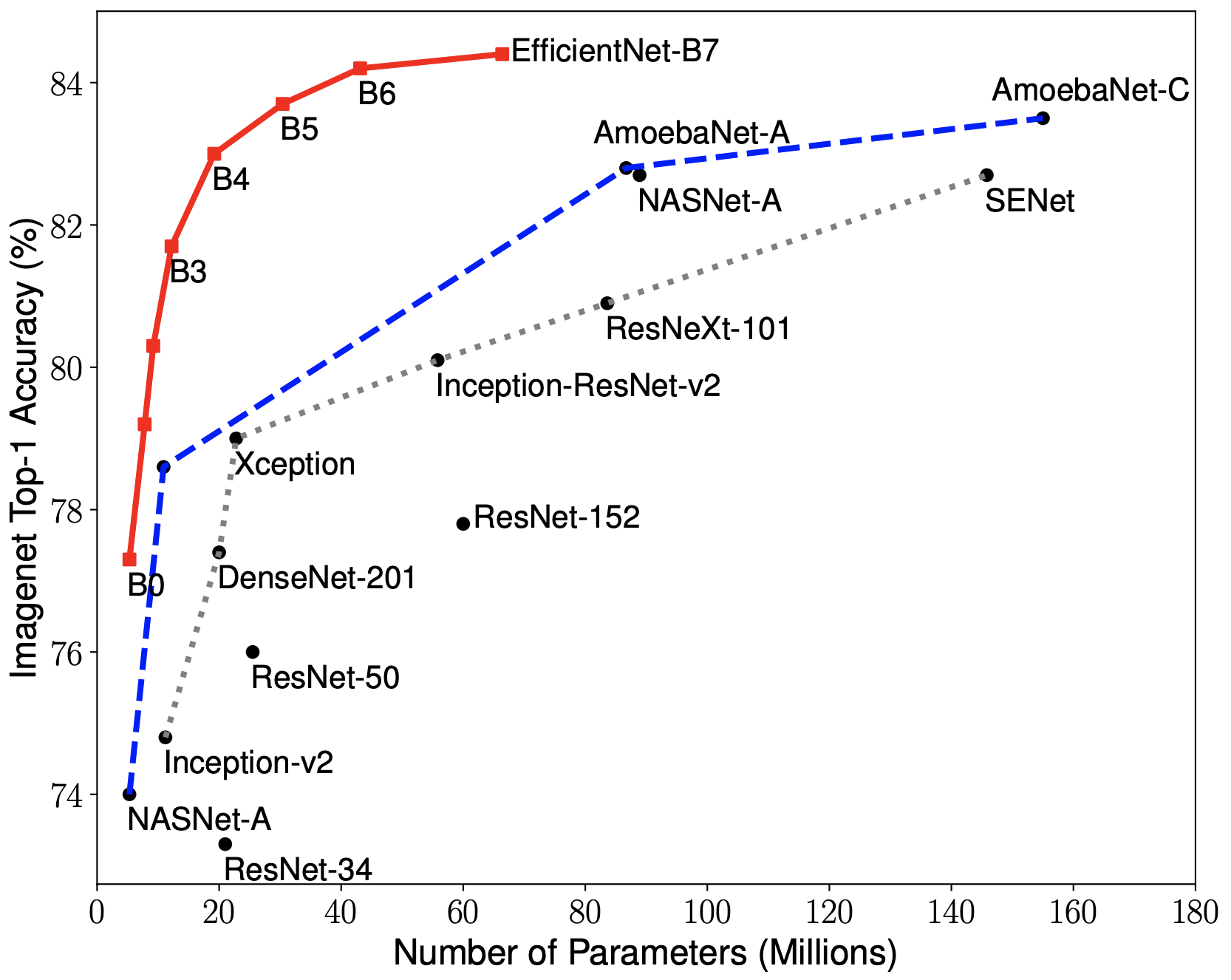
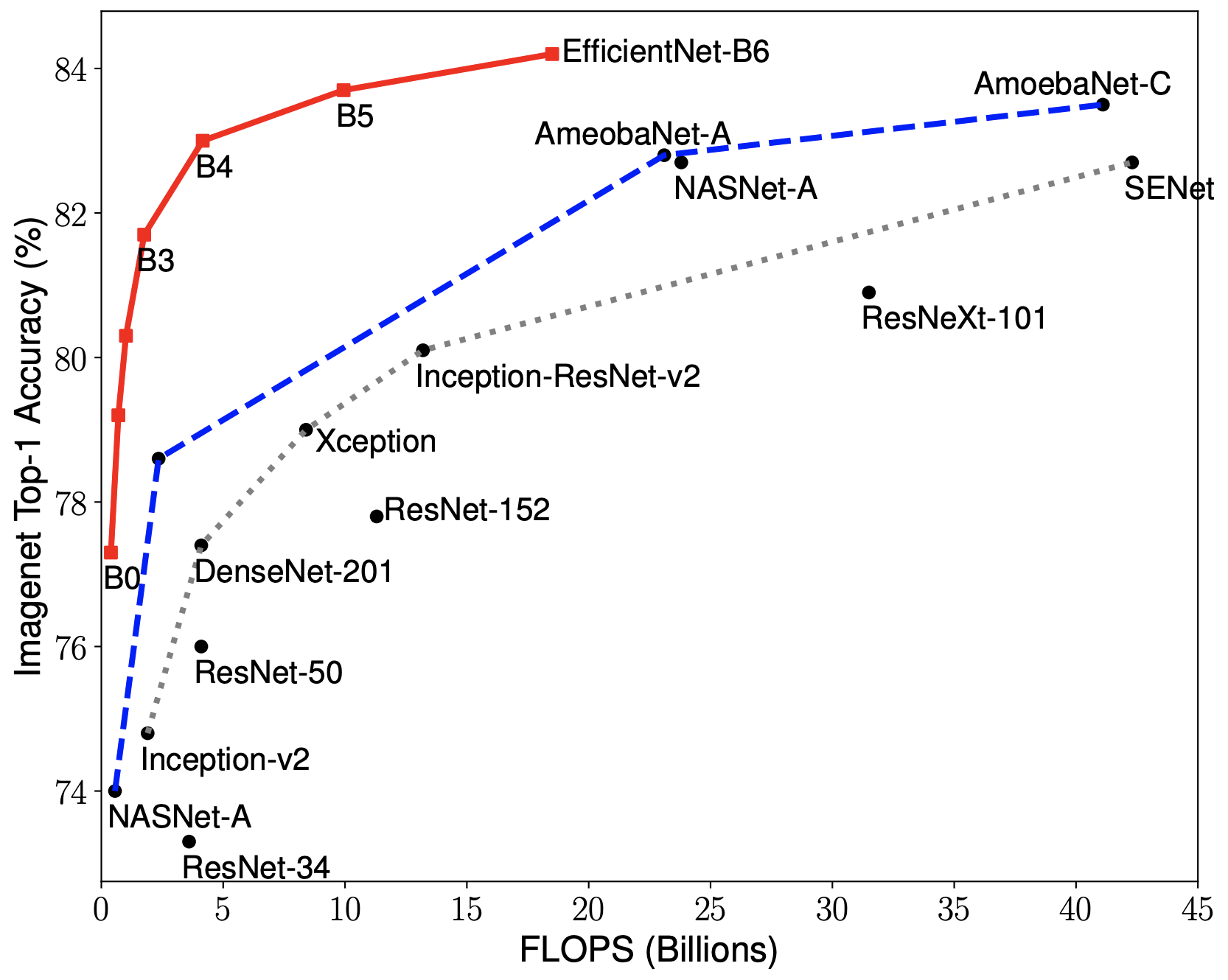
EfficientNets are a family of image classification models, which achieve state-of-the-art accuracy, yet being an order-of-magnitude smaller and faster than previous models. We develop EfficientNets based on AutoML and Compound Scaling. In particular, we first use [AutoML Mobile framework](https://ai.googleblog.com/2018/08/mnasnet-towards-automating-design-of.html) to develop a mobile-size baseline network, named as EfficientNet-B0; Then, we use the compound scaling method to scale up this baseline to obtain EfficientNet-B1 to B7.
|
|
Owner
- Name: Lz
- Login: 610265158
- Kind: user
- Location: CN
- Repositories: 2
- Profile: https://github.com/610265158
I am looking for a job now, contact me if got any opportunity.