https://github.com/anexen/pyxirr
Rust-powered collection of financial functions.
Science Score: 26.0%
This score indicates how likely this project is to be science-related based on various indicators:
-
○CITATION.cff file
-
✓codemeta.json file
Found codemeta.json file -
✓.zenodo.json file
Found .zenodo.json file -
○DOI references
-
○Academic publication links
-
○Committers with academic emails
-
○Institutional organization owner
-
○JOSS paper metadata
-
○Scientific vocabulary similarity
Low similarity (13.3%) to scientific vocabulary
Keywords
Repository
Rust-powered collection of financial functions.
Basic Info
- Host: GitHub
- Owner: Anexen
- License: unlicense
- Language: Rust
- Default Branch: main
- Homepage: https://anexen.github.io/pyxirr/
- Size: 852 KB
Statistics
- Stars: 196
- Watchers: 8
- Forks: 23
- Open Issues: 6
- Releases: 29
Topics
Metadata Files
README.md




PyXIRR
Rust-powered collection of financial functions.
PyXIRR stands for "Python XIRR" (for historical reasons), but contains many other financial functions such as IRR, FV, NPV, etc.
Features:
- correct
- supports different day count conventions (e.g. ACT/360, 30E/360, etc.)
- works with different input data types (iterators, numpy arrays, pandas DataFrames)
- no external dependencies
- type annotations
- blazingly fast
Installation
pip install pyxirr
WASM wheels for pyodide are also available, but unfortunately are not supported by PyPI. You can find them on the GitHub Releases page.
Benchmarks
Rust implementation has been tested against existing xirr package (uses scipy.optimize under the hood) and the implementation from the Stack Overflow (pure python).
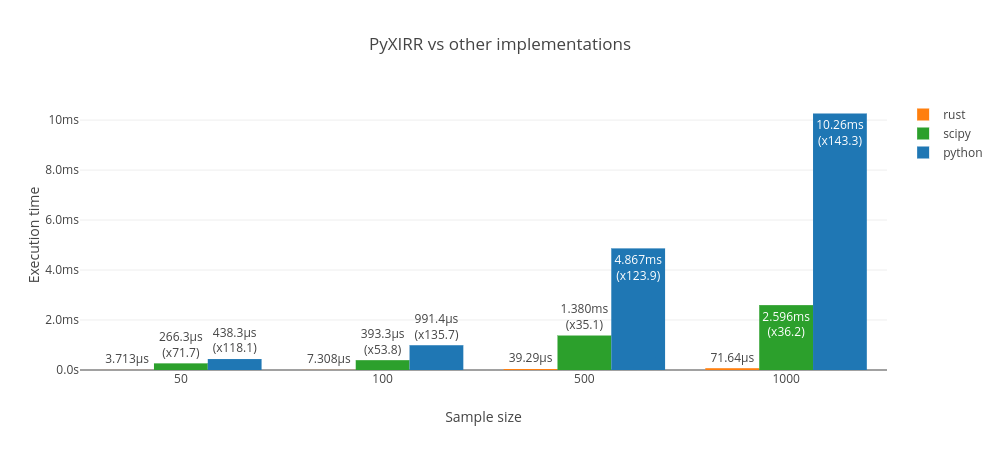
PyXIRR is much faster than the other implementations.
Powered by github-action-benchmark and plotly.js.
Live benchmarks are hosted on Github Pages.
Example
```python from datetime import date from pyxirr import xirr
dates = [date(2020, 1, 1), date(2021, 1, 1), date(2022, 1, 1)] amounts = [-1000, 750, 500]
feed columnar data
xirr(dates, amounts)
feed iterators
xirr(iter(dates), (x / 2 for x in amounts))
feed an iterable of tuples
xirr(zip(dates, amounts))
feed a dictionary
xirr(dict(zip(dates, amounts)))
dates as strings
xirr(['2020-01-01', '2021-01-01'], [-1000, 1200]) ```
Multiple IRR problem
The Multiple IRR problem occurs when the signs of cash flows change more than once. In this case, we say that the project has non-conventional cash flows. This leads to situation, where it can have more the one IRR or have no IRR at all.
PyXIRR addresses the Multiple IRR problem as follows:
- It looks for positive result around 0.1 (the same as Excel with the default guess=0.1).
- If it can't find a result, it uses several other attempts and selects the lowest IRR to be conservative.
Here is an example illustrating how to identify multiple IRRs:
```python import numpy as np import pyxirr
load cash flow:
cf = pd.read_csv("tests/samples/30-22.csv", names=["date", "amount"])
check whether the cash flow is conventional:
print(pyxirr.isconventionalcash_flow(cf["amount"])) # false
build NPV profile:
calculate 50 NPV values for different rates
rates = np.linspace(-0.5, 0.5, 50)
any iterable, any rates, e.g.
rates = [-0.5, -0.3, -0.1, 0.1, -0.6]
values = pyxirr.xnpv(rates, cf)
print NPV profile:
NPV changes sign two times:
1) between -0.316 and -0.295
2) between -0.03 and -0.01
print("NPV profile:") for rate, value in zip(rates, values): print(rate, value)
plot NPV profile
import pandas as pd series = pd.Series(values, index=rates) pd.DataFrame(series[series > -1e6]).assign(zero=0).plot()
find points where NPV function crosses zero
indexes = pyxirr.zerocrossingpoints(values)
print("Zero crossing points:") for idx in indexes: print("between", rates[idx], "and", rates[idx+1])
XIRR has two results:
-0.31540826742734207
-0.028668460065441048
for i, idx in enumerate(indexes, start=1): rate = pyxirr.xirr(cf, guess=rates[idx]) npv = pyxirr.xnpv(rate, cf) print(f"{i}) {rate}; XNPV = {npv}") ```
More Examples
Numpy and Pandas
```python import numpy as np import pandas as pd
feed numpy array
xirr(np.array([dates, amounts])) xirr(np.array(dates), np.array(amounts))
feed DataFrame (columns names doesn't matter; ordering matters)
xirr(pd.DataFrame({"a": dates, "b": amounts}))
feed Series with DatetimeIndex
xirr(pd.Series(amounts, index=pd.to_datetime(dates)))
bonus: apply xirr to a DataFrame with DatetimeIndex:
df = pd.DataFrame( index=pd.date_range("2021", "2022", freq="MS", inclusive="left"), data={ "one": [-100] + [20] * 11, "two": [-80] + [19] * 11, }, ) df.apply(xirr) # Series(index=["one", "two"], data=[5.09623547168478, 8.780801977141174]) ```
Day count conventions
Check out the available options on the docs/day-count-conventions.
```python from pyxirr import DayCount
xirr(dates, amounts, daycount=DayCount.ACT360)
parse day count from string
xirr(dates, amounts, day_count="30E/360") ```
Private equity performance metrics
```python from pyxirr import pe
pe.pme_plus([-20, 15, 0], index=[100, 115, 130], nav=20)
pe.direct_alpha([-20, 15, 0], index=[100, 115, 130], nav=20) ```
Other financial functions
```python import pyxirr
Future Value
pyxirr.fv(0.05/12, 10*12, -100, -100)
Net Present Value
pyxirr.npv(0, [-40000, 5000, 8000, 12000, 30_000])
IRR
pyxirr.irr([-100, 39, 59, 55, 20])
... and more! Check out the docs.
```
Vectorization
PyXIRR supports numpy-like vectorization.
If all input is scalar, returns a scalar float. If any input is arraylike, returns values for each input element. If multiple inputs are arraylike, performs broadcasting and returns values for each element.
```python import pyxirr
feed list
pyxirr.fv([0.05/12, 0.06/12], 1012, -100, -100) pyxirr.fv([0.05/12, 0.06/12], [1012, 9*12], [-100, -200], -100)
feed numpy array
import numpy as np rates = np.array([0.05, 0.06, 0.07])/12 pyxirr.fv(rates, 10*12, -100, -100)
feed any iterable!
pyxirr.fv( np.linspace(0.01, 0.2, 10), (x + 1 for x in range(10)), range(-100, -1100, -100), tuple(range(-100, -200, -10)) )
2d, 3d, 4d, and more!
rates = [[[[[[0.01], [0.02]]]]]] pyxirr.fv(rates, 10*12, -100, -100) ```
API reference
See the docs
Roadmap
- [x] Implement all functions from numpy-financial
- [x] Improve docs, add more tests
- [x] Type hints
- [x] Vectorized versions of numpy-financial functions.
- [ ] Compile library for rust/javascript/python
Development
Running tests with pyo3 is a bit tricky. In short, you need to compile your tests without extension-module feature to avoid linking errors.
See the following issues for the details: #341, #771.
If you are using pyenv, make sure you have the shared library installed (check for ${PYENV_ROOT}/versions/<version>/lib/libpython3.so file).
bash
$ PYTHON_CONFIGURE_OPTS="--enable-shared" pyenv install <version>
Install dev-requirements
bash
$ pip install -r dev-requirements.txt
Building
bash
$ maturin develop
Testing
bash
$ LD_LIBRARY_PATH=${PYENV_ROOT}/versions/3.10.8/lib cargo test
Benchmarks
bash
$ pip install -r bench-requirements.txt
$ LD_LIBRARY_PATH=${PYENV_ROOT}/versions/3.10.8/lib cargo +nightly bench
Building and distribution
This library uses maturin to build and distribute python wheels.
bash
$ docker run --rm -v $(pwd):/io ghcr.io/pyo3/maturin build --release --manylinux 2010 --strip
$ maturin upload target/wheels/pyxirr-${version}*
Owner
- Name: Alexander Volkovsky
- Login: Anexen
- Kind: user
- Repositories: 42
- Profile: https://github.com/Anexen
GitHub Events
Total
- Issues event: 11
- Watch event: 27
- Delete event: 1
- Issue comment event: 15
- Push event: 17
- Pull request event: 3
- Fork event: 5
- Create event: 3
Last Year
- Issues event: 11
- Watch event: 27
- Delete event: 1
- Issue comment event: 15
- Push event: 17
- Pull request event: 3
- Fork event: 5
- Create event: 3
Committers
Last synced: about 1 year ago
Top Committers
| Name | Commits | |
|---|---|---|
| Anexen | a****3@g****m | 161 |
| github-action-benchmark | g****b | 47 |
| amotzop | 1****p | 1 |
| Viktor Holmqvist | v****t@g****m | 1 |
| Nikita Almakov | n****v@g****m | 1 |
| Mart van de Ven | t****k | 1 |
| Bernardo Cordeiro | b****o | 1 |
Issues and Pull Requests
Last synced: 10 months ago
All Time
- Total issues: 43
- Total pull requests: 28
- Average time to close issues: 27 days
- Average time to close pull requests: 1 day
- Total issue authors: 36
- Total pull request authors: 8
- Average comments per issue: 2.16
- Average comments per pull request: 0.5
- Merged pull requests: 24
- Bot issues: 0
- Bot pull requests: 0
Past Year
- Issues: 10
- Pull requests: 3
- Average time to close issues: 3 days
- Average time to close pull requests: 2 days
- Issue authors: 10
- Pull request authors: 2
- Average comments per issue: 1.2
- Average comments per pull request: 1.67
- Merged pull requests: 1
- Bot issues: 0
- Bot pull requests: 0
Top Authors
Issue Authors
- Peque (4)
- askmedov (2)
- JoshCleaverEmpire (2)
- pmenegas (2)
- yonil7 (2)
- adhimmulia (1)
- dytttf (1)
- duboisbarron (1)
- ma-gh (1)
- PAgrawal16 (1)
- vlcp197 (1)
- yellowbean (1)
- paulfri (1)
- BrendoCosta (1)
- gp-bma (1)
Pull Request Authors
- Anexen (21)
- agriyakhetarpal (2)
- reneoctavio (1)
- amotzop (1)
- tijptjik (1)
- westandskif (1)
- harkylton (1)
- bernardofcordeiro (1)
- rbusquet (1)
Top Labels
Issue Labels
Pull Request Labels
Packages
- Total packages: 3
-
Total downloads:
- pypi 381,758 last-month
- Total docker downloads: 627
-
Total dependent packages: 6
(may contain duplicates) -
Total dependent repositories: 9
(may contain duplicates) - Total versions: 37
- Total maintainers: 2
pypi.org: pyxirr
Rust-powered collection of financial functions for Python.
- Homepage: https://github.com/Anexen/pyxirr
- Documentation: https://pyxirr.readthedocs.io/
- License: Unlicense
-
Latest release: 0.10.7
published 12 months ago
Rankings
Maintainers (1)
pypi.org: excele-xirr
Rust-powered collection of financial functions for Python.
- Homepage: https://github.com/Anexen/pyxirr
- Documentation: https://excele-xirr.readthedocs.io/
- License: Unlicense
-
Latest release: 0.10.6
published about 1 year ago
Rankings
Maintainers (1)
conda-forge.org: pyxirr
- Homepage: https://github.com/Anexen/pyxirr
- License: Unlicense
-
Latest release: 0.7.3
published over 3 years ago
Rankings
Dependencies
- autocfg 1.1.0
- bitflags 1.3.2
- cfg-if 1.0.0
- futures 0.3.21
- futures-channel 0.3.21
- futures-core 0.3.21
- futures-executor 0.3.21
- futures-io 0.3.21
- futures-macro 0.3.21
- futures-sink 0.3.21
- futures-task 0.3.21
- futures-timer 3.0.2
- futures-util 0.3.21
- indoc 1.0.6
- libc 0.2.126
- lock_api 0.4.7
- matrixmultiply 0.3.2
- memchr 2.5.0
- ndarray 0.15.4
- num-complex 0.4.2
- num-integer 0.1.45
- num-traits 0.2.15
- num_threads 0.1.6
- numpy 0.16.2
- once_cell 1.13.0
- parking_lot 0.12.1
- parking_lot_core 0.9.3
- pin-project-lite 0.2.9
- pin-utils 0.1.0
- proc-macro2 1.0.40
- pyo3 0.16.5
- pyo3-build-config 0.16.5
- pyo3-ffi 0.16.5
- pyo3-macros 0.16.5
- pyo3-macros-backend 0.16.5
- quote 1.0.20
- rawpointer 0.2.1
- redox_syscall 0.2.13
- rstest 0.15.0
- rstest_macros 0.14.0
- rustc_version 0.4.0
- scopeguard 1.1.0
- semver 1.0.12
- slab 0.4.7
- smallvec 1.9.0
- syn 1.0.98
- target-lexicon 0.12.4
- time 0.3.11
- time-macros 0.2.4
- unicode-ident 1.0.2
- unindent 0.1.9
- windows-sys 0.36.1
- windows_aarch64_msvc 0.36.1
- windows_i686_gnu 0.36.1
- windows_i686_msvc 0.36.1
- windows_x86_64_gnu 0.36.1
- windows_x86_64_msvc 0.36.1
- rstest 0.15 development
- numpy 0.16
- pyo3 0.16
- time 0.3
- numpy-financial ==1.
- scipy ==1.
- xirr ==0.1.6
- maturin ==0.11. development
- numpy ==1. development
- numpy-financial ==1. development
- pandas ==1. development
- actions-rs/toolchain v1 composite
- actions/cache v3 composite
- actions/checkout v3 composite
- actions/setup-python v4 composite
- rhysd/github-action-benchmark v1 composite
- actions-rs/toolchain v1 composite
- actions/cache v3 composite
- actions/checkout v3 composite
- actions/download-artifact v3 composite
- actions/setup-python v4 composite
- actions/upload-artifact v3 composite
- messense/maturin-action v1 composite
- softprops/action-gh-release v1 composite