https://github.com/braindynamicslab/dyneusr
Dynamical Neuroimaging Spatiotemporal Representations (DyNeuSR)
Science Score: 33.0%
This score indicates how likely this project is to be science-related based on various indicators:
-
○CITATION.cff file
-
○codemeta.json file
-
○.zenodo.json file
-
✓DOI references
Found 6 DOI reference(s) in README -
✓Academic publication links
Links to: nature.com -
✓Committers with academic emails
2 of 8 committers (25.0%) from academic institutions -
○Institutional organization owner
-
○JOSS paper metadata
-
○Scientific vocabulary similarity
Low similarity (9.2%) to scientific vocabulary
Keywords
Keywords from Contributors
Repository
Dynamical Neuroimaging Spatiotemporal Representations (DyNeuSR)
Basic Info
- Host: GitHub
- Owner: braindynamicslab
- License: bsd-3-clause-clear
- Language: Python
- Default Branch: master
- Homepage: https://braindynamicslab.github.io/dyneusr
- Size: 24.3 MB
Statistics
- Stars: 49
- Watchers: 8
- Forks: 16
- Open Issues: 13
- Releases: 0
Topics
Metadata Files
README.md
Dynamical Neuroimaging Spatiotemporal Representations

DyNeuSR is a Python visualization library for topological representations of neuroimaging data.
DyNeuSR was designed specifically for working with shape graphs produced by the Mapper algorithm from topological data analysis (TDA), as described in the papers "Generating dynamical neuroimaging spatiotemporal representations (DyNeuSR) using topological data analysis" (Geniesse et al., 2019) and "Towards a new approach to reveal dynamical organization of the brain using topological data analysis" (Saggar et al., 2018). Check out this blog post for more about the initial work that inspired the development of DyNeuSR.
Developed with neuroimaging data analysis in mind, DyNeuSR connects existing implementations of Mapper (e.g. KeplerMapper) with network analysis tools (e.g. NetworkX) and other neuroimaging data visualization libraries (e.g. Nilearn) and provides a high-level interface for interacting with and manipulating shape graph representations of neuroimaging data and relating these representations back to neurophysiology.
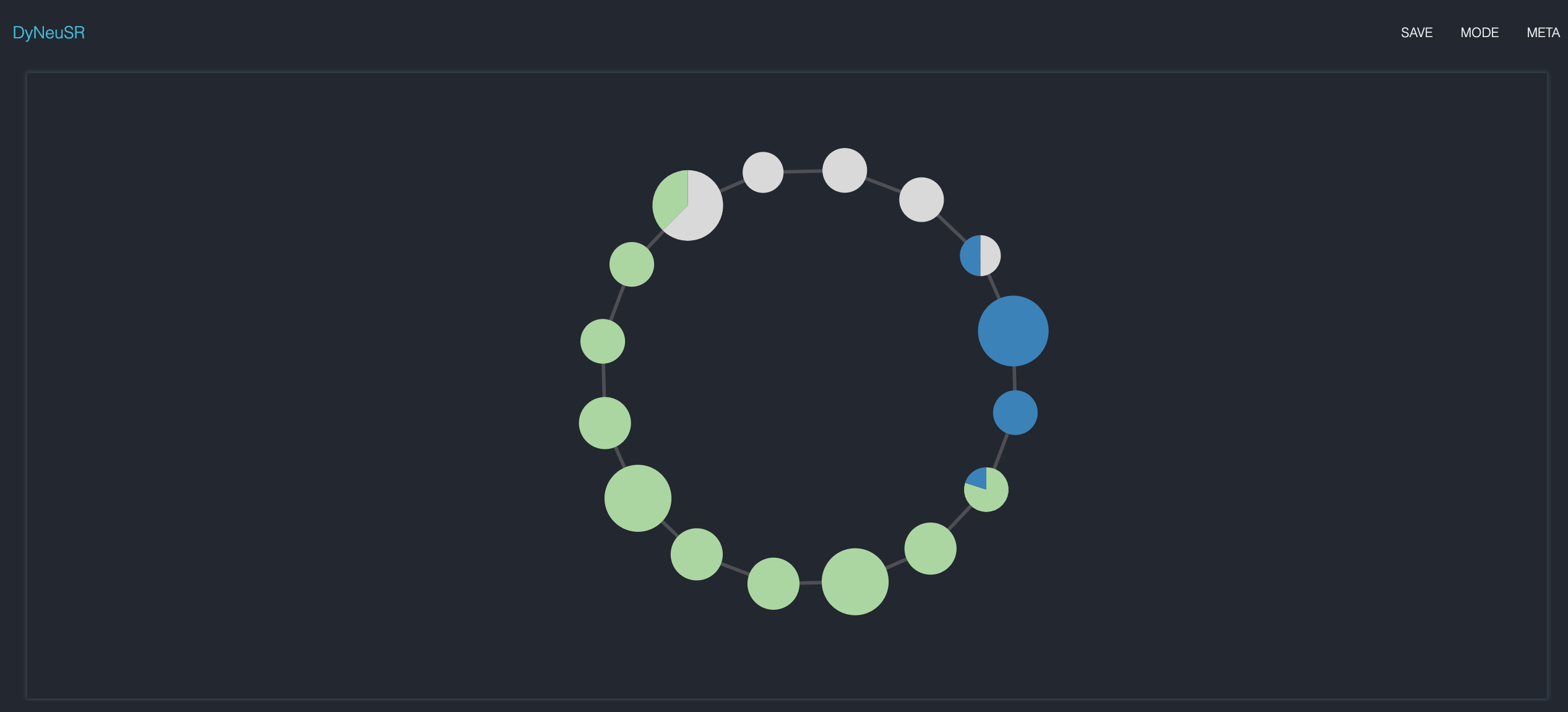
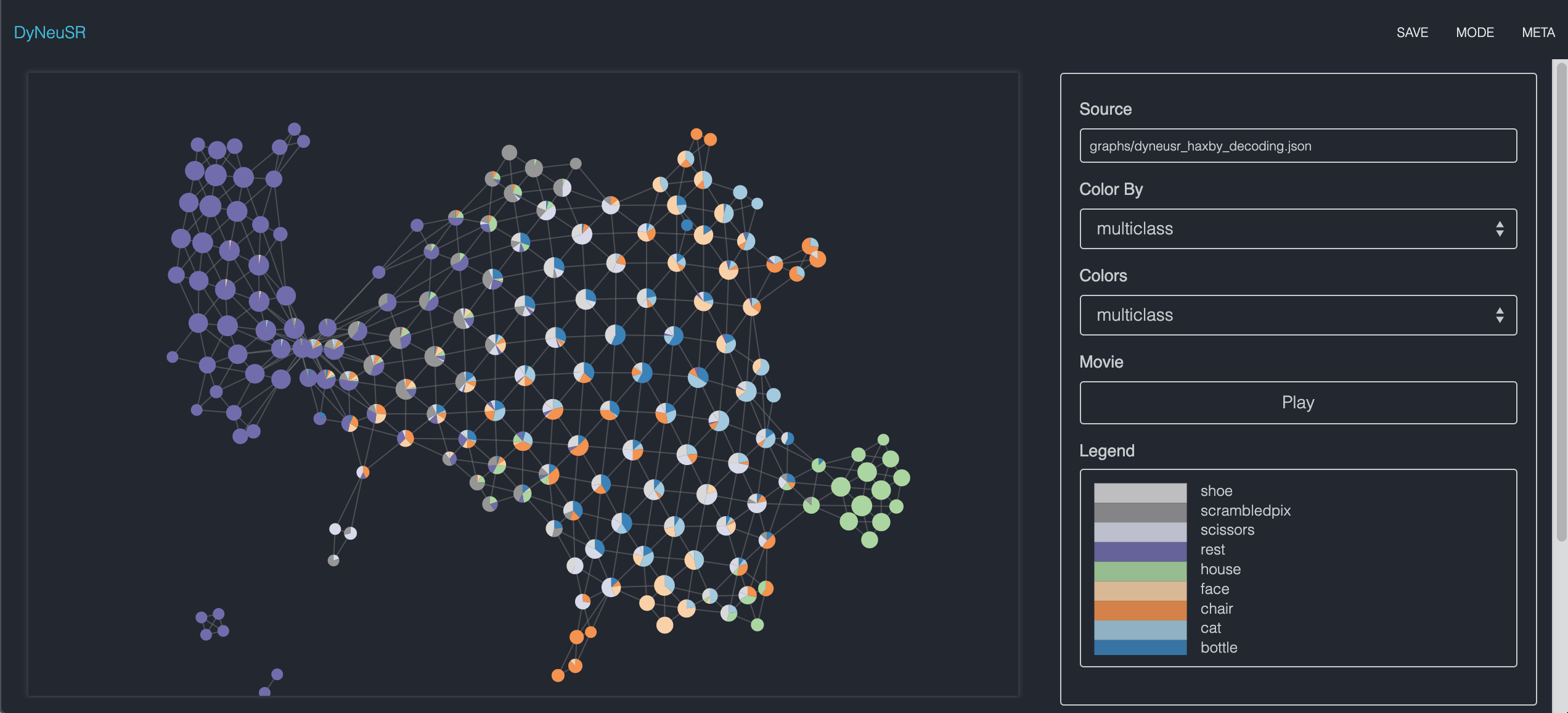
DyNeuSR also provides an interactive web interface for visualizing and exploring shape graphs. To see this visual interface in action, check out the demos.
Demos
- Trefoil knot (code)
- Trefoil knot (custom layouts) (code)
- Haxby fMRI data (t-SNE lens) (code)
- Haxby fMRI data (UMAP lens) (code)
- Haxby fMRI data (supervised UMAP lens) (code)
Related Projects
- DyNeuSR Fire is a new project that provides a command line interface for DyNeuSR. It wraps
kmapperanddyneusrinto a single pipeline, and uses the Python Fire library to automatically generate a simple command line interface that accepts several important options and allows users to customize this pipeline. For more information about DyNeuSR Fire, check out the docs.
References
If you find DyNeuSR useful, please consider citing:
Geniesse, C., Sporns, O., Petri, G., & Saggar, M. (2019). Generating dynamical neuroimaging spatiotemporal representations (DyNeuSR) using topological data analysis. Network Neuroscience. Advance publication. doi:10.1162/netna00093
For more information about the Mapper approach, please see:
Saggar, M., Sporns, O., Gonzalez-Castillo, J., Bandettini, P.A., Carlsson, G., Glover, G., & Reiss, A.L. (2018). Towards a new approach to reveal dynamical organization of the brain using topological data analysis. Nature Communications, 9(1). doi:10.1038/s41467-018-03664-4
API Usage & Examples
DyNeuSR provides a Python API for working with and visualizing shape graphs generated by Mapper. This repository includes several examples that introduce DyNeuSR's API and highlight different aspects of analysis with DyNeuSR. For more detailed tutorials, check out dyneusr-notebooks.
Shape Graph Visualization (trefoil knot)
```python
from dyneusr import DyNeuGraph from dyneusr.datasets import maketrefoil from dyneusr.tools import visualizemapper_stages from kmapper import KeplerMapper
Generate synthetic dataset
dataset = make_trefoil(size=100) X = dataset.data y = dataset.target
Generate shape graph using KeplerMapper
mapper = KeplerMapper(verbose=1) lens = mapper.fittransform(X, projection=[0]) graph = mapper.map(lens, X, nrcubes=6, overlap_perc=0.2)
Visualize the shape graph using DyNeuSR's DyNeuGraph
dG = DyNeuGraph(G=graph, y=y) dG.visualize('dyneusr_output.html')
```
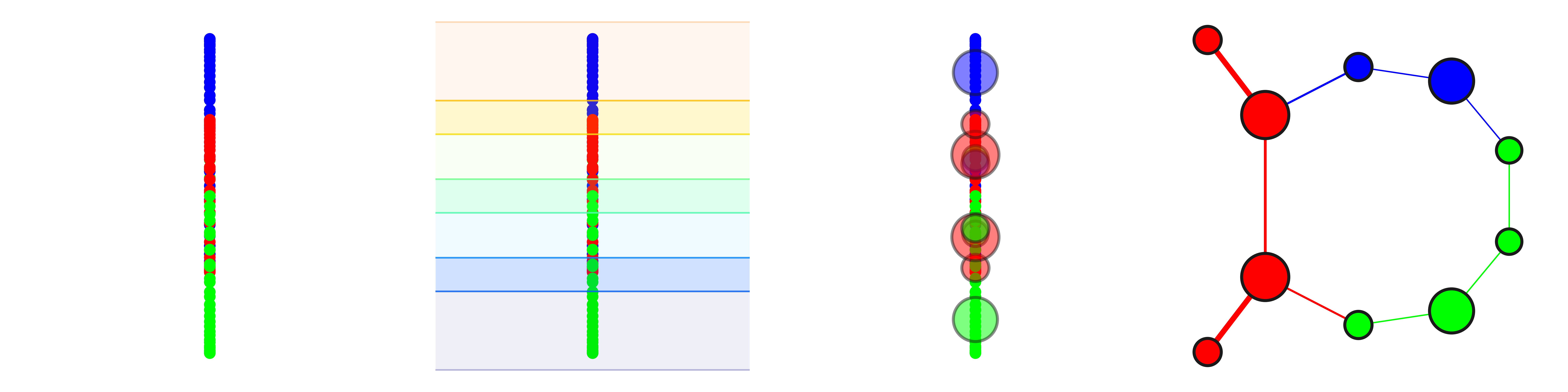
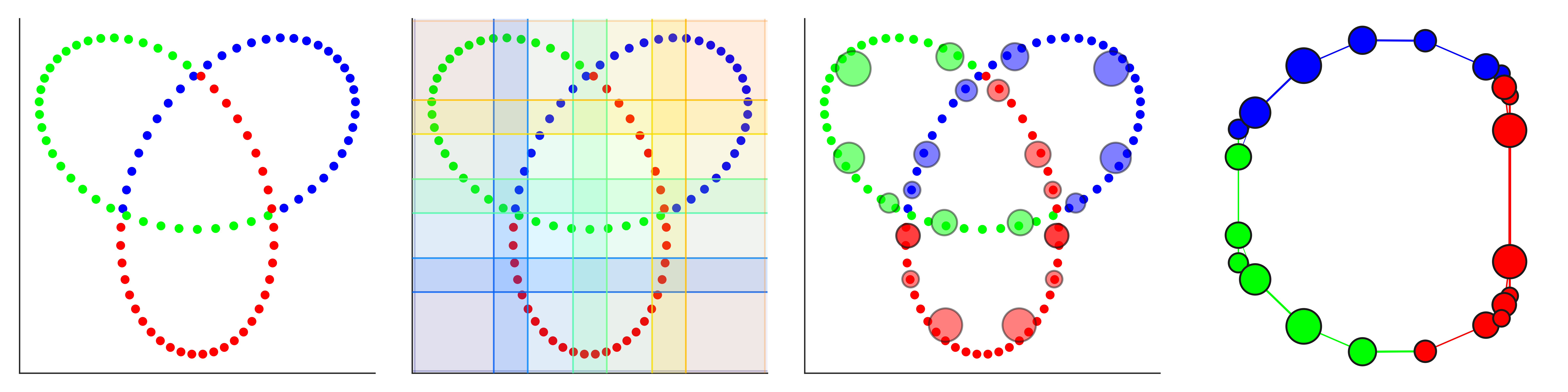
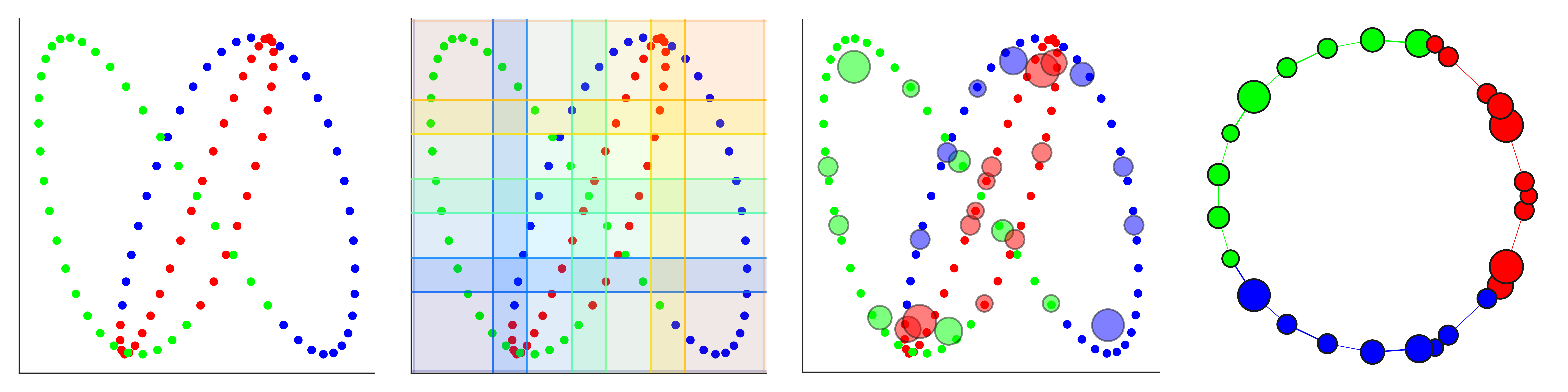
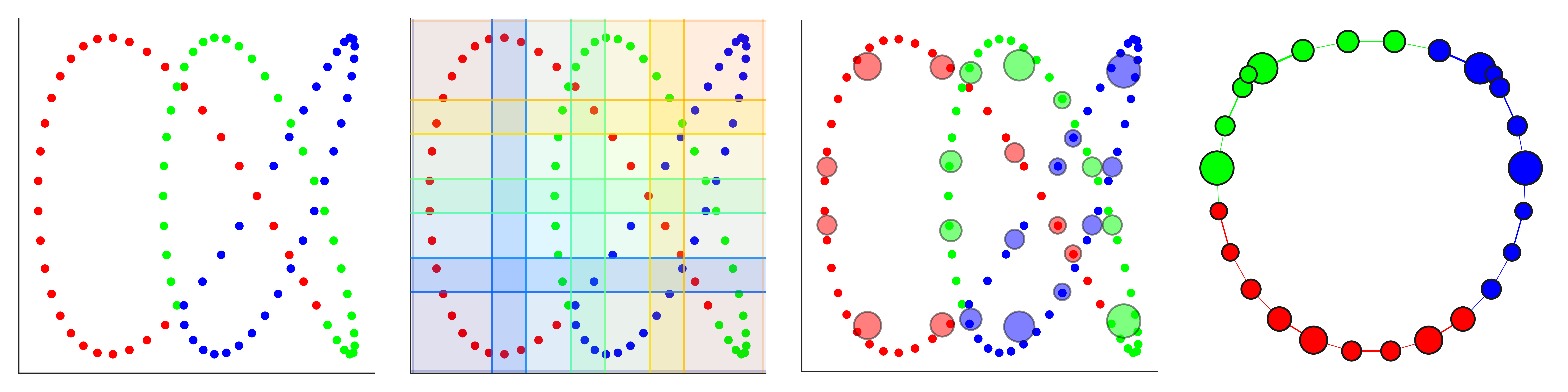
Mapper Parameter Comparison (trefoil knot)
```python
Define projections to compare
projections = ([0], [0,1], [1,2], [0, 2])
Compare different sets of columns as lenses
for projection in projections:
# Generate shape graph using KeplerMapper
mapper = KeplerMapper(verbose=1)
lens = mapper.fit_transform(X, projection=projection)
graph = mapper.map(lens, X, nr_cubes=4, overlap_perc=0.3)

# Visualize the stages of Mapper
fig, axes = visualize_mapper_stages(
    dataset, lens=lens, graph=graph, cover=mapper.cover,
    layout="spectral")
```
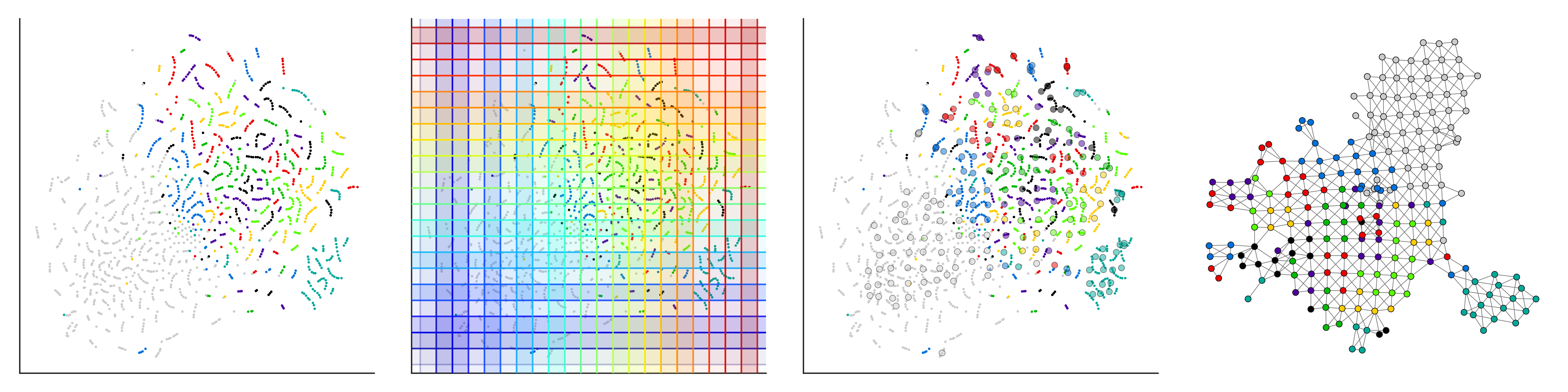
Neuroimaging Applications (haxby decoding)
```python
import numpy as np import pandas as pd
from nilearn.datasets import fetchhaxby from nilearn.inputdata import NiftiMasker
from kmapper import KeplerMapper, Cover from sklearn.manifold import TSNE from sklearn.cluster import DBSCAN
Fetch dataset, extract time-series from ventral temporal (VT) mask
dataset = fetchhaxby() masker = NiftiMasker( dataset.maskvt[0], standardize=True, detrend=True, smoothingfwhm=4.0, lowpass=0.09, highpass=0.008, tr=2.5, memory="nilearncache") X = masker.fittransform(dataset.func[0])
Encode labels as integers
df = pd.readcsv(dataset.sessiontarget[0], sep=" ") target, labels = pd.factorize(df.labels.values) y = pd.DataFrame({l:(target==i).astype(int) for i,l in enumerate(labels)})
Generate shape graph using KeplerMapper
mapper = KeplerMapper(verbose=1) lens = mapper.fit_transform(X, projection=TSNE(2)) graph = mapper.map(lens, X, cover=Cover(20, 0.5), clusterer=DBSCAN(eps=20.))
Visualize the shape graph using DyNeuSR's DyNeuGraph
dG = DyNeuGraph(G=graph, y=y) dG.visualize('dyneusr_output.html')
```
Setup
Dependencies
Python 3.6
Required Python Packages
For a full list of packages and required versions, see requirements.txt and requirements-versions.txt.
Install with PIP
To install with pip:
bash
pip install dyneusr
To install from source: ```bash git clone https://github.com/braindynamicslab/dyneusr.git cd dyneusr
pip install -r requirements.txt pip install -e .
pytest ```
Install with Conda
If your default environment is Python 2, we recommend that you install dyneusr in a separate Python 3 environment. You can find more information about creating a separate environment for Python 3 here.
If you don't have conda, or if you are new to scientific python, we recommend that you download the Anaconda scientific python distribution.
To create a new conda environment and install from source: ```bash conda create -n dyneusr python=3.6 conda activate dyneusr
git clone https://github.com/braindynamicslab/dyneusr.git cd dyneusr
conda install --file requirements-conda.txt pip install -e .
pytest ```
This creates a new conda environment dyneusr and installs in it the dependencies that are needed. To access it, use the conda activate dyneusr command (if your conda version >= 4.4) and use source activate dyneusr command (if your conda version < 4.4).
Run in a Singularity Container
To run dyneusr in a Singularity container, for use on clusters where you do not have root access for example, first install singularity. Then, you can use the following command:
singularity run shub://braindynamicslab/dyneusr
source activate neuro
This will download and run a singularity container from singularity-hub running centos 7 with dyneusr, jupyter, and all dependencies. It will also activate the conda environement neuro where these are installed. For more information on how to use singularity, see the documentation. The singularity recipe for this file was built with neurodocker
Support
Please feel free to report any issues, request new features, or propose improvements. You can also contact Caleb Geniesse at geniesse [at] stanford [dot] edu.
If you contribute to DyNeuSR, please feel free to add your name to the list of contributors.
Citation
Geniesse, C., Sporns, O., Petri, G., & Saggar, M. (2019). Generating dynamical neuroimaging spatiotemporal representations (DyNeuSR) using topological data analysis. Network Neuroscience. Advance publication. doi:10.1162/netna00093
Owner
- Name: brain dynamics lab @ stanford
- Login: braindynamicslab
- Kind: organization
- Location: Stanford, CA
- Website: http://braindynamicslab.github.io
- Repositories: 4
- Profile: https://github.com/braindynamicslab
GitHub Events
Total
- Issues event: 1
- Watch event: 2
Last Year
- Issues event: 1
- Watch event: 2
Committers
Last synced: over 3 years ago
All Time
- Total Commits: 447
- Total Committers: 8
- Avg Commits per committer: 55.875
- Development Distribution Score (DDS): 0.148
Top Committers
| Name | Commits | |
|---|---|---|
| calebgeniesse | c****e@g****m | 381 |
| Caleb Geniesse | g****e@s****u | 56 |
| Rafi Ayub | r****b@s****u | 2 |
| Daniel Hasegan | d****n@g****m | 2 |
| Jeff Mentch | j****f@J****l | 2 |
| Joseph Dehoney | j****y@g****m | 2 |
| Jeff Mentch | j****h@g****m | 1 |
| dependabot[bot] | 4****]@u****m | 1 |
Committer Domains (Top 20 + Academic)
Issues and Pull Requests
Last synced: 12 months ago
All Time
- Total issues: 12
- Total pull requests: 16
- Average time to close issues: about 22 hours
- Average time to close pull requests: 15 days
- Total issue authors: 11
- Total pull request authors: 6
- Average comments per issue: 3.42
- Average comments per pull request: 1.81
- Merged pull requests: 14
- Bot issues: 0
- Bot pull requests: 2
Past Year
- Issues: 1
- Pull requests: 0
- Average time to close issues: N/A
- Average time to close pull requests: N/A
- Issue authors: 1
- Pull request authors: 0
- Average comments per issue: 0.0
- Average comments per pull request: 0
- Merged pull requests: 0
- Bot issues: 0
- Bot pull requests: 0
Top Authors
Issue Authors
- calebgeniesse (2)
- sciencecasey (1)
- RuixueLiu (1)
- ErnestJohnston (1)
- huy29433 (1)
- jsmentch (1)
- atoda0414 (1)
- dhasegan (1)
- BeritSinger (1)
- tamjidimtiaz (1)
- max-hill (1)
Pull Request Authors
- calebgeniesse (9)
- dependabot[bot] (2)
- dhasegan (2)
- jsmentch (1)
- jodahoney (1)
- kristiandroste (1)
Top Labels
Issue Labels
Pull Request Labels
Packages
- Total packages: 1
-
Total downloads:
- pypi 47 last-month
- Total dependent packages: 0
- Total dependent repositories: 3
- Total versions: 12
- Total maintainers: 1
pypi.org: dyneusr
Dynamical Neural Spatiotemporal Representations.
- Homepage: https://braindynamicslab.github.io/dyneusr
- Documentation: https://dyneusr.readthedocs.io/
- License: BSD-3
-
Latest release: 0.3.11
published almost 4 years ago