Science Score: 54.0%
This score indicates how likely this project is to be science-related based on various indicators:
-
✓CITATION.cff file
Found CITATION.cff file -
✓codemeta.json file
Found codemeta.json file -
✓.zenodo.json file
Found .zenodo.json file -
○DOI references
-
✓Academic publication links
Links to: arxiv.org -
○Academic email domains
-
○Institutional organization owner
-
○JOSS paper metadata
-
○Scientific vocabulary similarity
Low similarity (8.8%) to scientific vocabulary
Repository
Basic Info
- Host: GitHub
- Owner: ceilingFan456
- License: other
- Language: C++
- Default Branch: main
- Size: 19.2 MB
Statistics
- Stars: 0
- Watchers: 1
- Forks: 0
- Open Issues: 0
- Releases: 0
Metadata Files
README.md
Tiny CUDA Neural Networks 
This is a small, self-contained framework for training and querying neural networks. Most notably, it contains a lightning fast "fully fused" multi-layer perceptron (technical paper), a versatile multiresolution hash encoding (technical paper), as well as support for various other input encodings, losses, and optimizers.
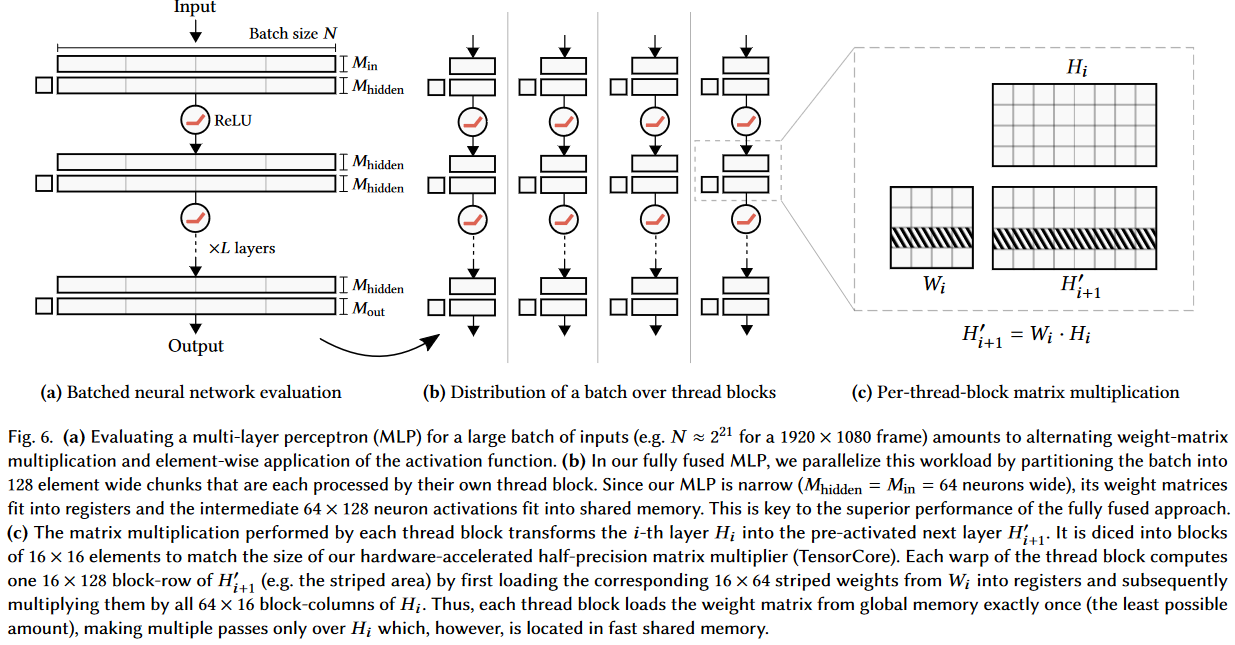
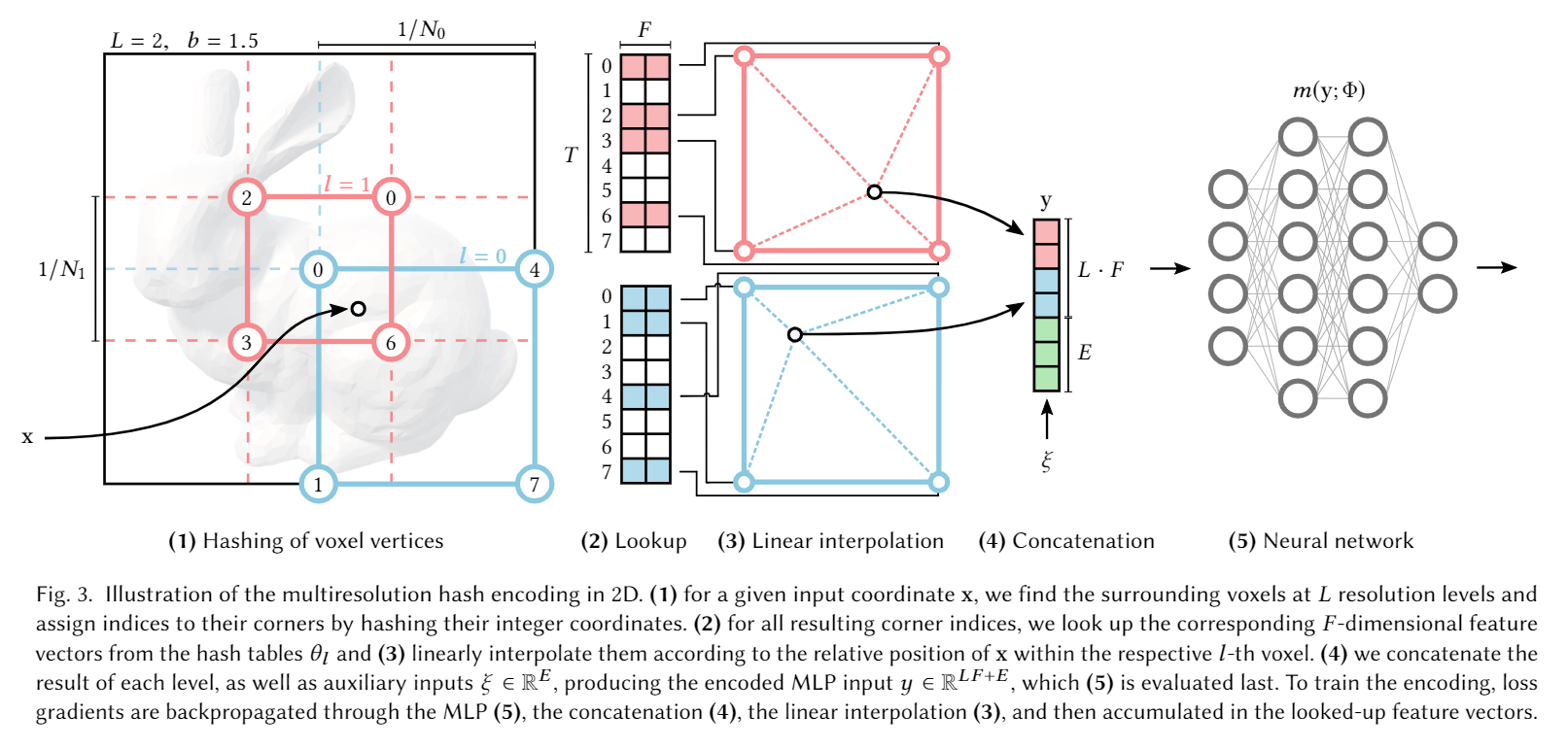
Performance
 Fully fused networks vs. TensorFlow v2.5.0 w/ XLA. Measured on 64 (solid line) and 128 (dashed line) neurons wide multi-layer perceptrons on an RTX 3090. Generated by `benchmarks/benchours.cu
andbenchmarks/benchtensorflow.pyusingdata/configoneblob.json`._
Usage
Tiny CUDA neural networks have a simple C++/CUDA API:
```cpp
include
// Configure the model nlohmann::json config = { {"loss", { {"otype", "L2"} }}, {"optimizer", { {"otype", "Adam"}, {"learningrate", 1e-3}, }}, {"encoding", { {"otype", "HashGrid"}, {"nlevels", 16}, {"nfeaturesperlevel", 2}, {"log2hashmapsize", 19}, {"baseresolution", 16}, {"perlevelscale", 2.0}, }}, {"network", { {"otype", "FullyFusedMLP"}, {"activation", "ReLU"}, {"outputactivation", "None"}, {"nneurons", 64}, {"nhiddenlayers", 2}, }}, };
using namespace tcnn;
auto model = createfromconfig(ninputdims, noutputdims, config);
// Train the model (batchsize must be a multiple of tcnn::BATCHSIZEGRANULARITY)
GPUMatrix
for (int i = 0; i < ntrainingsteps; ++i) { generatetrainingbatch(&trainingbatchinputs, &trainingbatchtargets); // <-- your code
float loss;
model.trainer->training_step(training_batch_inputs, training_batch_targets, &loss);
std::cout << "iteration=" << i << " loss=" << loss << std::endl;
}
// Use the model
GPUMatrix
GPUMatrix
Example: learning a 2D image
We provide a sample application where an image function (x,y) -> (R,G,B) is learned. It can be run via
sh
tiny-cuda-nn$ ./build/mlp_learning_an_image data/images/albert.jpg data/config_hash.json
producing an image every couple of training steps. Each 1000 steps should take a bit over 1 second with the default configuration on an RTX 4090.
| 10 steps | 100 steps | 1000 steps | Reference image |
|:---:|:---:|:---:|:---:|
|  |
|  |
|  |
|  |
|
Requirements
- An NVIDIA GPU; tensor cores increase performance when available. All shown results come from an RTX 3090.
- A C++14 capable compiler. The following choices are recommended and have been tested:
- Windows: Visual Studio 2019 or 2022
- Linux: GCC/G++ 8 or higher
- A recent version of CUDA. The following choices are recommended and have been tested:
- Windows: CUDA 11.5 or higher
- Linux: CUDA 10.2 or higher
- CMake v3.21 or higher.
- The fully fused MLP component of this framework requires a very large amount of shared memory in its default configuration. It will likely only work on an RTX 3090, an RTX 2080 Ti, or higher-end GPUs. Lower end cards must reduce the
n_neuronsparameter or use theCutlassMLP(better compatibility but slower) instead.
If you are using Linux, install the following packages
sh
sudo apt-get install build-essential git
We also recommend installing CUDA in /usr/local/ and adding the CUDA installation to your PATH.
For example, if you have CUDA 11.4, add the following to your ~/.bashrc
sh
export PATH="/usr/local/cuda-11.4/bin:$PATH"
export LD_LIBRARY_PATH="/usr/local/cuda-11.4/lib64:$LD_LIBRARY_PATH"
Compilation (Windows & Linux)
Begin by cloning this repository and all its submodules using the following command:
sh
$ git clone --recursive https://github.com/nvlabs/tiny-cuda-nn
$ cd tiny-cuda-nn
Then, use CMake to build the project: (on Windows, this must be in a developer command prompt)
sh
tiny-cuda-nn$ cmake . -B build -DCMAKE_BUILD_TYPE=RelWithDebInfo
tiny-cuda-nn$ cmake --build build --config RelWithDebInfo -j
If compilation fails inexplicably or takes longer than an hour, you might be running out of memory. Try running the above command without -j in that case.
PyTorch extension
tiny-cuda-nn comes with a PyTorch extension that allows using the fast MLPs and input encodings from within a Python context. These bindings can be significantly faster than full Python implementations; in particular for the multiresolution hash encoding.
The overheads of Python/PyTorch can nonetheless be extensive if the batch size is small. For example, with a batch size of 64k, the bundled
mlp_learning_an_imageexample is ~2x slower through PyTorch than native CUDA. With a batch size of 256k and higher (default), the performance is much closer.
Begin by setting up a Python 3.X environment with a recent, CUDA-enabled version of PyTorch. Then, invoke
sh
pip install git+https://github.com/NVlabs/tiny-cuda-nn/#subdirectory=bindings/torch
Alternatively, if you would like to install from a local clone of tiny-cuda-nn, invoke
sh
tiny-cuda-nn$ cd bindings/torch
tiny-cuda-nn/bindings/torch$ python setup.py install
Upon success, you can use tiny-cuda-nn models as in the following example: ```py import commentjson as json import tinycudann as tcnn import torch
with open("data/config_hash.json") as f: config = json.load(f)
Option 1: efficient Encoding+Network combo.
model = tcnn.NetworkWithInputEncoding( ninputdims, noutputdims, config["encoding"], config["network"] )
Option 2: separate modules. Slower but more flexible.
encoding = tcnn.Encoding(ninputdims, config["encoding"]) network = tcnn.Network(encoding.noutputdims, noutputdims, config["network"]) model = torch.nn.Sequential(encoding, network) ```
See samples/mlp_learning_an_image_pytorch.py for an example.
Components
Following is a summary of the components of this framework. The JSON documentation lists configuration options.
| Networks | |
| :--- | :---------- | :-----
| Fully fused MLP | src/fully_fused_mlp.cu | Lightning fast implementation of small multi-layer perceptrons (MLPs).
| CUTLASS MLP | src/cutlass_mlp.cu | MLP based on CUTLASS' GEMM routines. Slower than fully-fused, but handles larger networks and still is reasonably fast.
| Input encodings | |
| :--- | :---------- | :-----
| Composite | include/tiny-cuda-nn/encodings/composite.h | Allows composing multiple encodings. Can be, for example, used to assemble the Neural Radiance Caching encoding [Müller et al. 2021].
| Frequency | include/tiny-cuda-nn/encodings/frequency.h | NeRF's [Mildenhall et al. 2020] positional encoding applied equally to all dimensions.
| Grid | include/tiny-cuda-nn/encodings/grid.h | Encoding based on trainable multiresolution grids. Used for Instant Neural Graphics Primitives [Müller et al. 2022]. The grids can be backed by hashtables, dense storage, or tiled storage.
| Identity | include/tiny-cuda-nn/encodings/identity.h | Leaves values untouched.
| Oneblob | include/tiny-cuda-nn/encodings/oneblob.h | From Neural Importance Sampling [Müller et al. 2019] and Neural Control Variates [Müller et al. 2020].
| SphericalHarmonics | include/tiny-cuda-nn/encodings/spherical_harmonics.h | A frequency-space encoding that is more suitable to direction vectors than component-wise ones.
| TriangleWave | include/tiny-cuda-nn/encodings/triangle_wave.h | Low-cost alternative to the NeRF's encoding. Used in Neural Radiance Caching [Müller et al. 2021].
| Losses | |
| :--- | :---------- | :-----
| L1 | include/tiny-cuda-nn/losses/l1.h | Standard L1 loss.
| Relative L1 | include/tiny-cuda-nn/losses/l1.h | Relative L1 loss normalized by the network prediction.
| MAPE | include/tiny-cuda-nn/losses/mape.h | Mean absolute percentage error (MAPE). The same as Relative L1, but normalized by the target.
| SMAPE | include/tiny-cuda-nn/losses/smape.h | Symmetric mean absolute percentage error (SMAPE). The same as Relative L1, but normalized by the mean of the prediction and the target.
| L2 | include/tiny-cuda-nn/losses/l2.h | Standard L2 loss.
| Relative L2 | include/tiny-cuda-nn/losses/relative_l2.h | Relative L2 loss normalized by the network prediction [Lehtinen et al. 2018].
| Relative L2 Luminance | include/tiny-cuda-nn/losses/relative_l2_luminance.h | Same as above, but normalized by the luminance of the network prediction. Only applicable when network prediction is RGB. Used in Neural Radiance Caching [Müller et al. 2021].
| Cross Entropy | include/tiny-cuda-nn/losses/cross_entropy.h | Standard cross entropy loss. Only applicable when the network prediction is a PDF.
| Variance | include/tiny-cuda-nn/losses/variance_is.h | Standard variance loss. Only applicable when the network prediction is a PDF.
| Optimizers | |
| :--- | :---------- | :-----
| Adam | include/tiny-cuda-nn/optimizers/adam.h | Implementation of Adam [Kingma and Ba 2014], generalized to AdaBound [Luo et al. 2019].
| Novograd | include/tiny-cuda-nn/optimizers/lookahead.h | Implementation of Novograd [Ginsburg et al. 2019].
| SGD | include/tiny-cuda-nn/optimizers/sgd.h | Standard stochastic gradient descent (SGD).
| Shampoo | include/tiny-cuda-nn/optimizers/shampoo.h | Implementation of the 2nd order Shampoo optimizer [Gupta et al. 2018] with home-grown optimizations as well as those by Anil et al. [2020].
| Average | include/tiny-cuda-nn/optimizers/average.h | Wraps another optimizer and computes a linear average of the weights over the last N iterations. The average is used for inference only (does not feed back into training).
| Batched | include/tiny-cuda-nn/optimizers/batched.h | Wraps another optimizer, invoking the nested optimizer once every N steps on the averaged gradient. Has the same effect as increasing the batch size but requires only a constant amount of memory. |
| Composite | include/tiny-cuda-nn/optimizers/composite.h | Allows using several optimizers on different parameters.
| EMA | include/tiny-cuda-nn/optimizers/average.h | Wraps another optimizer and computes an exponential moving average of the weights. The average is used for inference only (does not feed back into training).
| Exponential Decay | include/tiny-cuda-nn/optimizers/exponential_decay.h | Wraps another optimizer and performs piecewise-constant exponential learning-rate decay.
| Lookahead | include/tiny-cuda-nn/optimizers/lookahead.h | Wraps another optimizer, implementing the lookahead algorithm [Zhang et al. 2019].
License and Citation
This framework is licensed under the BSD 3-clause license. Please see LICENSE.txt for details.
If you use it in your research, we would appreciate a citation via
bibtex
@software{tiny-cuda-nn,
    author = {M\"uller, Thomas},
    license = {BSD-3-Clause},
    month = {4},
    title = {{tiny-cuda-nn}},
    url = {https://github.com/NVlabs/tiny-cuda-nn},
    version = {1.7},
    year = {2021}
}
For business inquiries, please visit our website and submit the form: NVIDIA Research Licensing
Publications & Software
Among others, this framework powers the following publications:
Instant Neural Graphics Primitives with a Multiresolution Hash Encoding
Thomas Müller, Alex Evans, Christoph Schied, Alexander Keller
ACM Transactions on Graphics (SIGGRAPH), July 2022
Website / Paper / Code / Video / BibTeXExtracting Triangular 3D Models, Materials, and Lighting From Images
Jacob Munkberg, Jon Hasselgren, Tianchang Shen, Jun Gao, Wenzheng Chen, Alex Evans, Thomas Müller, Sanja Fidler
CVPR (Oral), June 2022
Website / Paper / Video / BibTeXReal-time Neural Radiance Caching for Path Tracing
Thomas Müller, Fabrice Rousselle, Jan Novák, Alexander Keller
ACM Transactions on Graphics (SIGGRAPH), August 2021
Paper / GTC talk / Video / Interactive results viewer / BibTeX
As well as the following software:
NerfAcc: A General NeRF Accleration Toolbox
Ruilong Li, Matthew Tancik, Angjoo Kanazawa
https://github.com/KAIR-BAIR/nerfaccNerfstudio: A Framework for Neural Radiance Field Development
Matthew Tancik*, Ethan Weber*, Evonne Ng*, Ruilong Li, Brent Yi, Terrance Wang, Alexander Kristoffersen, Jake Austin, Kamyar Salahi, Abhik Ahuja, David McAllister, Angjoo Kanazawa
https://github.com/nerfstudio-project/nerfstudio
Please feel free to make a pull request if your publication or software is not listed.
Acknowledgments
Special thanks go to the NRC authors for helpful discussions and to Nikolaus Binder for providing part of the infrastructure of this framework, as well as for help with utilizing TensorCores from within CUDA.
Owner
- Name: Huang Qiming
- Login: ceilingFan456
- Kind: user
- Repositories: 1
- Profile: https://github.com/ceilingFan456
Citation (CITATION.cff)
cff-version: 1.2.0
title: tiny-cuda-nn
message: >-
  If you use this software, please cite it using the
  metadata from this file.
type: software
authors:
  - given-names: Thomas
    email: thomas94@gmx.net
    family-names: Müller
    affiliation: NVIDIA
repository-code: 'https://github.com/NVlabs/tiny-cuda-nn'
abstract: >-
  This is a small, self-contained framework for training and querying neural
  networks. Most notably, it contains a lightning fast "fully fused" multi-
  layer perceptron (technical paper), a versatile multiresolution hash encoding
  (technical paper), as well as support for various other input encodings,
  losses, and optimizers.
keywords:
  - 'neural network, tiny, tensor cores, cuda'
license: BSD-3-Clause
license-url: https://github.com/NVlabs/tiny-cuda-nn/blob/master/LICENSE.txt
version: 1.7
date-released: '2021-04-21'
GitHub Events
Total
Last Year
Dependencies
- actions/checkout v3 composite