https://github.com/agopal42/atari-representation-learning
Code for "Unsupervised State Representation Learning in Atari"
Science Score: 10.0%
This score indicates how likely this project is to be science-related based on various indicators:
-
○CITATION.cff file
-
○codemeta.json file
-
○.zenodo.json file
-
○DOI references
-
✓Academic publication links
Links to: arxiv.org -
○Academic email domains
-
○Institutional organization owner
-
○JOSS paper metadata
-
○Scientific vocabulary similarity
Low similarity (10.8%) to scientific vocabulary
Last synced: 9 months ago
·
JSON representation
Repository
Code for "Unsupervised State Representation Learning in Atari"
Basic Info
- Host: GitHub
- Owner: agopal42
- License: mit
- Default Branch: master
- Homepage: https://arxiv.org/abs/1906.08226
- Size: 2.39 MB
Statistics
- Stars: 0
- Watchers: 0
- Forks: 0
- Open Issues: 0
- Releases: 0
Fork of mila-iqia/atari-representation-learning
Created over 6 years ago
· Last pushed over 6 years ago
https://github.com/agopal42/atari-representation-learning/blob/master/
# Unsupervised State Representation Learning in Atari Ankesh Anand*, Evan Racah*, Sherjil Ozair*, Yoshua Bengio, Marc-Alexandre Ct, R Devon Hjelm This repo provides code for the benchmark and techniques introduced in the paper [Unsupervised State Representation Learning in Atari](https://arxiv.org/abs/1906.08226) * [ Install ](#install) -- Install relevant dependencies and the project * [ Usage ](#usage) -- Learn how to use AtariARI and train representations with Spatio-Temporal DeepInfomax (ST-DIM) ## Install ### AtariARI Wrapper You can do a minimal install to get just the AtariARI (Atari Annotated RAM Interface) wrapper by doing: ```bash git clone https://github.com/mila-iqia/atari-representation-learning.git cd atari-representation-learning python setup.py install ``` This just requires `gym[atari]` and it gives you the ability to play around with the AtariARI wrapper. If you want to use the code for training representation learning methods and probing them, you will need a full installation: ### Full installation (AtariARI Wrapper + Training & Probing Code) ```bash # PyTorch and scikit learn conda install pytorch torchvision -c pytorch conda install scikit-learn # Baselines for Atari preprocessing # Tensorflow is a dependency, but you don't need to install the GPU version conda install tensorflow pip install git+git://github.com/openai/baselines # pytorch-a2c-ppo-acktr for RL utils pip install git+git://github.com/ankeshanand/pytorch-a2c-ppo-acktr-gail # Clone and install our package pip install -r requirements.txt git clone https://github.com/mila-iqia/atari-representation-learning.git cd atari-representation-learning python setup.py install ``` ## Usage ### Atari Annotated RAM Interface (AtariARI):AtariARI exposes the ground truth labels for different state variables for each observation. We have made AtariARI available as a Gym wrapper, to use it simply wrap an Atari gym env with `AtariARIWrapper`. ```python import gym from atariari.wrapper import AtariARIWrapper env = AtariARIWrapper(gym.make('MsPacmanNoFrameskip-v4')) obs = env.reset() obs, reward, done, info = env.step(1) ``` Now, `info` is a dictionary of the form: ```python {'ale.lives': 3, 'labels': {'enemy_sue_x': 88, 'enemy_inky_x': 88, 'enemy_pinky_x': 88, 'enemy_blinky_x': 88, 'enemy_sue_y': 80, 'enemy_inky_y': 80, 'enemy_pinky_y': 80, 'enemy_blinky_y': 50, 'player_x': 88, 'player_y': 98, 'fruit_x': 0, 'fruit_y': 0, 'ghosts_count': 3, 'player_direction': 3, 'dots_eaten_count': 0, 'player_score': 0, 'num_lives': 2}} ``` **Note:** In our experiments, we use additional preprocessing for Atari environments mainly following Minh et. al, 2014. See [atariari/benchmark/envs.py](atariari/envs.py) for more info! If you want the raw RAM annotations (which parts of ram correspond to each state variable), check out [atariari/benchmark/ram_annotations.py](atariari/ram_annotations.py) ### Probing ---- **Important** : The RAM labels are meant for full-sized Atari observations (210 * 160). Probing results won't be accurate if you downsample the observations. We provide an interface for the included probing tasks. First, get episodes for train, val and, test: ```python from atariari.episodes import get_episodes tr_episodes, val_episodes,\ tr_labels, val_labels,\ test_episodes, test_labels = get_episodes(env_name="PitfallNoFrameskip-v4", steps=50000, collect_mode="random_agent") ``` Then probe them using ProbeTrainer and your encoder (`my_encoder`): ```python from atariari.probe import ProbeTrainer probe_trainer = ProbeTrainer(my_encoder, representation_len=my_encoder.feature_size) probe_trainer.train(tr_episodes, val_episodes, tr_labels, val_labels,) final_accuracies, final_f1_scores = probe_trainer.test(test_episodes, test_labels) ``` To see how we use ProbeTrainer, check out [scripts/run_probe.py](scripts/run_probe.py) Here is an example of `my_encoder`: ```python # get your encoder import torch.nn as nn import torch class MyEncoder(nn.Module): def __init__(self, input_channels, feature_size): super().__init__() self.feature_size = feature_size self.input_channels = input_channels self.final_conv_size = 64 * 9 * 6 self.cnn = nn.Sequential( nn.Conv2d(input_channels, 32, 8, stride=4), nn.ReLU(), nn.Conv2d(32, 64, 4, stride=2), nn.ReLU(), nn.Conv2d(64, 128, 4, stride=2), nn.ReLU(), nn.Conv2d(128, 64, 3, stride=1), nn.ReLU() ) self.fc = nn.Linear(self.final_conv_size, self.feature_size) def forward(self, inputs): x = self.cnn(inputs) x = x.view(x.size(0), -1) return self.fc(x) my_encoder = MyEncoder(input_channels=1,feature_size=256) # load in weights my_encoder.load_state_dict(torch.load(open("path/to/my/weights.pt", "rb"))) ``` ### Spatio-Temporal DeepInfoMax:
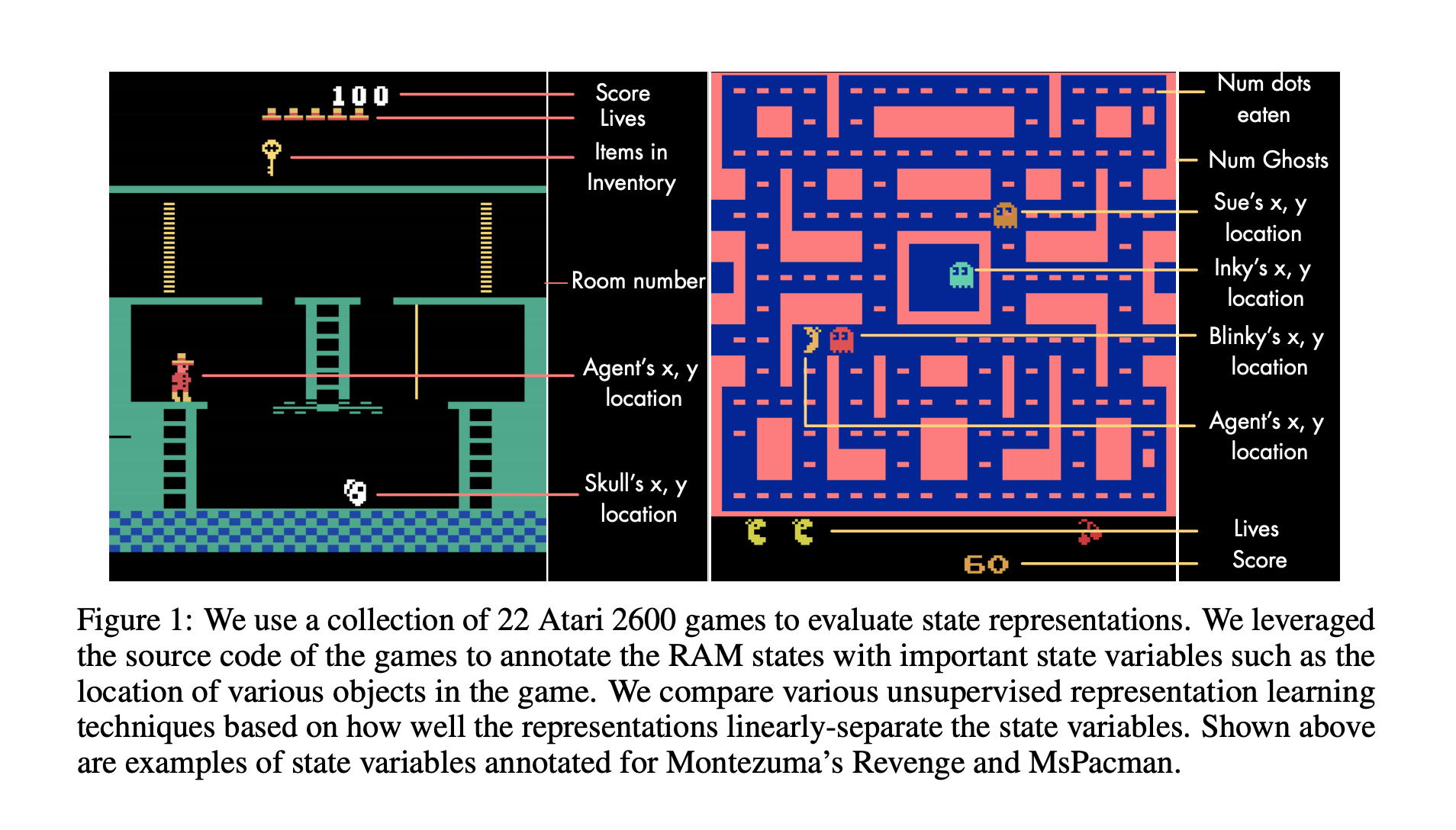
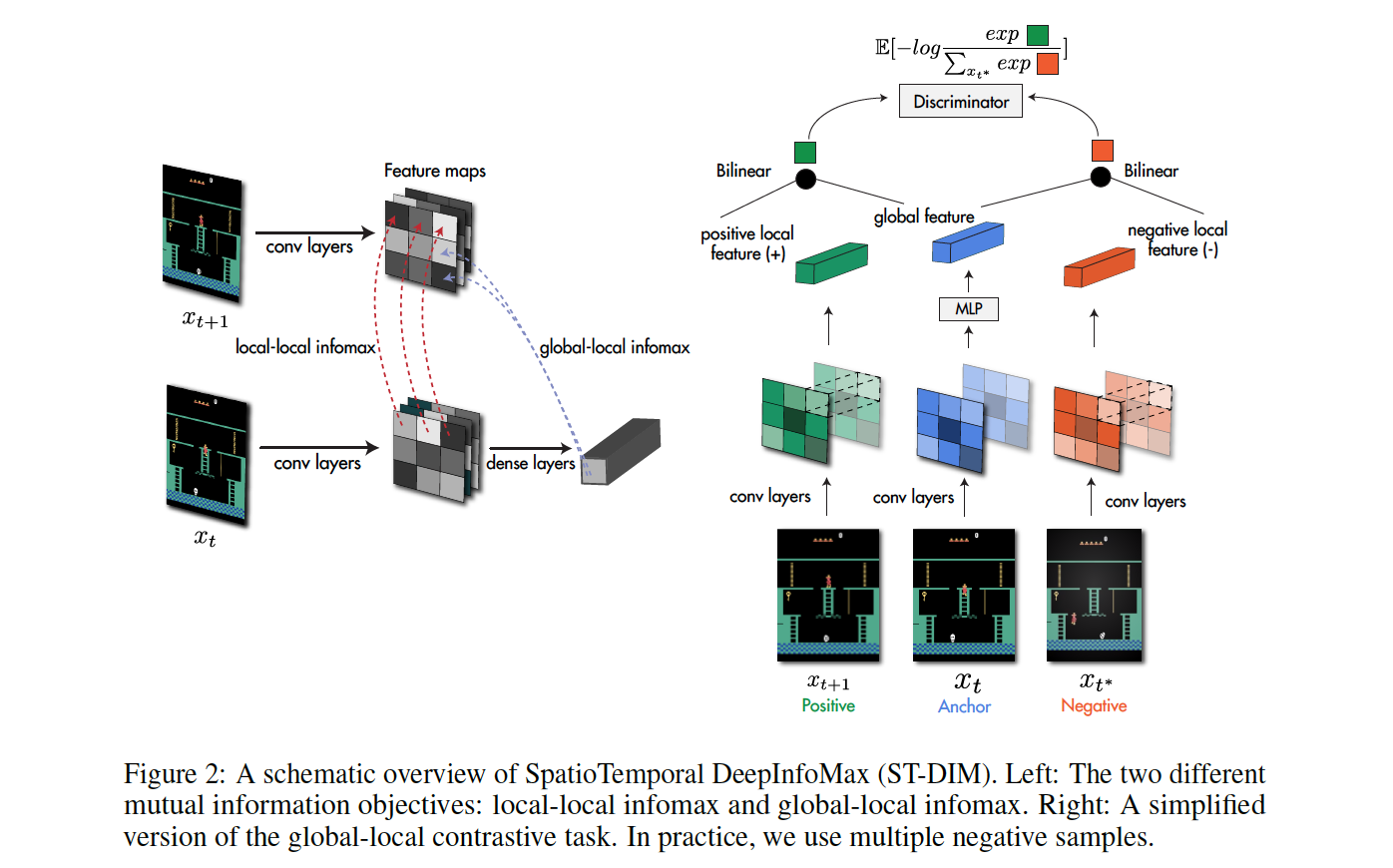
`src/` contains implementations of several representation learning methods, along with `ST-DIM`. Here's a sample usage: ```bash python -m scripts.run_probe --method infonce-stdim --env-name {env_name} ``` ### Citation ``` @article{anand2019unsupervised, title={Unsupervised State Representation Learning in Atari}, author={Anand, Ankesh and Racah, Evan and Ozair, Sherjil and Bengio, Yoshua and C{\^o}t{\'e}, Marc-Alexandre and Hjelm, R Devon}, journal={arXiv preprint arXiv:1906.08226}, year={2019} } ```
Owner
- Name: Anand Gopalakrishnan
- Login: agopal42
- Kind: user
- Company: The Swiss AI Lab (IDSIA)
- Repositories: 3
- Profile: https://github.com/agopal42