https://github.com/ai-forever/kandinskyvideo
KandinskyVideo — multilingual end-to-end text2video latent diffusion model
Science Score: 36.0%
This score indicates how likely this project is to be science-related based on various indicators:
-
○CITATION.cff file
-
✓codemeta.json file
Found codemeta.json file -
✓.zenodo.json file
Found .zenodo.json file -
○DOI references
-
✓Academic publication links
Links to: arxiv.org, scholar.google -
○Committers with academic emails
-
○Institutional organization owner
-
○JOSS paper metadata
-
○Scientific vocabulary similarity
Low similarity (10.1%) to scientific vocabulary
Keywords
Repository
KandinskyVideo — multilingual end-to-end text2video latent diffusion model
Basic Info
Statistics
- Stars: 184
- Watchers: 13
- Forks: 20
- Open Issues: 6
- Releases: 0
Topics
Metadata Files
README.md
Kandinsky Video 1.1 — a new text-to-video generation model
SoTA quality among open-source solutions on EvalCrafter benchmark
This repository is the official implementation of Kandinsky Video 1.1 model.
 | Telegram-bot | Habr post | Our text-to-image model | Project page
Our previous model Kandinsky Video 1.0, divides the video generation process into two stages: initially generating keyframes at a low FPS and then creating interpolated frames between these keyframes to increase the FPS. In Kandinsky Video 1.1, we further break down the keyframe generation into two extra steps: first, generating the initial frame of the video from the textual prompt using Text to Image Kandinsky 3.0, and then generating the subsequent keyframes based on the textual prompt and the previously generated first frame. This approach ensures more consistent content across the frames and significantly enhances the overall video quality. Furthermore, the approach allows animating any input image as an additional feature.
Pipeline

In the Kandinsky Video 1.0, the encoded text prompt enters the text-to-video U-Net3D keyframe generation model with temporal layers or blocks, and then the sampled latent keyframes are sent to the latent interpolation model to predict three interpolation frames between
two keyframes. An image MoVQ-GAN decoder is used to obtain the final video result. In Kandinsky Video 1.1, text-to-video U-Net3D is also conditioned on text-to-image U-Net2D, which helps to improve the content quality. A temporal MoVQ-GAN decoder is used to decode the final video.
Architecture details
- Text encoder (Flan-UL2) - 8.6B
- Latent Diffusion U-Net3D - 4.15B
- The interpolation model (Latent Diffusion U-Net3D) - 4.0B
- Image MoVQ encoder/decoder - 256M
- Video (temporal) MoVQ decoder - 556M
How to use
1. text2video
```python from kandinskyvideo import getT2V_pipeline
devicemap = 'cuda:0' t2vpipe = getT2Vpipeline(device_map)
prompt = "A cat wearing sunglasses and working as a lifeguard at a pool."
fps = 'medium' # ['low', 'medium', 'high'] motion = 'high' # ['low', 'medium', 'high']
video = t2vpipe( prompt, width=512, height=512, fps=fps, motion=motion, keyframeguidancescale=5.0, guidanceweightprompt=5.0, guidanceweightimage=3.0, )
pathtosave = f'./assets/video.gif' video[0].save( pathtosave, saveall=True, appendimages=video[1:], duration=int(5500/len(video)), loop=0 ) ```

Generated video
2. image2video
```python from kandinskyvideo import getT2V_pipeline
devicemap = 'cuda:0' t2vpipe = getT2Vpipeline(device_map)
from PIL import Image import requests from io import BytesIO
url = 'https://media.cnn.com/api/v1/images/stellar/prod/gettyimages-1961294831.jpg' response = requests.get(url) img = Image.open(BytesIO(response.content)) img.show()
prompt = "A panda climbs up a tree."
fps = 'medium' # ['low', 'medium', 'high'] motion = 'medium' # ['low', 'medium', 'high']
video = t2vpipe( prompt, image=img, width=640, height=384, fps=fps, motion=motion, keyframeguidancescale=5.0, guidanceweightprompt=5.0, guidanceweightimage=3.0, )
pathtosave = f'./assets/video2.gif' video[0].save( pathtosave, saveall=True, appendimages=video[1:], duration=int(5500/len(video)), loop=0 ) ```
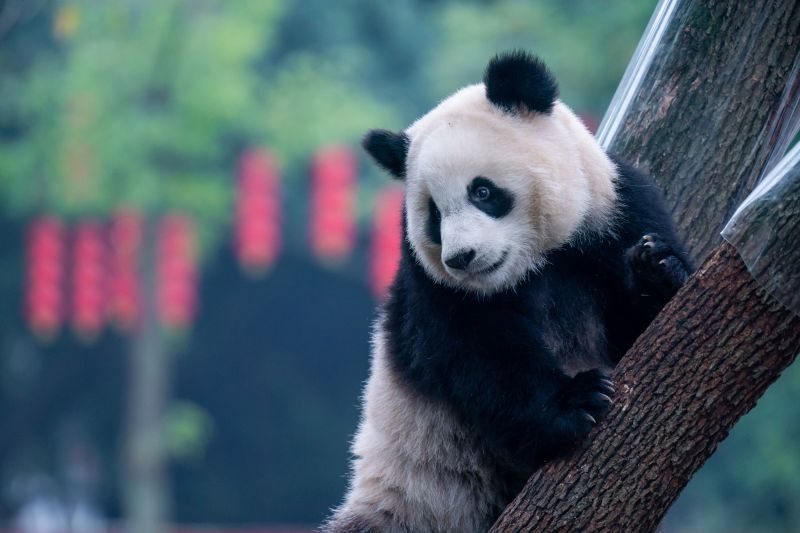
Input image.

Generated Video.
Motion score and Noise Augmentation conditioning

Variations in generations based on different motion scores and noise augmentation levels. The horizontal axis shows noise augmentation levels (NA), while the vertical axis displays motion scores (MS).
Results

Kandinsky Video 1.1 achieves second place overall and best open source model on EvalCrafter text to video benchmark. VQ: visual quality, TVA: text-video alignment, MQ: motion quality, TC: temporal consistency and FAS: final average score.

Polygon-radar chart representing the performance of Kandinsky Video 1.1 on EvalCrafter benchmark.

Human evaluation study results. The bars in the plot correspond to the percentage of “wins” in the side-by-side comparison of model generations. We compare our model with Video LDM.
Authors
- Zein Shaheen: Github, Google Scholar
- Vladimir Arkhipkin: Github, Google Scholar
- Viacheslav Vasilev: Github, Google Scholar
- Igor Pavlov: Github
- Elizaveta Dakhova: Github
- Anastasia Lysenko: Github
- Sergey Markov
- Denis Dimitrov: Github, Google Scholar
- Andrey Kuznetsov: Github, Google Scholar
BibTeX
If you use our work in your research, please cite our publication:
@article{arkhipkin2023fusionframes,
  title     = {FusionFrames: Efficient Architectural Aspects for Text-to-Video Generation Pipeline},
  author    = {Arkhipkin, Vladimir and Shaheen, Zein and Vasilev, Viacheslav and Dakhova, Elizaveta and Kuznetsov, Andrey and Dimitrov, Denis},
  journal   = {arXiv preprint arXiv:2311.13073},
  year      = {2023},
}
Owner
- Name: AI Forever
- Login: ai-forever
- Kind: organization
- Location: Armenia
- Repositories: 60
- Profile: https://github.com/ai-forever
Creating ML for the future. AI projects you already know. We are non-profit organization with members from all over the world.
GitHub Events
Total
- Watch event: 15
- Issue comment event: 1
- Fork event: 4
Last Year
- Watch event: 15
- Issue comment event: 1
- Fork event: 4
Committers
Last synced: about 1 year ago
Top Committers
| Name | Commits | |
|---|---|---|
| vivasilev | s****8@y****u | 14 |
| oriBetelgeuse | a****8@g****m | 8 |
| Andrey Kuznetsov | k****y@g****m | 4 |
| Zein Shaheen | z****e@g****m | 3 |
| Andrei Filatov | 4****h | 3 |
| chenxi | c****e@g****m | 1 |
| Denis | d****v@g****m | 1 |
Committer Domains (Top 20 + Academic)
Issues and Pull Requests
Last synced: 11 months ago
All Time
- Total issues: 7
- Total pull requests: 4
- Average time to close issues: 3 days
- Average time to close pull requests: 2 days
- Total issue authors: 7
- Total pull request authors: 3
- Average comments per issue: 0.29
- Average comments per pull request: 0.0
- Merged pull requests: 4
- Bot issues: 0
- Bot pull requests: 0
Past Year
- Issues: 3
- Pull requests: 1
- Average time to close issues: 3 days
- Average time to close pull requests: 1 minute
- Issue authors: 3
- Pull request authors: 1
- Average comments per issue: 0.0
- Average comments per pull request: 0.0
- Merged pull requests: 1
- Bot issues: 0
- Bot pull requests: 0
Top Authors
Issue Authors
- SoftologyPro (1)
- hcgprague (1)
- Hangsiin (1)
- Jzow (1)
- l-dawei (1)
- eisneim (1)
Pull Request Authors
- oriBetelgeuse (2)
- chenxwh (1)
- zeinsh (1)
Top Labels
Issue Labels
Pull Request Labels
Dependencies
- accelerate *
- albumentations *
- av *
- bezier *
- datasets *
- diffusers *
- einops *
- fsspec *
- hydra-core *
- matplotlib *
- omegaconf *
- pytorch_lightning ==1.7.5
- s3fs *
- scikit-image *
- sentencepiece *
- setuptools ==59.5.0
- timm *
- torch ==1.10.1
- torchaudio ==0.10.1
- torchvision ==0.11.2
- transformers *
- wandb *
- webdataset *