DPFEHM
DPFEHM: a differentiable subsurface physics simulator - Published in JOSS (2023)
Science Score: 95.0%
This score indicates how likely this project is to be science-related based on various indicators:
-
○CITATION.cff file
-
✓codemeta.json file
Found codemeta.json file -
✓.zenodo.json file
Found .zenodo.json file -
✓DOI references
Found 1 DOI reference(s) in JOSS metadata -
✓Academic publication links
Links to: arxiv.org -
✓Committers with academic emails
5 of 9 committers (55.6%) from academic institutions -
○Institutional organization owner
-
✓JOSS paper metadata
Published in Journal of Open Source Software
Keywords
Scientific Fields
Repository
DPFEHM: A Differentiable Subsurface Flow Simulator
Basic Info
Statistics
- Stars: 40
- Watchers: 5
- Forks: 15
- Open Issues: 3
- Releases: 2
Topics
Metadata Files
README.md
DPFEHM: A Differentiable Subsurface Physics Simulator

Description
DPFEHM is a Julia module that includes differentiable numerical models with a focus on the Earth's subsurface, especially fluid flow. Currently it supports the groundwater flow equations (single phase flow), Richards equation (air/water), the advection-dispersion equation, and the 2d wave equation. Since it is differentiable, it can easily be combined with machine learning models in a workflow such as this:

This workflow shows how to train a machine learning model to mitigate problems with injecting fluid into the earth's subsurface (such as induced seismicity or leakage of carbon dioxide). More details on this workflow are available here.
Installation
Within Julia, you can install DPFEHM and test that it works by running
julia
import Pkg
Pkg.add("DPFEHM")
Pkg.test("DPFEHM")
Basic Usage
The examples are a good place to get started to see how to use DPFEHM. Two examples will be described in detail here that illustrate the basic usage patterns via an examples of steady-state single-phase flow and transient Richards equation.
Steady-state single-phase flow
Here, we solve a steady-state single phase flow problem . Let's start by importing several libraries that we will use.
julia
import DPFEHM
import GaussianRandomFields
import Optim
import PyPlot
import Random
import Zygote
Random.seed!(0)#set the seed so we can reproduce the same results with each run
Next, we'll set up the grid. Here, we use a regular grid with 100,000 nodes that covers a domain that is 50 meters by 50 meters by 5 meters.
julia
mins = [0, 0, 0]; maxs = [50, 50, 5]#size of the domain, in meters
ns = [100, 100, 10]#number of nodes on the grid
coords, neighbors, areasoverlengths, _ = DPFEHM.regulargrid3d(mins, maxs, ns)#build the grid
The result of this grid-building is three variables that we will use. The, coords is a matrix describing the coordinates of the cell centers on the grid. The second, neighbors, is an array describing which cells neighbor other cells. The third, areasoverlengths, is another array whose length is equal to the length of neighbors and describes the area of the interface between two neighboring cells dividing by the length between the cell centers. The last variable is dumped to _ and gives the volumes of the cells. The volumes of the cells are not needed for steady state problems, so they are not used in this example.
Now we set up the boundary conditions.
julia
Qs = zeros(size(coords, 2))
injectionnode = 1#inject in the lower left corner
Qs[injectionnode] = 1e-4#m^3/s
dirichletnodes = Int[size(coords, 2)]#fix the pressure in the upper right corner
dirichleths = zeros(size(coords, 2))
dirichleths[size(coords, 2)] = 0.0
The variable Qs describes fluid sources/sinks -- the amount of fluid injected at cell i on the grid is given by Qs[i]. In this example, the only place were we inject fluid is at node 1. Another variable, dirichletnodes is a list of cells at which the pressure will be fixed. In this example, the pressure is fixed at the last cell, which is cell number size(coords, 2). The variable dirichleths describes the pressures (or heads in hydrology jargon) that the cells are fixed at. Note that the length of dirichleths is size(coords, 2), but these values are ignored except at the indices that appear in dirichletnodes.
The final set-up step before moving on to solving the equations is to construct a heterogeneous conductivity field.
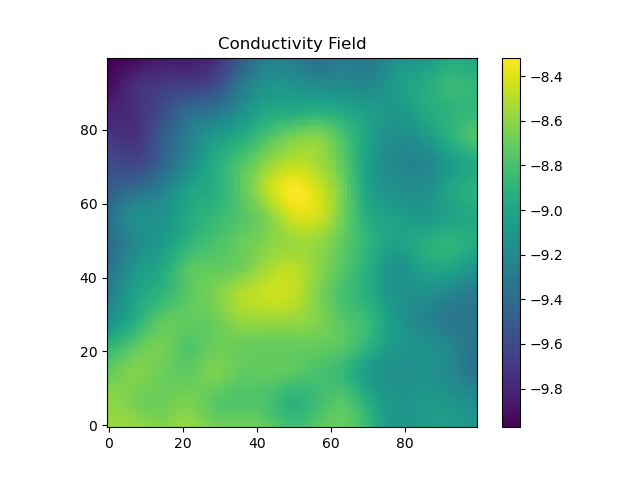
Here, we use the package GaussianRandomFields to construct a conductivity field with a correlation length of 50 meters. The mean of the log-conductivity is 1e-4meters/second (note that we use a natural logarithm when defining this), and the standard deviation of the log-conductivity is 1. GaussianRandomFields is used to construct a field in 2 dimensions and then it is copied through each of the layers, so that the heterogeneity only exists in the x and y coordinate directions, but not in the z direction.
julia
lambda = 50.0#meters -- correlation length of log-conductivity
sigma = 1.0#standard deviation of log-conductivity
mu = -9.0#mean of log conductivity -- ~1e-4 m/s, like clean sand here https://en.wikipedia.org/wiki/Hydraulic_conductivity#/media/File:Groundwater_Freeze_and_Cherry_1979_Table_2-2.png
cov = GaussianRandomFields.CovarianceFunction(2, GaussianRandomFields.Matern(lambda, 1; σ=sigma))
x_pts = range(mins[1], maxs[1]; length=ns[1])
y_pts = range(mins[2], maxs[2]; length=ns[2])
num_eigenvectors = 200
grf = GaussianRandomFields.GaussianRandomField(cov, GaussianRandomFields.KarhunenLoeve(num_eigenvectors), x_pts, y_pts)
logKs = zeros(reverse(ns)...)
logKs2d = mu .+ GaussianRandomFields.sample(grf)'#generate a random realization of the log-conductivity field
for i = 1:ns[3]#copy the 2d field to each of the 3d layers
    v = view(logKs, i, :, :)
    v .= logKs2d
end
The conductivity field is shown:
 <!--
<!--
plot the log-conductivity
fig, ax = PyPlot.subplots() img = ax.imshow(logKs[1, :, :], origin="lower") ax.title.set_text("Conductivity Field") fig.colorbar(img) display(fig) println() PyPlot.close(fig) -->
Now, we look to solve the flow problem. First, we define a helper function, logKs2Ks_neighbors. This function is needed because the flow solver wants to know the conductivity on the interface between two cells, but our previous construction defined the conductivities at the cells themselves. It also converts from log-conductivity to conductivity and uses the geometric mean to move from the cells to the interfaces. The heart of this code is the call to DPFEHM.groundwater_steadystate, which solves the single phase steady-state flow problem that we pose. The solveforh function calls this function and returns the result after reshaping.
julia
logKs2Ks_neighbors(Ks) = exp.(0.5 * (Ks[map(p->p[1], neighbors)] .+ Ks[map(p->p[2], neighbors)]))#convert from permeabilities at the nodes to permeabilities connecting the nodes
function solveforh(logKs, dirichleths)
    @assert length(logKs) == length(Qs)
    Ks_neighbors = logKs2Ks_neighbors(logKs)
    return reshape(DPFEHM.groundwater_steadystate(Ks_neighbors, neighbors, areasoverlengths, dirichletnodes, dirichleths, Qs), reverse(ns)...)
    end
end
With this function in hand, we can solve the problem using the solveforh wrapper function we previously defined. This function requires us to explicitly pass in logKs (the hydraulic conductivity) and dirichleths (the fixed-head boundary condition), but the other inputs to DPFEHM.groundwater_steadystate are fixed to global values.
julia
h = solveforh(logKs, dirichleths)#solve for the head
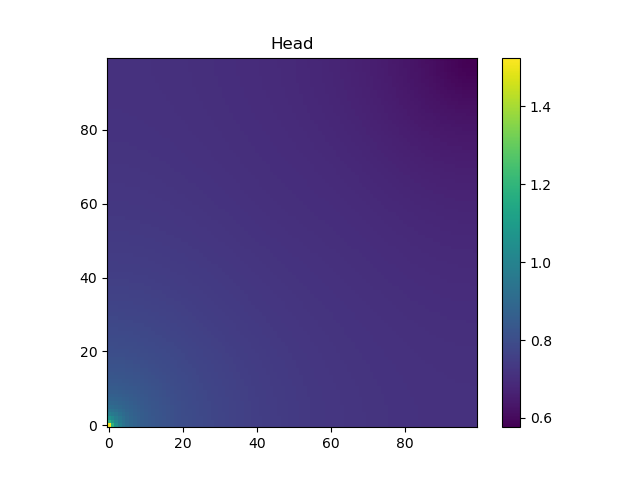
The head at the bottom layer of the domain is shown (note the pressure is higher in the lower corner, where there is fluid injection, than in the rest of the domain):
 <!--
<!--
plot the head at the bottom of the domain
fig, ax = PyPlot.subplots() img = ax.imshow(h[1, :, :], origin="lower") ax.title.set_text("Head") fig.colorbar(img) display(fig) println() PyPlot.close(fig) -->
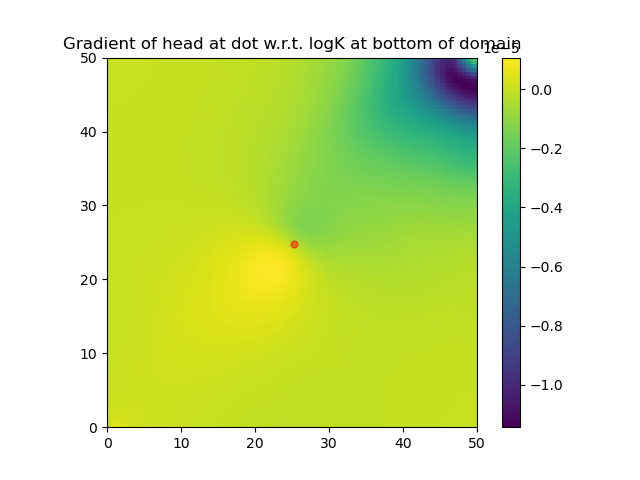
DPFEHM also allows us to compute the gradient of functions involving DPFEHM.groundwater_steadystate using Zygote.gradient or Zygote.pullback.
julia
isfreenode, nodei2freenodei, freenodei2nodei = DPFEHM.getfreenodes(length(dirichleths), dirichletnodes)
gradient_node = nodei2freenodei[div(size(coords, 2), 2) + 500]
gradient_node_x = coords[1, gradient_node]
gradient_node_y = coords[2, gradient_node]
grad = Zygote.gradient((x, y)->solveforh(x, y)[gradient_node], logKs, dirichleths)#calculate the gradient (which involves a redundant calculation of the forward pass)
function_evaluation, back = Zygote.pullback((x, y)->solveforh(x, y)[gradient_node], logKs, dirichleths)#this pullback thing lets us not redo the forward pass
print("gradient time")
grad2 = back(1.0)#compute the gradient of a function involving solveforh using Zygote.pullback
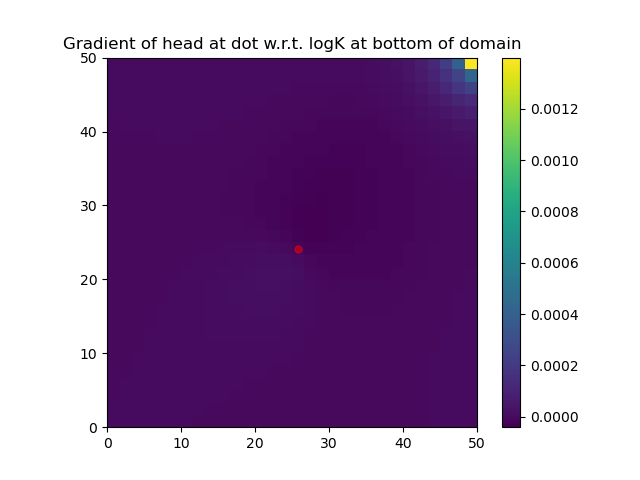
Note that the function DPFEHM.getfreenodes allows one to map indices between the free nodes (i.e., the ones that do not have fixed-pressure boundary conditions) and all nodes. The gradient of logK at the bottom layer of the domain is shown:
 <!--
<!--
plot the gradient of the function w.r.t. the logK at the bottom of the domain
fig, ax = PyPlot.subplots() img = ax.imshow(grad[1][1, :, :], origin="lower", extent=[mins[1], maxs[1], mins[2], maxs[2]]) ax.plot([gradientnodex], [gradientnodey], "r.", ms=10, alpha=0.5) ax.title.set_text("Gradient of head at dot w.r.t. logK at bottom of domain") fig.colorbar(img) display(fig) println() PyPlot.close(fig) -->
Transient Richards flow
Now, we consider an example using DPFEHM's solver for Richards equation, which can be used to model flow in a porous medium where both air and water fill the pores (i.e., unsaturated flow). This example is similar to the previous example and we again start by importing several libraries, setting up the grid (lower resolution this time), the boundary conditions, and the conductivity. ```julia import DifferentiableBackwardEuler import DPFEHM import GaussianRandomFields import PyPlot import Random import Zygote Random.seed!(0)#set the seed so we get the same permeability over and over
set up the grid
mins = [0, 0, 0]; maxs = [50, 50, 5]#size of the domain, in meters ns = [30, 30, 3]#number of nodes on the grid coords, neighbors, areasoverlengths, volumes = DPFEHM.regulargrid3d(mins, maxs, ns)#build the grid
set up the boundary conditions
Qs = zeros(size(coords, 2)) injectionnode = 1#inject in the lower left corner Qs[injectionnode] = 1e-4#m^3/s dirichletnodes = Int[size(coords, 2)]#fix the pressure in the upper right corner dirichleths = zeros(size(coords, 2)) dirichleths[size(coords, 2)] = 0.0
set up the conductivity field
lambda = 50.0#meters -- correlation length of log-conductivity sigma = 1.0#standard deviation of log-conductivity mu = -9.0#mean of log conductivity -- ~1e-4 m/s, like clean sand here https://en.wikipedia.org/wiki/Hydraulicconductivity#/media/File:GroundwaterFreezeandCherry1979Table2-2.png cov = GaussianRandomFields.CovarianceFunction(2, GaussianRandomFields.Matern(lambda, 1; σ=sigma)) xpts = range(mins[1], maxs[1]; length=ns[1]) ypts = range(mins[2], maxs[2]; length=ns[2]) numeigenvectors = 200 grf = GaussianRandomFields.GaussianRandomField(cov, GaussianRandomFields.KarhunenLoeve(numeigenvectors), xpts, y_pts) logKs = zeros(reverse(ns)...) logKs2d = mu .+ GaussianRandomFields.sample(grf)'#generate a random realization of the log-conductivity field for i = 1:ns[3]#copy the 2d field to each of the 3d layers v = view(logKs, i, :, :) v .= logKs2d end ``` <!--
plot the log-conductivity
fig, ax = PyPlot.subplots() img = ax.imshow(logKs[1, :, :], origin="lower") ax.title.set_text("Conductivity Field") fig.colorbar(img) display(fig) println() fig.savefig("conductivity.png") PyPlot.close(fig) -->
Since we'll be solving a time-dependent problem this time, we must set the initial condition and define a storage parameter. Note that in unsaturated flows the storage parameter is often neglected (and this can be achieved by setting specificstorage to an array of ones), but this problem involves a saturated flow so we include it here. Since this is a multi-phase flow problem, we also need to define a couple parameters that control the hydraulic conductivity's dependence on the saturation. The conductivity is given by the conductivity when saturated multiplied by a relative permeability (which depends on the saturation and varies between 0 and 1).
```julia
set up the initial condition, the storage, and the van genuchten parameters for relative permeability
h0 = zeros(size(coords, 2))#initial condition specificstorage = fill(0.1, size(coords, 2))#storage alphas = fill(0.5, length(neighbors))#van genuchten relative permeability parameters Ns = fill(1.25, length(neighbors)) ```
With the basic description of the problem complete, now we can start to write the code for solving the equations. Note that the solveforh function does not call DPFEHM.richards_steadystate to solve the equations, and instead calls DifferentiableBackwardEuler.steps. The first argument to DifferentiableBackwardEuler.steps is the initial condition, but only at the nodes that are not controlled by the Dirichlet boundary conditions. The most important parts of this call are f_richards, f_richards_u, and f_richards_p, which we will describe in the next paragraph. The argument 0.0 is the initial time, and 60 * 60 * 24 * 365 * 1 gives the simulation time (in seconds, so 1 year). The keyword arguments will eventually be passed to DifferentialEquations.solve. The last step adds the boundary conditions back into the solution, which is needed since DifferentiableBackwardEuler.steps only solves the equations on the free nodes (i.e, the nodes where the pressure is not fixed by the boundary conditions).
julia
logKs2Ks_neighbors(Ks) = exp.(0.5 * (Ks[map(p->p[1], neighbors)] .+ Ks[map(p->p[2], neighbors)]))#convert from permeabilities at the nodes to permeabilities at the interface between nodes using the geometric mean
isfreenode, nodei2freenodei, freenodei2nodei = DPFEHM.getfreenodes(length(Qs), dirichletnodes)
function solveforh(logKs, dirichleths)
    @assert length(logKs) == length(Qs)
    Ks_neighbors = logKs2Ks_neighbors(logKs)
    p = [Ks_neighbors; dirichleths]
    h_richards = DifferentiableBackwardEuler.steps(h0[isfreenode], f_richards, f_richards_u, f_richards_p, f_richards_t, p, 0.0, 60 * 60 * 24 * 365 * 1; abstol=1e-1, reltol=1e-1)
    h_with_bcs = hcat(map(i->DPFEHM.addboundaryconditions(h_richards[:, i], dirichletnodes, dirichleths, isfreenode, nodei2freenodei), 1:size(h_richards, 2))...)#add the dirichlet boundary conditions back
    return h_with_bcs
end
<!--hflat2h3d(h) = reshape(h, reverse(ns)...)-->
Now, we define the key functions f_richards, f_richards_u, and f_richards_p from the previous paragraph. The function f_richards basically tells DifferentiableBackwardEuler to solve du/dt=f_richards and this is the function richards_residuals. The function f_richards_u is the Jacobian of f_richards with respect to the variable that is being integrated by DifferentiableBackwardEuler. We can compute the Jacobian of richards_residuals with respect to any of its inputs using the function DPFEHM.richards_XYZ where XZY is the name of the argument (as defined within DPFEHM). In the jargon of DPFEHM's Richards equation solve, the variable we are solving for is named psi, so f_richards_u just unpacks the parameters and calls DPFEHM.richards_psi. The function f_richards_p is the Jacobian of f_richards with respect to the parameter p. Since p consists of Ks and dirichleths (or dirichletpsis in the jargon of DPFEHM's Richards solver), we concatenate the two Jacobians DPFEHM.richards_Ks and DPFEHM.richards_dirichletpsis. The last function f_richards_t is currently unused, but in principle should give the Jacobian of f_richards with respect to t.
```julia
set up some functions needed by DifferentiableBackwardEuler
function frichards(u, p, t)#tells DifferentiableBackwardEuler to solve du/dt=frichards Ks, dirichleths = unpack(p) return DPFEHM.richardsresiduals(u, Ks, neighbors, areasoverlengths, dirichletnodes, dirichleths, coords, alphas, Ns, Qs, specificstorage, volumes) end function frichardsu(u, p, t)#give DifferentiableBackwardEuler the derivative of frichards with respect to u -- needed for the backward euler method that we use Ks, dirichleths = unpack(p) return DPFEHM.richardspsi(u, Ks, neighbors, areasoverlengths, dirichletnodes, dirichleths, coords, alphas, Ns, Qs, specificstorage, volumes) end function frichardsp(u, p, t)#give DifferentiableBackwardEuler the derivative of frichards with respect to p -- needed for computing gradients with respect to p of functions involving the richards equation solution Ks, dirichleths = unpack(p) J1 = DPFEHM.richardsKs(u, Ks, neighbors, areasoverlengths, dirichletnodes, dirichleths, coords, alphas, Ns, Qs, specificstorage, volumes) J2 = DPFEHM.richardsdirichletpsis(u, Ks, neighbors, areasoverlengths, dirichletnodes, dirichleths, coords, alphas, Ns, Qs, specificstorage, volumes) return hcat(J1, J2) end frichardst(u, p, t) = zeros(length(u))#the DifferentiableBackwardEuler API requires this but it currently isn't used ```
These functions use a helper function, unpack, which unpacks the "parameters" p from a big array into two smaller arrays. Here, unpack converts p into the conductivities, Ks and boundary conditions, dirichleths. We can also think of packing the parameters by doing p = [Ks; dirichleths]'. This packing/unpacking is needed because DifferentiableBackwardEuler needs the parameters to be in a single array.
julia
function unpack(p)
    @assert length(p) == length(neighbors) + size(coords, 2)
    Ks = p[1:length(neighbors)]
    dirichleths = p[length(neighbors) + 1:length(neighbors) + size(coords, 2)]
    return Ks, dirichleths
end
`
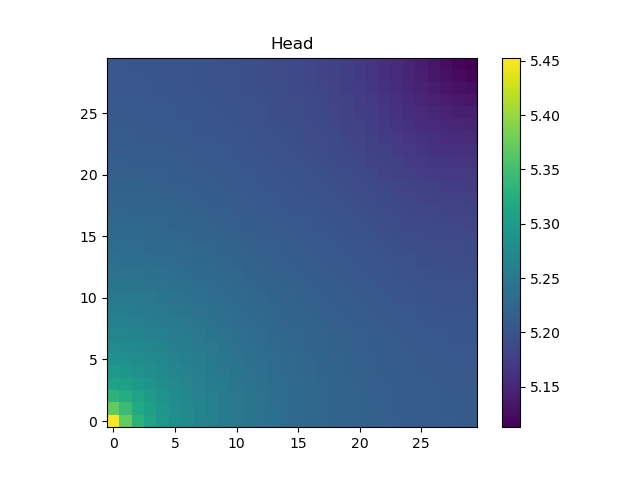
Now, we can solve the equations using solveforh.
julia
h = solveforh(logKs, dirichleths)#solve for the head
<!--
plot the head at the bottom of the domain
fig, ax = PyPlot.subplots()
img = ax.imshow(hflat2h3d(h[:, end])[1, :, :], origin="lower")
ax.title.set_text("Head")
fig.colorbar(img)
display(fig)
println()
PyPlot.close(fig)
-->
Finally, we can compute the gradient of functions involving the solution of these equations using Zygote.gradient or Zygote.pullback.
julia
hflat2h3d(h) = reshape(h, reverse(ns)...)
gradient_node = div(size(coords, 2) + ns[3] * ns[2], 2)
gradient_node_x = coords[1, gradient_node]
gradient_node_y = coords[2, gradient_node]
grad = Zygote.gradient((x, y)->hflat2h3d(solveforh(x, y)[:, end])[gradient_node], logKs, dirichleths)#calculate the gradient (which involves a redundant calculation of the forward pass)
<!--
functionevaluation, back = Zygote.pullback((x, y)->hflat2h3d(solveforh(x, y)[:, end])[gradientnode], logKs, dirichleths)#this pullback thing lets us not redo the forward pass
print("gradient time")
@time grad = back(1.0)#compute the gradient of a function involving solveforh
plot the gradient of the function w.r.t. the logK at the bottom of the domain
fig, ax = PyPlot.subplots()
img = ax.imshow(grad[1][1, :, :], origin="lower", extent=[mins[1], maxs[1], mins[2], maxs[2]])
ax.plot([gradientnodex], [gradientnodey], "r.", ms=10, alpha=0.5)
ax.title.set_text("Gradient of head at dot w.r.t. logK at bottom of domain")
fig.colorbar(img)
display(fig)
println()
PyPlot.close(fig)
-->
Advanced usage
The examples illustrate more advanced usage including inverse problems, combining DPFEHM with a neural network, flow on discrete fracture networks, as well as solving the advection-dispersion and wave equations.
Note on the numerical methods
DPFEHM generally uses a two-point flux approximation to discretize the equations. This means, for example, that when the fluid flux between cell $i$ and cell $j$ that is proportional to the pressure gradient, the pressure gradient is approximated as being proportional to $pi-pj$ where $pi$ and $pj$ are the pressures in cells $i$ and $j$, respectively.
License
DPFEHM is provided under a BSD style license. See LICENSE.md file for the full text.
This package is part of the Orchard suite, known internally as C20086 Orchard.
Development and questions
If you would like to contribute to DPFEHM, please for the repo and make a pull request. If you have any questions, please contact Daniel O'Malley, omalled@lanl.gov.
Owner
- Name: OrchardLANL
- Login: OrchardLANL
- Kind: organization
- Repositories: 3
- Profile: https://github.com/OrchardLANL
JOSS Publication
DPFEHM: a differentiable subsurface physics simulator
Authors

Los Alamos National Laboratory, USA
Los Alamos National Laboratory, USA, Massachussets Institute of Technology, USA
Los Alamos National Laboratory, USA
Los Alamos National Laboratory, USA
The Freshwater Trust, USA
SmartTensors, LLC, USA
Editor
Jed Brown
Tags
hydrology multiphase flow transport wave equationGitHub Events
Total
- Watch event: 8
- Push event: 2
- Pull request event: 5
- Fork event: 1
Last Year
- Watch event: 8
- Push event: 2
- Pull request event: 5
- Fork event: 1
Committers
Last synced: 11 months ago
Top Committers
| Name | Commits | |
|---|---|---|
| Daniel O'Malley | o****d@l****v | 114 |
| HARUN UR RASHID | 5****0 | 43 |
| Sarah Greer | s****r@m****u | 3 |
| monty | v****v@g****m | 3 |
| Aleksandra Pachalieva | a****a@l****v | 2 |
| Wu Hao | w****o@p****v | 2 |
| jkath-cgu | 1****u | 1 |
| Kevin Mattheus Moerman | K****n | 1 |
| Dylan Harp | d****p@l****v | 1 |
Committer Domains (Top 20 + Academic)
Issues and Pull Requests
Last synced: 10 months ago
All Time
- Total issues: 10
- Total pull requests: 16
- Average time to close issues: 20 days
- Average time to close pull requests: 2 months
- Total issue authors: 4
- Total pull request authors: 7
- Average comments per issue: 2.0
- Average comments per pull request: 0.0
- Merged pull requests: 12
- Bot issues: 0
- Bot pull requests: 0
Past Year
- Issues: 0
- Pull requests: 8
- Average time to close issues: N/A
- Average time to close pull requests: about 2 months
- Issue authors: 0
- Pull request authors: 3
- Average comments per issue: 0
- Average comments per pull request: 0.0
- Merged pull requests: 5
- Bot issues: 0
- Bot pull requests: 0
Top Authors
Issue Authors
- WilkAndy (7)
- rezgarshakeri (1)
- hrashid10 (1)
- JuliaTagBot (1)
- rtmills (1)
Pull Request Authors
- hrashid10 (8)
- apachalieva (5)
- jkath-cgu (4)
- sygreer (2)
- Kevin-Mattheus-Moerman (1)
- wuhao-111 (1)
- dharp (1)
Top Labels
Issue Labels
Pull Request Labels
Packages
- Total packages: 1
- Total downloads: unknown
- Total dependent packages: 0
- Total dependent repositories: 0
- Total versions: 2
juliahub.com: DPFEHM
DPFEHM: A Differentiable Subsurface Flow Simulator
- Documentation: https://docs.juliahub.com/General/DPFEHM/stable/
- License: BSD-3-Clause
-
Latest release: 0.1.1
published almost 3 years ago
Rankings
Dependencies
- JuliaRegistries/TagBot v1 composite
- actions/cache v1 composite
- actions/checkout v2 composite
- codecov/codecov-action v1 composite
- julia-actions/julia-buildpkg v1 composite
- julia-actions/julia-processcoverage v1 composite
- julia-actions/julia-runtest v1 composite
- julia-actions/setup-julia v1 composite
- actions/checkout v2 composite
- actions/upload-artifact v1 composite
- openjournals/openjournals-draft-action master composite