roman18
Collection de romans français du dix-huitième siècle (1751-1800) / Collection of Eighteenth-Century French Novels (1751-1800)
Science Score: 49.0%
This score indicates how likely this project is to be science-related based on various indicators:
-
○CITATION.cff file
-
✓codemeta.json file
Found codemeta.json file -
✓.zenodo.json file
Found .zenodo.json file -
✓DOI references
Found 5 DOI reference(s) in README -
✓Academic publication links
Links to: zenodo.org -
○Academic email domains
-
○Institutional organization owner
-
○JOSS paper metadata
-
○Scientific vocabulary similarity
Low similarity (8.8%) to scientific vocabulary
Keywords
Repository
Collection de romans français du dix-huitième siècle (1751-1800) / Collection of Eighteenth-Century French Novels (1751-1800)
Basic Info
- Host: GitHub
- Owner: MiMoText
- License: mit
- Language: HTML
- Default Branch: master
- Homepage: https://www.mimotext.uni-trier.de
- Size: 440 MB
Statistics
- Stars: 22
- Watchers: 6
- Forks: 7
- Open Issues: 1
- Releases: 5
Topics
Metadata Files
README.md

Collection de romans franais du dix-huitime sicle (1751-1800) / Collection of Eighteenth-Century French Novels (1751-1800)
This collection of Eighteenth-Century French Novels contains 200 digital texts of novels created or first published between 1751 and 1800. The collection is created in the context of Mining and Modeling Text (2019-2023), a project which is located at the Trier Center for Digital Humanities (TCDH) at Trier University.
Data paper
Rttgermann, J. (2024). The Collection of Eighteenth Century French Novels 17511800. Journal of Open Humanities Data, 10: 31, pp. 15. DOI: https://doi.org/10.5334/johd.201
Corpus building
In the first step, about 40 novels have been carefully created by double keying. Using this first group of novels, an OCR-model has been trained in cooperation with Christian Reul (University of Wrzburg), who is one of the developers of OCR4all. The result is an OCR model for French prints of the late 18th century. This model is available within OCR4all as '18thcenturyfrench', but is specifically tailored to version 0.4.0 of OCR4all and to version 0.4.0 of LAREX. Consequently, it is not compatible with the latest OCR4all version.
By applying this OCR model to additional scans obtained from sources such as Gallica (bnf.fr) and others (refer to metadata for specifics), a second batch of novels, previously unavailable in full text or only available in poor quality, was generated.
A third set of texts, sourced from existing full texts (e.g., Wikisource and other repositories), contributed to reaching a total of 200 volumes.
Balancing criteria
At the beginning, corpus composition depended primarily on pragmatic criteria. We then proceeded and used additional metadata on the literary production to balance the corpus of full texts. A bibliography documenting the overall production of novels in the period is Angus Martin, Vivienne G. Mylne and Richard Frautschi, Bibliographie du genre romanesque franais 1751-1800, 1977. We used this metadata to balance our corpus of texts regarding the parameters gender, year of first publication and narrative form in approaching the historical distribution of these parameters in our full text metadata.
BGRF = abreviation for Bibliographie du genre romanesque franais 1751-1800, a source of bibliographic metadata we mined for extracting publication years, narrative form, authors and more.
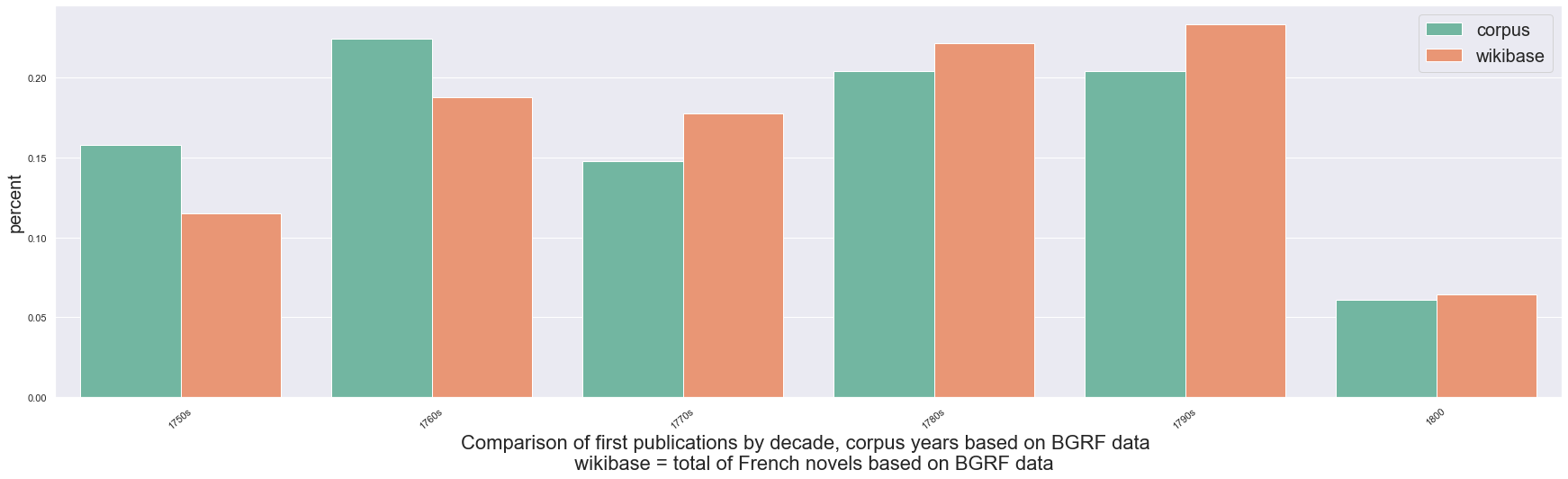
Year of first publication per decades
The year of first publication according to BGRF data. We compared the overall novel publication with the corpus data and added novels per year according to the known historical publication proportions. Shown here is an overview per decade. Please note that the last bar ('1800') contains only data for one year.
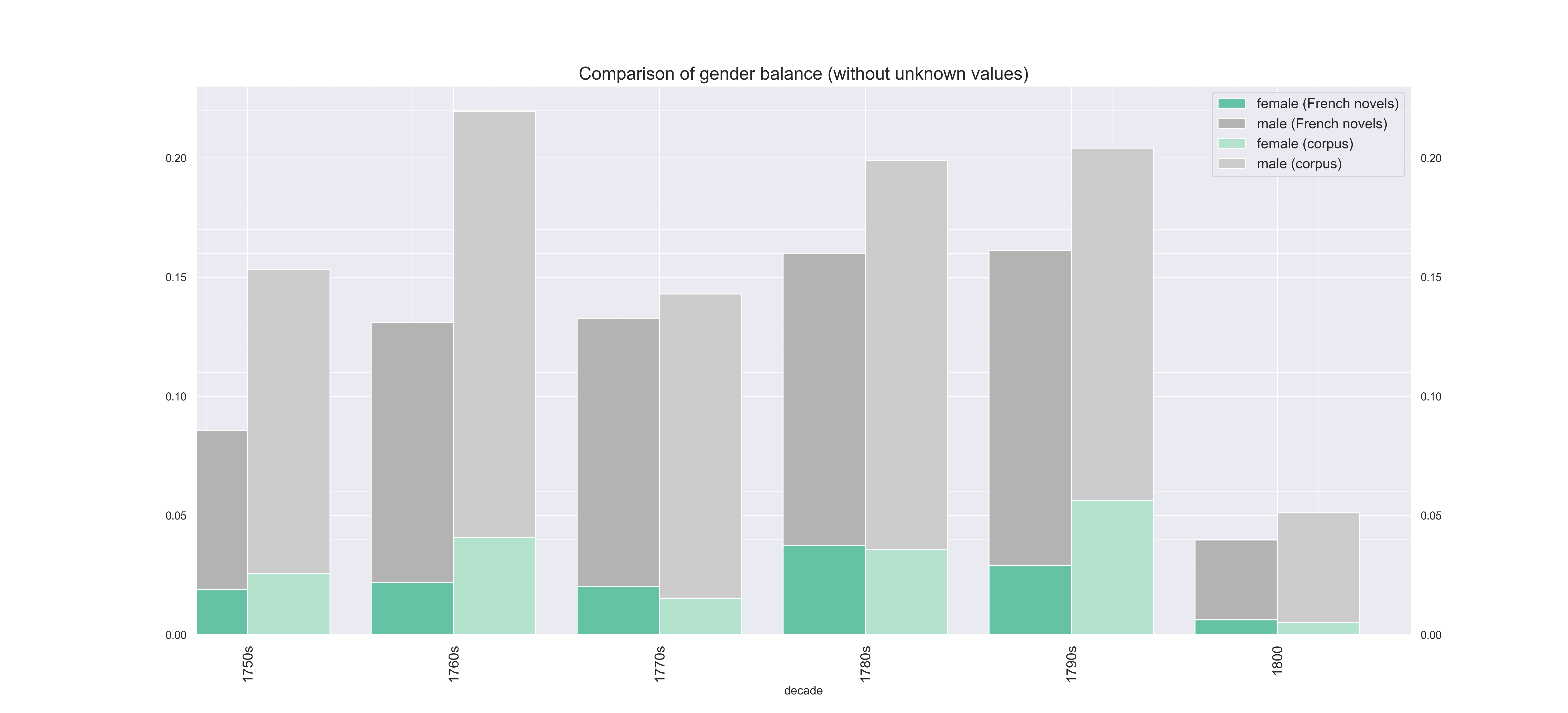
Gender balance
Concerning gender, we used statements from Wikidata as well as a python script filtering for gender specific titles. Additionally, we employed the gender guesser Python package to make gender predictions.
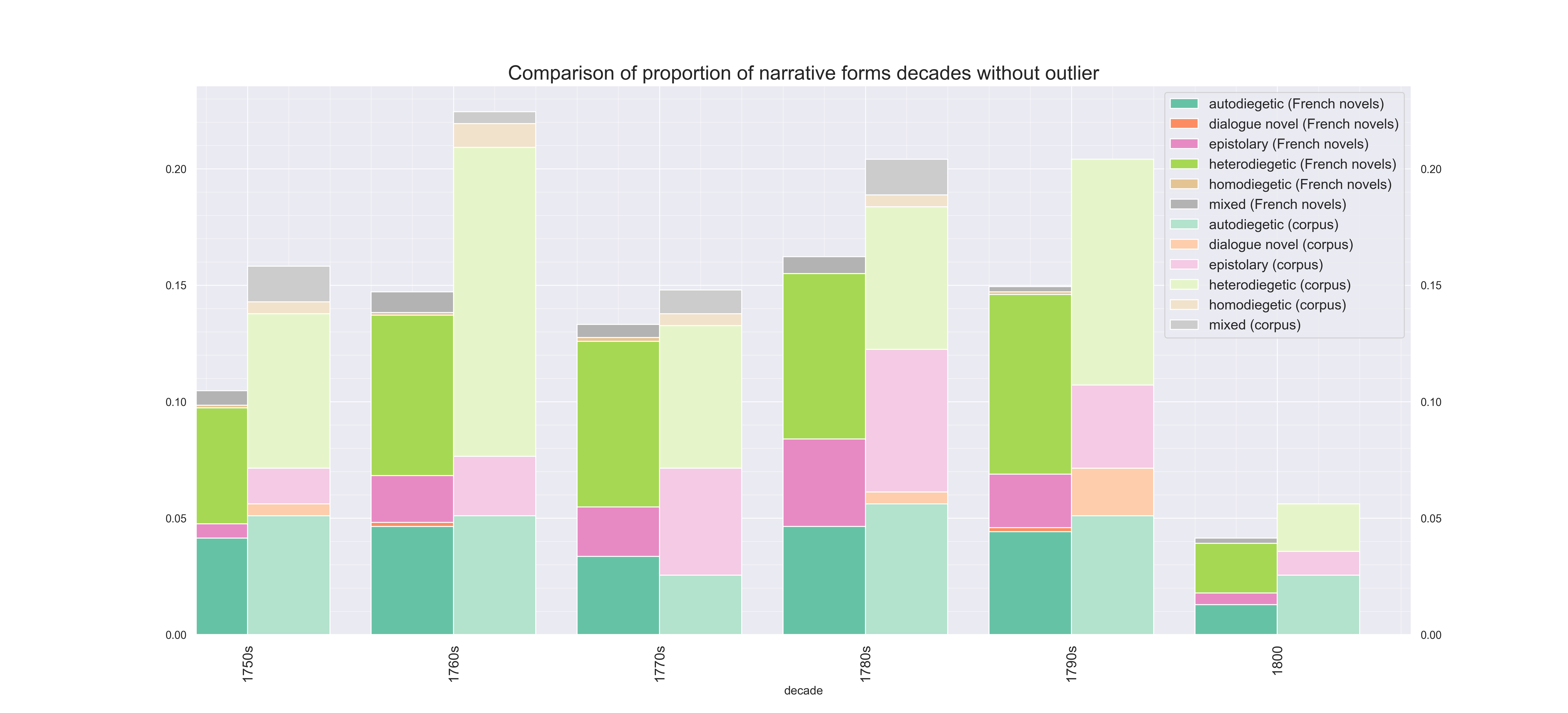
Narrative form
Information on narrative form was extracted from the BGRF data (Mylne et al., 1977) supplemented by human evaluations conducted on the full texts.
For a more detailed documentation of our sampling and balancing strategy, see our Jupyter Notebook.
Formats: XML, plaintext (original or normalized)
The texts are provided in several different formats. For the texts from the first group, the original double keying files are available. In addition, a cleaned-up XML version closely reflecting the original documents layout is available (folder Archiv/XML4OCR).
The master format for all texts is an XML format following the Guidelines of the Text Encoding Initiative (folder XML-TEI). The files are encoded in accordance with a relatively restrictive schema developed in the COST Action Distant Reading for European Literary History (level-1 encoding).
For pragmatic reasons, we have decided to deviate from this scheme in some cases and still generate valid documents. The following tags are affected:
- "timeSlot": As our corpus does not fit into the given ELTeC time-period, we use the metadatum "timeSlot" with key=T0.
- <pb/>: For digital source where page breaks were provided, we adopted those. For texts, which came from the OCR-pipeline, we omitted the pagebreaks.
- <gap/>: As for Table of contents or graphics we did not use the <gap>-Tag.
- <milestone/>: We did not use this tag for mid-chapter structural markings.
- Font change: We have marked non-French text passages with the tag <foreign>, in other places we have marked font changes, especially from digital sources where could re-use tags, with the tag <hi>.
As for the foreign text-passages we automatically detected the different languages, see https://github.com/MiMoText/roman18/tree/master/Python-Scripts/lang_dec and manually corrected the output before inserting the tags in the XML-files.
In addition, we provide plain text versions of the texts. However, these are best generated depending on individual needs using the scripts tei2txt.py & "tei2txt_run.py"(in the Scripts folder).
The folder "plain" contains the files (within folder "files") with a basic normalization of historical spellings. The folder "filesnonmodernized" contains the plaintext without normalization. Please note that some sources contain already modernized text from the beginning. All details on print and digital sources can be found in the teiHeader of the XML-files.
Metadata
There is a short and an extensive metadata description in TSV for all TEI/XML files: * Metadata, short version: https://github.com/MiMoText/roman18/blob/master/XML-TEI/xml-teimetadata.tsv * Metadata, long version: https://github.com/MiMoText/roman18/blob/master/XML-TEI/xml-teifull_metadata.tsv
| Column name | filename| au-name |title |au-gender| firsted-yr| printSource-yr| | ------------- | ------------- |------------- |------------- |------------- |------------- |------------- | | Definition | name of file|name of author |title of the novel | author gender |first year of publication |describes the year of the print source edition used as the source of the encoding which is not the first edition |
| Column name | form |spelling |data-capture| token count| size | | ------------- | ------------- |------------- |------------- |------------- |------------- | | Definition | narrative form |spelling (modern or historical) | mode of data capture |token count |size category following the scheme of ELTeC |
|Column name | bgrf|authorwikidata |titlewikidata | | ------------- | ------------- |------------- |------------- | | Definition | ID in Bibliographie du genre romanesque franais (Martin / Mylne / Frautschi 1977) | Wikidata identifier of the author | Wikidata identifier of the novel |
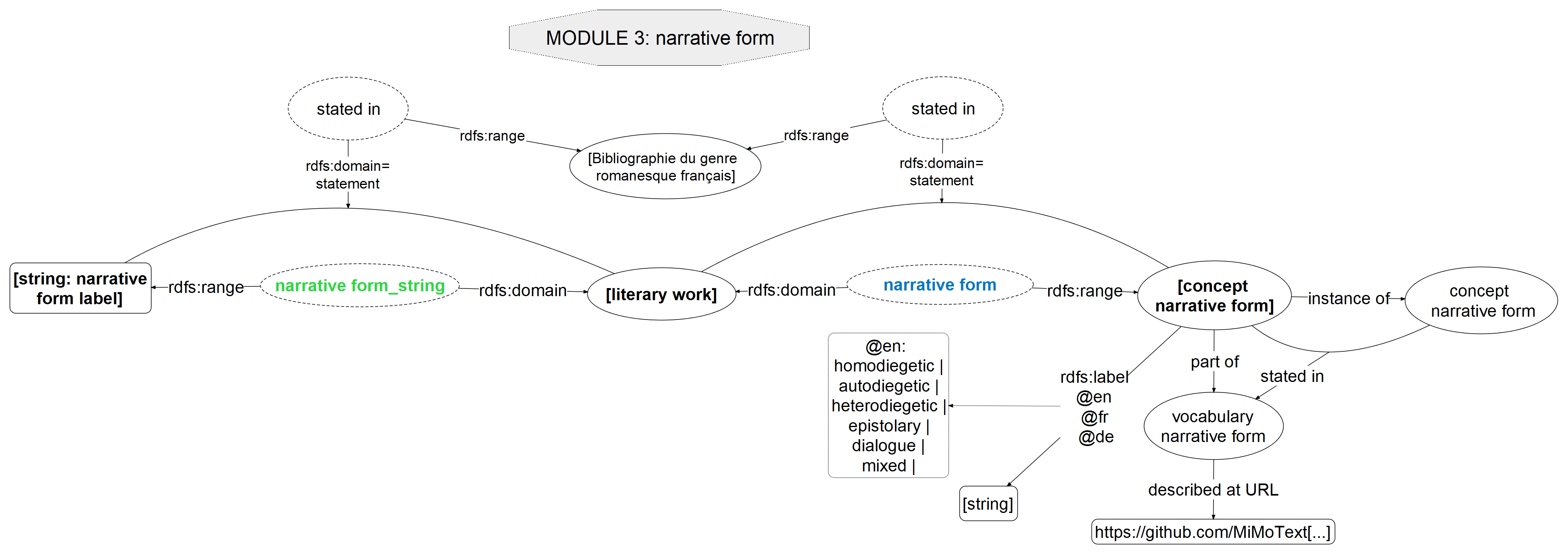
Narrative forms
The controlled vocabulary of narrative forms consists of six possible values: homodiegetic, autodiegetic, heterodiegetic, epistolary, dialogue novel, mixed.
Language
The main language of all texts is French.
Structure of the repository
- Python-Scripts: the scripts folder contains python scripts needed for corpus creation
- Schemas: current versions of the ELTeC schema in RELAX NG are available from this repository
- XML-TEI: our corpus of french novels 1751-1800 in XML/TEI and metadata are stored here
- plain/files: our corpus of french novels 1751-1800 in plain text is stored here
- plain/filesnonmodernized: our corpus of french novels 1751-1800 is stored here in a normalized plain text version
- roman18_ext: this folder contains further novels in XML/TEI which were sorted out and not included in the final MiMoText corpus
Licence
All texts and scripts are in the public domain and can be reused without restrictions. We dont claim any copyright or other rights on the transcription, markup or metadata. If you use our texts, for example in research or teaching, please reference this collection using the citation suggestion below.
Citation suggestion
Collection de romans franais du dix-huitime sicle (1751-1800) / Eighteenth-Century French Novels (1751-1800), edited by Julia Rttgermann, with contributions from Julia Dudar, Henning Gebhard, Anne Klee, Johanna Konstanciak, Damir Padieu, Amelie Probst, Sarah Rebecca Ondraszek and Christof Schch. Release v.1.2.1. Trier: TCDH, 2023. URL: https://github.com/mimotext/roman18. DOI: https://doi.org/10.5281/zenodo.4061903.
Related resources
- MiMoTextBase - a knowledge graph on Eighteenth Century French Novels
- MiMoText SPARQL endpoint
- MiMoTextBase Tutorial: How to query the graph and an introduction to SPARQL
- Our controlled vocabularies
- MiMoText ontology
Funding
Forschungsinitiative des Landes Rheinland-Pfalz 2019-2023
Owner
- Name: Mining and Modeling Text (MiMoText)
- Login: MiMoText
- Kind: organization
- Email: schoech@uni-trier.de
- Repositories: 13
- Profile: https://github.com/MiMoText