https://github.com/aladyn/picongpu
PIConGPU - A particle-in-cell code for GPGPUs :sparkles:
Science Score: 13.0%
This score indicates how likely this project is to be science-related based on various indicators:
-
○CITATION.cff file
-
○codemeta.json file
-
○.zenodo.json file
-
✓DOI references
Found 20 DOI reference(s) in README -
○Academic publication links
-
○Academic email domains
-
○Institutional organization owner
-
○JOSS paper metadata
-
○Scientific vocabulary similarity
Low similarity (9.3%) to scientific vocabulary
Last synced: 10 months ago
·
JSON representation
Repository
PIConGPU - A particle-in-cell code for GPGPUs :sparkles:
Basic Info
- Host: GitHub
- Owner: ALaDyn
- License: other
- Language: C++
- Default Branch: dev
- Homepage: http://picongpu.hzdr.de
- Size: 58.5 MB
Statistics
- Stars: 0
- Watchers: 8
- Forks: 0
- Open Issues: 0
- Releases: 0
Fork of ComputationalRadiationPhysics/picongpu
Created over 9 years ago
· Last pushed 11 months ago
https://github.com/ALaDyn/picongpu/blob/dev/
PIConGPU - Particle-in-Cell Simulations for the Exascale Era ============================================================ [](https://gitlab.com/hzdr/crp/picongpu/pipelines/dev/latest) [](http://picongpu.readthedocs.io) [](http://computationalradiationphysics.github.io/picongpu) [](https://isocpp.org/) [](https://www.gnu.org/licenses/gpl-3.0.html) [](https://www.gnu.org/licenses/lgpl-3.0.html) [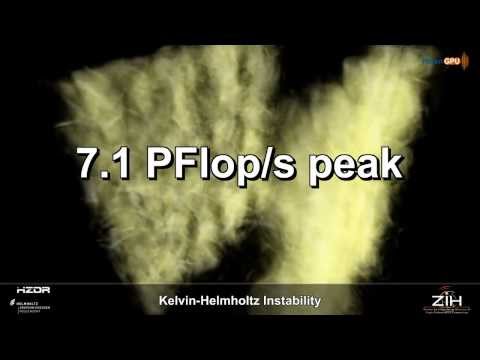](http://www.youtube.com/watch?v=nwZuG-XtUDE) [](http://www.youtube.com/watch?v=nwZuG-XtUDE) Introduction ------------ PIConGPU is a fully relativistic, [manycore](https://en.wikipedia.org/wiki/Manycore_processor), 3D3V particle-in-cell ([PIC](http://en.wikipedia.org/wiki/Particle-in-cell)) code. The Particle-in-Cell algorithm is a central tool in plasma physics. It describes the dynamics of a plasma by computing the motion of electrons and ions in the plasma based on [Maxwell's equations](http://en.wikipedia.org/wiki/Maxwell%27s_equations). PIConGPU implements various numerical schemes to solve the PIC cycle. Its features for the electro-magnetic PIC algorithm include: - a central or Yee-lattice for fields - particle pushers that solve the equation of motion for charged and neutral particles, e.g., the *Boris-* and the [*Vay-Pusher*](http://dx.doi.org/10.1063/1.2837054) - Maxwell field solvers, e.g. [*Yee's*](http://dx.doi.org/10.1109/TAP.1966.1138693) and [*Lehe's*](http://dx.doi.org/10.1103/PhysRevSTAB.16.021301) scheme - rigorously charge conserving current deposition schemes, such as [*Esirkepov*](http://dx.doi.org/10.1016/S0010-4655%2800%2900228-9) and *EZ* (Esirkepov meets ZigZag) - macro-particle form factors ranging from NGP (0th order), CIC (1st), TSC (2nd), PQS (3rd) to PCS (4th) and the electro-magnetic PIC algorithm is further self-consistently coupled to: - classical radiation reaction ([DOI:10.1016/j.cpc.2016.04.002](http://dx.doi.org/10.1016/j.cpc.2016.04.002)) - advanced field ionization methods ([DOI:10.1103/PhysRevA.59.569](http://dx.doi.org/10.1103/PhysRevA.59.569), [LV Keldysh](http://www.jetp.ac.ru/cgi-bin/dn/e_020_05_1307.pdf), BSI) Besides the electro-magnetic PIC algorithm and extensions to it, we developed a wide range of tools and diagnostics, e.g.: - online, far-field radiation diagnostics for coherent and incoherent radiation emitted by charged particles - full restart and output capabilities via [openPMD](http://openPMD.org), including [parallel HDF5](http://hdfgroup.org/) - 2D and 3D live view and diagnostics tools - a large selection of extensible [online-plugins](http://picongpu.readthedocs.io/en/latest/usage/plugins.html) As one of our supported compute platforms, GPUs provide a computational performance of several [TFLOP/s](http://en.wikipedia.org/wiki/FLOPS) at considerable lower invest and maintenance costs compared to multi CPU-based compute architectures of similar performance. The latest high-performance systems ([TOP500](http://www.top500.org/)) are enhanced by accelerator hardware that boost their peak performance up to the multi-PFLOP/s level. With its outstanding performance and scalability to more than 18'000 GPUs, PIConGPU was one of the **finalists** of the 2013 [Gordon Bell Prize](http://sc13.supercomputing.org/content/acm-gordon-bell-prize). PIConGPU is developed and maintained by the [Computational Radiation Physics Group](https://www.hzdr.de/db/Cms?pNid=2097) at the [Institute for Radiation Physics](http://www.hzdr.de/db/Cms?pNid=132) at [HZDR](http://www.hzdr.de/) in close collaboration with the Center for Information Services and High Performance Computing ([ZIH](http://tu-dresden.de/die_tu_dresden/zentrale_einrichtungen/zih)) of the Technical University Dresden ([TUD](http://www.tu-dresden.de)). We are a member of the [Dresden GPU Center of Excellence](http://ccoe-dresden.de/) that cooperates on a broad range of scientific GPU and manycore applications, workshops and teaching efforts. Attribution ----------- PIConGPU is a *scientific project*. If you **present and/or publish** scientific results that used PIConGPU, you should set a **reference** to show your support. Our according **up-to-date publication** at **the time of your publication** should be inquired from: - [REFERENCE.md](https://raw.githubusercontent.com/ComputationalRadiationPhysics/picongpu/master/REFERENCE.md) Please also consider adding yourself to our [community map](https://github.com/ComputationalRadiationPhysics/picongpu-communitymap). We would love to hear from you! Oral Presentations ------------------ The following slide should be part of **oral presentations**. It is intended to acknowledge the team maintaining PIConGPU and to support our community: (*coming soon*) presentation_picongpu.pdf (svg version, key note version, png version: 1920x1080 and 1024x768) Software License ---------------- *PIConGPU* is licensed under the **GPLv3+**. Furthermore, you can develop your own particle-mesh algorithms based on our general library *PMacc* that is shipped alongside PIConGPU. *PMacc* is *dual licensed* under both the **GPLv3+ and LGPLv3+**. For a detailed description, please refer to [LICENSE.md](LICENSE.md) ******************************************************************************** Install ------- See our notes in [INSTALL.rst](INSTALL.rst). Users ----- Dear User, we hereby emphasize that we are still actively developing PIConGPU at great speed and do, from time to time, break backwards compatibility. When using this software, please stick to the latest release or use the `dev` branch containing the latest changes. It also contains a file `CHANGELOG.md` with the latest changes (and how to update your simulations). Read it first before updating between two versions! Also, we add a git `tag` according to a version number for each release. For any questions regarding the usage of PIConGPU please **do not** contact the developers and maintainers directly. Instead, please [open an issue on GitHub](https://github.com/ComputationalRadiationPhysics/picongpu/issues/new). Before you post a question, browse the PIConGPU [documentation](https://github.com/ComputationalRadiationPhysics/picongpu/search?l=markdown), [wiki](https://github.com/ComputationalRadiationPhysics/picongpu/wiki) and the [issue tracker](https://github.com/ComputationalRadiationPhysics/picongpu/issues) to see if your question has been answered, already. PIConGPU is a collaborative project. We thus encourage users to engage in answering questions of other users and post solutions to problems to the list. A problem you have encountered might be the future problem of another user. In addition, please consider using the collaborative features of GitHub if you have questions or comments on code or documentation. This will allow other users to see the piece of code or documentation you are referring to. Main ressources are in our [online manual](https://picongpu.readthedocs.io), the [user section](https://github.com/ComputationalRadiationPhysics/picongpu/wiki) of our wiki, documentation files in [`.md` (Markdown)](http://commonmark.org/help/) and [`.rst` (reStructuredText)](http://www.sphinx-doc.org/en/stable/rest.html) format in this repository and a [getting started video](http://www.youtube.com/watch?v=7ybsD8G4Rsk). Feel free to visit [picongpu.hzdr.de](http://picongpu.hzdr.de) to learn more about the PIC algorithm. Software Upgrades ----------------- PIConGPU ships new and frequent changes to the code in the development branch `dev`. From time to time we publish a new release of PIConGPU. Before you pull the changes in, please read our [ChangeLog](CHANGELOG.md)! You may have to update some of your simulation `.param` and `.cfg` files by hand since PIConGPU is an active project and new features often require changes in input files. Additionally, a full description of new features and fixed bugs in comparison to the previous release is provided in that file. In case you decide to use *new, potentially buggy and experimental* features from our `dev` branch, be aware that you must participate or at least follow the development yourself. Syntax changes and in-development bugs will *not* be announced outside of their according pull requests and issues. Before drafting a new release, we open a new `release-*` branch from `dev` with the `*` being the version number of the upcoming release. This branch only receives bug fixes (feature freeze) and users are welcome to try it out (however, the change log and a detailed announcement might still be missing in it). Developers ---------- ### How to participate See [CONTRIBUTING.md](CONTRIBUTING.md) If you like to jump in right away, see [](https://github.com/ComputationalRadiationPhysics/picongpu/issues?q=is%3Aopen+is%3Aissue+label%3A%22good+first+issue%22) Active Team ----------- ### Scientific Supervision - Dr. Michael Bussmann - Dr. Thomas Kluge - Dr. Richard Pausch - Dr. Klaus Steiniger ### Maintainers* and core developers - Finn-Ole Carstens - Dr. Alexander Debus - Dr. Marco Garten* - Dr. Axel Huebl* - Dr. Jeffrey Kelling* - Dr. Julian Lenz* - Brian Edward Marre - Tapish Narwal* - Pawel Ordyna - Dr. Richard Pausch* - Franz Poeschel - Dr. Klaus Steiniger* - Rene Widera* ### Former Members, Contributions and Thanks The PIConGPU team expresses its gratitude to: Dr. Sergei Bastrakov, Florian Berninger, Heiko Burau, Fabia Dietrich, Robert Dietrich, Carlchristian Eckert, Simeon Ehrig, Ph.D. Wen Fu, Alexander Grund, Sebastian Hahn, Anton Helm, Wolfgang Hoehnig, Dr.-Ing. Guido Juckeland, Jeffrey Kelling, Maximilian Knespel, Dr. Remi Lehe, Felix Schmitt, Frank Winkler, Benjamin Schneider, Joseph Schuchart, Conrad Schumann, Stefan Tietze, Ph.D. Marija Vranic, Benjamin Worpitz, Erik Zenker, Sophie Rudat, Sebastian Starke, Alexander Matthes, Kseniia Bastrakova, Bernhard Manfred Gruber, Jakob Trojok, Anton Lebedev, Nils Prinz, Felix Meyer, Lennert Sprenger, Manhui Wang, Maxence Thevenet, Ilja Goethel, Mika Soren Vo, Lei Bifeng, Andrei Berceanu, Felix Meyer, Lennert Sprenger and Nico Wrobel. Kudos to everyone, mentioned or unmentioned, who contributed further in any way! ********************************************************************************  
Owner
- Name: ALaDyn Collaboration
- Login: ALaDyn
- Kind: organization
- Email: aladyn@hotmail.it
- Repositories: 21
- Profile: https://github.com/ALaDyn
GitHub Events
Total
- Delete event: 2
- Push event: 9
- Create event: 2
Last Year
- Delete event: 2
- Push event: 9
- Create event: 2