airisc_core_complex
Fraunhofer IMS processor core. RISC-V ISA (RV32IM) with additional peripherals for embedded AI applications and smart sensors.
Science Score: 36.0%
This score indicates how likely this project is to be science-related based on various indicators:
-
○CITATION.cff file
-
✓codemeta.json file
Found codemeta.json file -
✓.zenodo.json file
Found .zenodo.json file -
○DOI references
-
✓Academic publication links
Links to: zenodo.org -
○Academic email domains
-
○Institutional organization owner
-
○JOSS paper metadata
-
○Scientific vocabulary similarity
Low similarity (11.1%) to scientific vocabulary
Keywords
Repository
Fraunhofer IMS processor core. RISC-V ISA (RV32IM) with additional peripherals for embedded AI applications and smart sensors.
Basic Info
- Host: GitHub
- Owner: Fraunhofer-IMS
- License: other
- Language: Verilog
- Default Branch: main
- Homepage: https://www.airisc.de
- Size: 79 MB
Statistics
- Stars: 94
- Watchers: 10
- Forks: 19
- Open Issues: 1
- Releases: 3
Topics
Metadata Files
README.md

AIRISC - The RISC-V Processor for Embedded AI



The Fraunhofer IMS AIRISC is a RISC-V-powered ASIC- and FPGA-proven processor core optimized for embedded AI applications. It comes with a set of common peripherals together with a wide variety of optional extensions to build a customizable yet powerful system on chip (SoC).
Overview


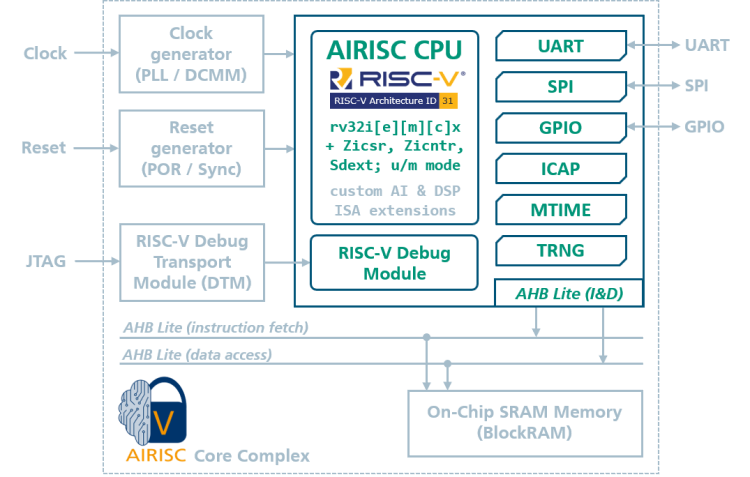
The AIRISC Core Complex is based on a 32-bit RISC-V CPU compatible to the
RISC-V unprivileged and privileged specifications also supporting
the RISC-V External Debug specification.
The CPU implements a Harvard architecture with a four-level pipeline and separate AHB-Lite interfaces for instruction fetch
and data access. The core's RV32I_Zicsr base ISA can be further extended via a unified co-processor interface (PCPI).
The default setup already includes a co-processor for integer multiplication and division operations implementing
the RISC-V M ISA extension.
In addition to the CPU core itself, the AIRISC Core Complex includes common peripherals to build a complete SoC. These include a RISC-V-compatible system timer (MTIME), a serial UART interface with optional FIFO buffers, a SPI controller also with configurable FIFO buffers and acting either as host device or as peripheral, general-purpose IO ports (GPIO) and a RISC-V-compatible on-chip debugger that provides a JTAG interface to debug the core online and in-system.
The provided SoC is ready for an implementation on various FPGA boards (Digilent Nexys Video, Digilent Arty A7 and Digilent Cmod A7) and can be easily ported to other boards, platforms and technologies as the core itself is written in vendor-agnostic plain Verilog.
:bulb: For more information check out the AIRISC fact sheet (PDF) or have a look at the online documentation.
Development
The project is developed primarily in a closed-source organization-internal repository to take advantage of sophisticated continuous integration stages that require licensed EDA tools. New releases with novel features and overall improvements will be uploaded frequently to this repository under the permissive Solderpad license. All releases include a pre-compiled FPGA bitstream as well as a pre-compiled "hello world!" application program to get started immediately.
:loudspeaker: Feedback from the community is always highly appreciated! Feel free to open a new issue or get in contact directly if you have questions, requests, ideas or any kind of problems with the provided project.
Additional Modules and Extensions
Files for ASIC synthesis, additional and advanced peripherals as well as area/energy/performance-optimized core configurations can be obtained from Fraunhofer IMS under a less permissive license. See the Contact section for more information how to get in touch. Some of the additional features are listed below:
- RISC-V
Cextension - 16-bit compressed instructions for improved code density - RISC-V
Fextension - IEEE754 single-precision floating-point unit - Fraunhofer IMS AI extensions based on SIMD processor module (RISC-V
Pextension) and co-processors for computing activation functions - QSPI interface; also providing Execute-In-Place (XIP)
- On-chip Physical Unclonable Function ("PUF") for advanced security functions
- AXI-compatible bus interface to interface with off-the-shelve IP components
- A safety version of the AIRISC prepared for ISO 26262 ASIL-D certification extended with multiple additional safety features
- A security version of the AIRISC equipped with hardware features for encryption and decryption, secure boot and update mechanisms
- more to come! :rocket:
AIfES Integration

The Fraunhofer AIfES machine learning library integrates seamlessly into the AIRISC processor, which allows fast and easy development of on-the-edge AI applications such as inference of neuronal networks. In additions to the software-only AIfES libraries, Fraunhofer IMS also provides additional ISA extensions and dedicated co-processors to improve throughput resulting in optimized performance at a minimal energy budget. Hence, the combination of the AIfES libraries and the dedicated hardware accelerators (some examples are shown in section Additional Modules and Extensions) make the AIRISC a well-suited platform for embedded AI applications.
Quickstart
This section provides instructions to get you started:
- Synthesize the core complex for a specific FPGA board.
- Run the pre-compiled example application program using openOCD and GDB.
- Run a simulation using the default testbench, which checks the ISA for RISC-V-compatibility as well as the general core functionality.
:bulb: See the project's Quickstart Guide for step-by-step instructions on how to program the FPGA board and how to run a GDB session executing the provided example application program.
Synthesis
Requirements for (re-)building the hardware and programming the (pre-build) bitstream:
- Xilinx Vivado: 2020.2 WebPack (for generating and programming the bitstream)
- Xilinx Vivado: 2020.2 LabEdition (for programming the pre-compiled bitstream only)
- FPGA board: Digilent Nexys Video or Digilent Arty A7
The fpga folder provides pre-configured TCL scripts
to automatically generate a Xilinx Vivado project and to program the bitstream to the FPGA. See the project's
online documentation for more information on how to setup a
AIRISC Xilinx Vivado project from scratch.
:bulb: Prebuilt bitstreams for the supported boards can be found in
fpga/sdcard.
Exemplary Synthesis Results
- FPGA: Xilinx Artix-7
xc7a200tsbg484-1 - Board: Digilent Nexys Video
- Results generated on Dec. 19th, 2022
| Name | Slice LUTs | Slice Registers | DSPs | |:-----|-----------:|----------------:|-----:| | FPGATop | 8476 | 4236 | 4 | | > clkgen (clkwiz0) | 0 | 0 | 0 | | > DUT (airi5ctopasic) | 6650 | 4167 | 4 | | >> airi5c (airi5ccore) | 4351 | 2612 | 4 | | >>> debugmodule (airi5cdebugmodule) | 168 | 214 | 0 | | >>> debugrom (airi5cdebugrom) | 20 | 75 | 0 | | >>> muldiv (airi5cmuldiv) | 581 | 337 | 4 | | >>> pipeline (airi5cpipeline) | 2963 | 1984 | 0 | | >>>> csr (airi5ccsrfile) | 394 | 425 | 0 | | >>>> ctrl (airi5cctrl) | 114 | 24 | 0 | | >>>> decoder (airi5cdecode) | 52 | 65 | 0 | | >>>> EXpipelineregs (airi5cEXpregs) | 1049 | 107 | 0 | | >>>> fetcher (airi5cfetch) | 283 | 119 | 0 | | >>>> immgen (airi5cimmgen) | 3 | 0 | 0 | | >>>> regfile (airi5cregfile) | 834 | 1024 | 0 | | >>>> srcamux (airi5csrcamux) | 64 | 0 | 0 | | >>>> thedmemlatch (airi5cdmemlatch) | 16 | 32 | 0 | | >>>> WBpipelineregs (airi5cWBpregs) | 155 | 188 | 0 | | >> dtm (airi5cdtm) | 86 | 178 | 0 | | >> gpio0 (airi5cgpio) | 43 | 33 | 0 | | >> icap1 (airi5cicap) | 0 | 2 | 0 | | >> peripheralmux (airi5cperiphmux) | 110 | 24 | 0 | | >> spi0 (airi5cspi) | 267 | 336 | 0 | | >> systemtimer (airi5ctimer) | 131 | 163 | 0 | | >> uart0 (airi5cuart) | 1664 | 819 | 0 | | > SRAM (blkmemgen_0) | 1819 | 44 | 0 |
CoreMark Benchmark
Coremark result @32 MHz on the NexysVideo FPGA Dev Board with local BlockRAM as instruction memory:
2K performance run parameters for coremark.
  CoreMark Size    : 666
  Total ticks      : 7794
  Total time (secs): 15
  Iterations/Sec   : 80
  Iterations       : 1200
  Compiler version : GCC10.1.0
  Compiler flags   : -o3
  Memory location  : STACK
  seedcrc          : 0xe9f5
  [0]crclist       : 0xe714
  [0]crcmatrix     : 0x1fd7
  [0]crcstate      : 0x8e3a
  [0]crcfinal      : 0x988c
  Correct operation validated. See README.md for run and reporting rules.
Application
Requirements for running the hello world example program:
- OpenOCD: risc-v openOCD (upstream version)
- GDB: risc32-unknown-elf-gdb 9.1
- Serial terminal like Picocom
Requirements for (re-)building the software example (optional):
:bulb: A pre-compiled version (*.elf; including debug symbols) of the example/demo program can be found in
bsp/example.
Simulation / CI
The .ci ("continuous integration") folder is used
to check the core's functionality when modifying project sources. A GitHub workflow
is configured to run a simulation of the default testbench
using the free and open-source Icarus Verilog simulator.
Requirements for running the (CI) simulation:
You can run the simulation by yourself using the provided script:
bash
airisc_core_complex/.ci$ sh iverilog_sim.sh
Contact
Fraunhofer Institute for Microelectronic Circuits and Systems, Duisburg, Germany
- Homepage: ims.fraunhofer.de/en.html
- Contact for questions regarding license and exploitation: AIRISC-support
External Dependencies
- The
*.memfiles intb/memfilesare used to test/verify the core for RISC-V ISA compliance were pre-compiled by us. The source files were obtained from the official RISC-V riscv-software-src/riscv-tests GitHub repository (see the repository's license). - The SoC's TRNG is submoduled from github.com/stnolting/neoTRNG.
- The ELF-to-plain-hex converter tool
elf2hexis submoduled from github.com/sifive/elf2hex.
Owner
- Name: Fraunhofer-IMS
- Login: Fraunhofer-IMS
- Kind: organization
- Repositories: 2
- Profile: https://github.com/Fraunhofer-IMS
GitHub Events
Total
- Watch event: 18
- Push event: 1
- Fork event: 2
Last Year
- Watch event: 18
- Push event: 1
- Fork event: 2
Dependencies
- actions/checkout v3 composite
- actions/upload-artifact v3 composite
- actions/checkout v3 composite
- actions/upload-artifact v3 composite