Science Score: 46.0%
This score indicates how likely this project is to be science-related based on various indicators:
-
○CITATION.cff file
-
✓codemeta.json file
Found codemeta.json file -
✓.zenodo.json file
Found .zenodo.json file -
○DOI references
-
✓Academic publication links
Links to: arxiv.org, acm.org -
✓Committers with academic emails
1 of 6 committers (16.7%) from academic institutions -
○Institutional organization owner
-
○JOSS paper metadata
-
○Scientific vocabulary similarity
Low similarity (13.4%) to scientific vocabulary
Keywords
Keywords from Contributors
Repository
Python library for CMA Evolution Strategy.
Basic Info
- Host: GitHub
- Owner: CyberAgentAILab
- License: mit
- Language: Python
- Default Branch: main
- Homepage: https://arxiv.org/abs/2402.01373
- Size: 403 KB
Statistics
- Stars: 441
- Watchers: 13
- Forks: 71
- Open Issues: 9
- Releases: 20
Topics
Metadata Files
README.md
cmaes


:whale: Paper is now available on arXiv!
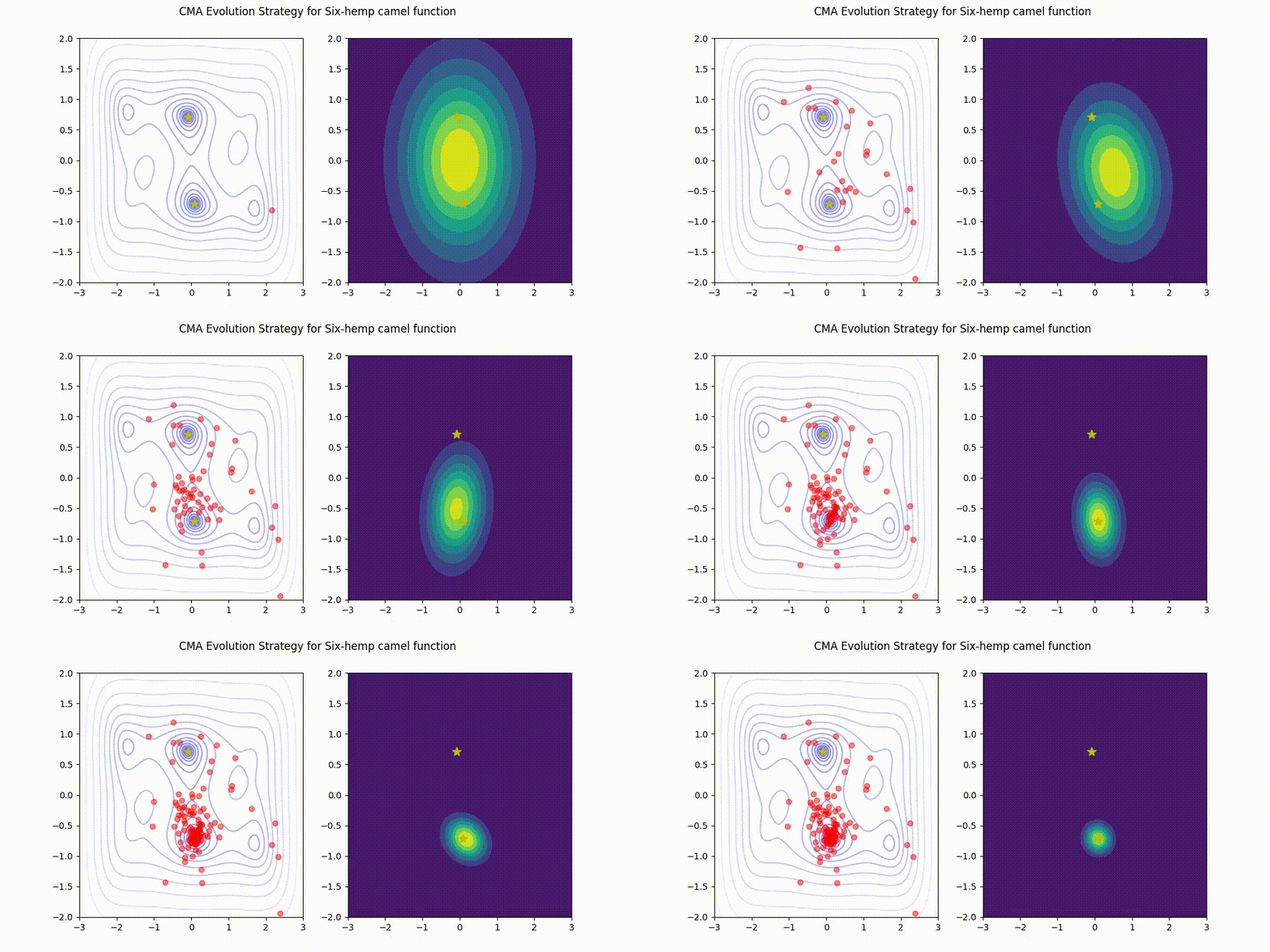
Simple and Practical Python library for CMA-ES. Please refer to the paper [Nomura and Shibata 2024] for detailed information, including the design philosophy and advanced examples.
Installation
Supported Python versions are 3.8 or later.
$ pip install cmaes
Or you can install via conda-forge.
$ conda install -c conda-forge cmaes
Usage
This library provides an "ask-and-tell" style interface. We employ the standard version of CMA-ES [Hansen 2016].
```python import numpy as np from cmaes import CMA
def quadratic(x1, x2): return (x1 - 3) ** 2 + (10 * (x2 + 2)) ** 2
if name == "main": optimizer = CMA(mean=np.zeros(2), sigma=1.3)
for generation in range(50):
    solutions = []
    for _ in range(optimizer.population_size):
        x = optimizer.ask()
        value = quadratic(x[0], x[1])
        solutions.append((x, value))
        print(f"#{generation} {value} (x1={x[0]}, x2 = {x[1]})")
    optimizer.tell(solutions)
```
You can also use this library via Optuna [Akiba et al. 2019], an automatic hyperparameter optimization framework.
```python import optuna
def objective(trial: optuna.Trial): x1 = trial.suggestfloat("x1", -4, 4) x2 = trial.suggestfloat("x2", -4, 4) return (x1 - 3) ** 2 + (10 * (x2 + 2)) ** 2
if name == "main": sampler = optuna.samplers.CmaEsSampler() study = optuna.createstudy(sampler=sampler) study.optimize(objective, ntrials=250) ```
For more information, see the documentation.
CMA-ES variants
CatCMA with Margin [Hamano et al. 2025]
CatCMA with Margin (CatCMAwM) is a method for mixed-variable optimization problems, simultaneously optimizing continuous, integer, and categorical variables. CatCMAwM extends CatCMA by introducing a novel integer handling mechanism, and supports arbitrary combinations of continuous, integer, and categorical variables in a unified framework.
Source code
```python import numpy as np from cmaes import CatCMAwM def SphereIntCOM(x, z, c): return sum(x * x) + sum(z * z) + len(c) - sum(c[:, 0]) def SphereInt(x, z): return sum(x * x) + sum(z * z) def SphereCOM(x, c): return sum(x * x) + len(c) - sum(c[:, 0]) def f_cont_int_cat(): # [lower_bound, upper_bound] for each continuous variable X = [[-5, 5], [-5, 5]] # possible values for each integer variable Z = [[-1, 0, 1], [-2, -1, 0, 1, 2]] # number of categories for each categorical variable C = [3, 3] optimizer = CatCMAwM(x_space=X, z_space=Z, c_space=C) for generation in range(50): solutions = [] for _ in range(optimizer.population_size): sol = optimizer.ask() value = SphereIntCOM(sol.x, sol.z, sol.c) solutions.append((sol, value)) print(f"#{generation} {sol} evaluation: {value}") optimizer.tell(solutions) def f_cont_int(): # [lower_bound, upper_bound] for each continuous variable X = [[-np.inf, np.inf], [-np.inf, np.inf]] # possible values for each integer variable Z = [[-2, -1, 0, 1, 2], [-2, -1, 0, 1, 2]] # initial distribution parameters (Optional) # If you know a promising solution for X and Z, set init_mean to that value. init_mean = np.ones(len(X) + len(Z)) init_cov = np.diag(np.ones(len(X) + len(Z))) init_sigma = 1.0 optimizer = CatCMAwM( x_space=X, z_space=Z, mean=init_mean, cov=init_cov, sigma=init_sigma ) for generation in range(50): solutions = [] for _ in range(optimizer.population_size): sol = optimizer.ask() value = SphereInt(sol.x, sol.z) solutions.append((sol, value)) print(f"#{generation} {sol} evaluation: {value}") optimizer.tell(solutions) def f_cont_cat(): # [lower_bound, upper_bound] for each continuous variable X = [[-5, 5], [-5, 5]] # number of categories for each categorical variable C = [3, 5] # initial distribution parameters (Optional) init_cat_param = np.array( [ [0.5, 0.3, 0.2, 0.0, 0.0], # zero-padded at the end [0.2, 0.2, 0.2, 0.2, 0.2], # each row must sum to 1 ] ) optimizer = CatCMAwM(x_space=X, c_space=C, cat_param=init_cat_param) for generation in range(50): solutions = [] for _ in range(optimizer.population_size): sol = optimizer.ask() value = SphereCOM(sol.x, sol.c) solutions.append((sol, value)) print(f"#{generation} {sol} evaluation: {value}") optimizer.tell(solutions) if __name__ == "__main__": f_cont_int_cat() # f_cont_int() # f_cont_cat() ``` The full source code is available [here](./examples/catcma_with_margin.py).We recommend using CatCMAwM for continuous+integer and continuous+categorical settings. In particular, [Hamano et al. 2025] shows that CatCMAwM outperforms CMA-ES with Margin in mixed-integer scenarios. Therefore, we suggest CatCMAwM in place of CMA-ES with Margin or CatCMA.
CatCMA [Hamano et al. 2024a]
CatCMA is a method for mixed-category optimization problems, which is the problem of simultaneously optimizing continuous and categorical variables. CatCMA employs the joint probability distribution of multivariate Gaussian and categorical distributions as the search distribution.
Source code
```python import numpy as np from cmaes import CatCMA def sphere_com(x, c): dim_co = len(x) dim_ca = len(c) if dim_co < 2: raise ValueError("dimension must be greater one") sphere = sum(x * x) com = dim_ca - sum(c[:, 0]) return sphere + com def rosenbrock_clo(x, c): dim_co = len(x) dim_ca = len(c) if dim_co < 2: raise ValueError("dimension must be greater one") rosenbrock = sum(100 * (x[:-1] ** 2 - x[1:]) ** 2 + (x[:-1] - 1) ** 2) clo = dim_ca - (c[:, 0].argmin() + c[:, 0].prod() * dim_ca) return rosenbrock + clo def mc_proximity(x, c, cat_num): dim_co = len(x) dim_ca = len(c) if dim_co < 2: raise ValueError("dimension must be greater one") if dim_co != dim_ca: raise ValueError( "number of dimensions of continuous and categorical variables " "must be equal in mc_proximity" ) c_index = np.argmax(c, axis=1) / cat_num return sum((x - c_index) ** 2) + sum(c_index) if __name__ == "__main__": cont_dim = 5 cat_dim = 5 cat_num = np.array([3, 4, 5, 5, 5]) # cat_num = 3 * np.ones(cat_dim, dtype=np.int64) optimizer = CatCMA(mean=3.0 * np.ones(cont_dim), sigma=1.0, cat_num=cat_num) for generation in range(200): solutions = [] for _ in range(optimizer.population_size): x, c = optimizer.ask() value = mc_proximity(x, c, cat_num) if generation % 10 == 0: print(f"#{generation} {value}") solutions.append(((x, c), value)) optimizer.tell(solutions) if optimizer.should_stop(): break ``` The full source code is available [here](./examples/catcma.py).Safe CMA [Uchida et al. 2024a]
Safe CMA-ES is a variant of CMA-ES for safe optimization. Safe optimization is formulated as a special type of constrained optimization problem aiming to solve the optimization problem with fewer evaluations of the solutions whose safety function values exceed the safety thresholds. The safe CMA-ES requires safe seeds that do not violate the safety constraints. Note that the safe CMA-ES is designed for noiseless safe optimization. This module needs torch and gpytorch.
Source code
```python import numpy as np from cmaes.safe_cma import SafeCMA # objective function def quadratic(x): coef = 1000 ** (np.arange(dim) / float(dim - 1)) return np.sum((x * coef) ** 2) # safety function def safe_function(x): return x[0] """ example with a single safety function """ if __name__ == "__main__": # number of dimensions dim = 5 # safe seeds safe_seeds_num = 10 safe_seeds = (np.random.rand(safe_seeds_num, dim) * 2 - 1) * 5 safe_seeds[:,0] = - np.abs(safe_seeds[:,0]) # evaluation of safe seeds (with a single safety function) seeds_evals = np.array([ quadratic(x) for x in safe_seeds ]) seeds_safe_evals = np.stack([ [safe_function(x)] for x in safe_seeds ]) safety_threshold = np.array([0]) # optimizer (safe CMA-ES) optimizer = SafeCMA( sigma=1., safety_threshold=safety_threshold, safe_seeds=safe_seeds, seeds_evals=seeds_evals, seeds_safe_evals=seeds_safe_evals, ) unsafe_eval_counts = 0 best_eval = np.inf for generation in range(400): solutions = [] for _ in range(optimizer.population_size): # Ask a parameter x = optimizer.ask() value = quadratic(x) safe_value = np.array([safe_function(x)]) # save best eval best_eval = np.min((best_eval, value)) unsafe_eval_counts += (safe_value > safety_threshold) solutions.append((x, value, safe_value)) # Tell evaluation values. optimizer.tell(solutions) print(f"#{generation} ({best_eval} {unsafe_eval_counts})") if optimizer.should_stop(): break ``` The full source code is available [here](./examples/safecma.py).Maximum a Posteriori CMA-ES [Hamano et al. 2024b]
MAP-CMA is a method that is introduced to interpret the rank-one update in the CMA-ES from the perspective of the natural gradient. The rank-one update derived from the natural gradient perspective is extensible, and an additional term, called momentum update, appears in the update of the mean vector. The performance of MAP-CMA is not significantly different from that of CMA-ES, as the primary motivation for MAP-CMA comes from the theoretical understanding of CMA-ES.
Source code
```python import numpy as np from cmaes import MAPCMA def rosenbrock(x): dim = len(x) if dim < 2: raise ValueError("dimension must be greater one") return sum(100 * (x[:-1] ** 2 - x[1:]) ** 2 + (x[:-1] - 1) ** 2) if __name__ == "__main__": dim = 20 optimizer = MAPCMA(mean=np.zeros(dim), sigma=0.5, momentum_r=dim) print(" evals f(x)") print("====== ==========") evals = 0 while True: solutions = [] for _ in range(optimizer.population_size): x = optimizer.ask() value = rosenbrock(x) evals += 1 solutions.append((x, value)) if evals % 1000 == 0: print(f"{evals:5d} {value:10.5f}") optimizer.tell(solutions) if optimizer.should_stop(): break ``` The full source code is available [here](./examples/mapcma.py).CMA-ES-SoP [Uchida et al. 2024b]
CMA-ES on sets of points (CMA-ES-SoP) is a variant of CMA-ES for optimization on sets of points. In the optimization on sets of points, the search space consists of several disjoint subspaces containing multiple possible points where the objective function value can be computed. In the mixed-variable cases, some subspaces are continuous spaces. Note that the discrete subspaces with more than five dimensions require computational cost for the construction of the Voronoi diagrams.
Source code
```python import numpy as np from cmaes.cma_sop import CMASoP # numbers of dimensions in each subspace subspace_dim_list = [2, 3, 5] cont_dim = 10 # numbers of points in each subspace point_num_list = [10, 20, 40] # number of total dimensions dim = int(np.sum(subspace_dim_list) + cont_dim) # objective function def quadratic(x): coef = 1000 ** (np.arange(dim) / float(dim - 1)) return np.sum((coef * x) ** 2) # sets_of_points (on [-5, 5]) discrete_subspace_num = len(subspace_dim_list) sets_of_points = [( 2 * np.random.rand(point_num_list[i], subspace_dim_list[i]) - 1) * 5 for i in range(discrete_subspace_num)] # add the optimal solution (for benchmark function) for i in range(discrete_subspace_num): sets_of_points[i][-1] = np.zeros(subspace_dim_list[i]) np.random.shuffle(sets_of_points[i]) # optimizer (CMA-ES-SoP) optimizer = CMASoP( sets_of_points=sets_of_points, mean=np.random.rand(dim) * 4 + 1, sigma=2.0, ) best_eval = np.inf eval_count = 0 for generation in range(400): solutions = [] for _ in range(optimizer.population_size): # Ask a parameter x, enc_x = optimizer.ask() value = quadratic(enc_x) # save best eval best_eval = np.min((best_eval, value)) eval_count += 1 solutions.append((x, value)) # Tell evaluation values. optimizer.tell(solutions) print(f"#{generation} ({best_eval} {eval_count})") if best_eval < 1e-4 or optimizer.should_stop(): break ``` The full source code is available [here](./examples/cma_sop.py).Learning Rate Adaptation CMA-ES [Nomura et al. 2023]
The performance of the CMA-ES can deteriorate when faced with difficult problems such as multimodal or noisy ones, if its hyperparameter values are not properly configured. The Learning Rate Adaptation CMA-ES (LRA-CMA) effectively addresses this issue by autonomously adjusting the learning rate. Consequently, LRA-CMA eliminates the need for expensive hyperparameter tuning.
LRA-CMA can be used by simply adding lr_adapt=True to the initialization of CMA().
Source code
```python import numpy as np from cmaes import CMA def rastrigin(x): dim = len(x) return 10 * dim + sum(x**2 - 10 * np.cos(2 * np.pi * x)) if __name__ == "__main__": dim = 40 optimizer = CMA(mean=3*np.ones(dim), sigma=2.0, lr_adapt=True) for generation in range(50000): solutions = [] for _ in range(optimizer.population_size): x = optimizer.ask() value = rastrigin(x) if generation % 500 == 0: print(f"#{generation} {value}") solutions.append((x, value)) optimizer.tell(solutions) if optimizer.should_stop(): break ``` The full source code is available [here](./examples/lra_cma.py).CMA-ES with Margin [Hamano et al. 2022]
CMA-ES with Margin (CMAwM) introduces a lower bound on the marginal probability for each discrete dimension, ensuring that samples avoid being fixed to a single point. This method can be applied to mixed spaces consisting of continuous (such as float) and discrete elements (including integer and binary types).
|CMA|CMAwM|
|---|---|
||
|
The above figures are taken from EvoConJP/CMA-ESwithMargin.
Source code
```python import numpy as np from cmaes import CMAwM def ellipsoid_onemax(x, n_zdim): n = len(x) n_rdim = n - n_zdim r = 10 if len(x) < 2: raise ValueError("dimension must be greater one") ellipsoid = sum([(1000 ** (i / (n_rdim - 1)) * x[i]) ** 2 for i in range(n_rdim)]) onemax = n_zdim - (0.0 < x[(n - n_zdim) :]).sum() return ellipsoid + r * onemax def main(): binary_dim, continuous_dim = 10, 10 dim = binary_dim + continuous_dim bounds = np.concatenate( [ np.tile([-np.inf, np.inf], (continuous_dim, 1)), np.tile([0, 1], (binary_dim, 1)), ] ) steps = np.concatenate([np.zeros(continuous_dim), np.ones(binary_dim)]) optimizer = CMAwM(mean=np.zeros(dim), sigma=2.0, bounds=bounds, steps=steps) print(" evals f(x)") print("====== ==========") evals = 0 while True: solutions = [] for _ in range(optimizer.population_size): x_for_eval, x_for_tell = optimizer.ask() value = ellipsoid_onemax(x_for_eval, binary_dim) evals += 1 solutions.append((x_for_tell, value)) if evals % 300 == 0: print(f"{evals:5d} {value:10.5f}") optimizer.tell(solutions) if optimizer.should_stop(): break if __name__ == "__main__": main() ``` Source code is also available [here](./examples/cmaes_with_margin.py).Warm Starting CMA-ES [Nomura et al. 2021]
Warm Starting CMA-ES (WS-CMA) is a method that transfers prior knowledge from similar tasks through the initialization of the CMA-ES. This is useful especially when the evaluation budget is limited (e.g., hyperparameter optimization of machine learning algorithms).
Source code
```python import numpy as np from cmaes import CMA, get_warm_start_mgd def source_task(x1: float, x2: float) -> float: b = 0.4 return (x1 - b) ** 2 + (x2 - b) ** 2 def target_task(x1: float, x2: float) -> float: b = 0.6 return (x1 - b) ** 2 + (x2 - b) ** 2 if __name__ == "__main__": # Generate solutions from a source task source_solutions = [] for _ in range(1000): x = np.random.random(2) value = source_task(x[0], x[1]) source_solutions.append((x, value)) # Estimate a promising distribution of the source task, # then generate parameters of the multivariate gaussian distribution. ws_mean, ws_sigma, ws_cov = get_warm_start_mgd( source_solutions, gamma=0.1, alpha=0.1 ) optimizer = CMA(mean=ws_mean, sigma=ws_sigma, cov=ws_cov) # Run WS-CMA-ES print(" g f(x1,x2) x1 x2 ") print("=== ========== ====== ======") while True: solutions = [] for _ in range(optimizer.population_size): x = optimizer.ask() value = target_task(x[0], x[1]) solutions.append((x, value)) print( f"{optimizer.generation:3d} {value:10.5f}" f" {x[0]:6.2f} {x[1]:6.2f}" ) optimizer.tell(solutions) if optimizer.should_stop(): break ``` The full source code is available [here](./examples/ws_cma.py).Separable CMA-ES [Ros and Hansen 2008]
Sep-CMA-ES is an algorithm that limits the covariance matrix to a diagonal form. This reduction in the number of parameters enhances scalability, making Sep-CMA-ES well-suited for high-dimensional optimization tasks. Additionally, the learning rate for the covariance matrix is increased, leading to superior performance over the (full-covariance) CMA-ES on separable functions.
Source code
```python import numpy as np from cmaes import SepCMA def ellipsoid(x): n = len(x) if len(x) < 2: raise ValueError("dimension must be greater one") return sum([(1000 ** (i / (n - 1)) * x[i]) ** 2 for i in range(n)]) if __name__ == "__main__": dim = 40 optimizer = SepCMA(mean=3 * np.ones(dim), sigma=2.0) print(" evals f(x)") print("====== ==========") evals = 0 while True: solutions = [] for _ in range(optimizer.population_size): x = optimizer.ask() value = ellipsoid(x) evals += 1 solutions.append((x, value)) if evals % 3000 == 0: print(f"{evals:5d} {value:10.5f}") optimizer.tell(solutions) if optimizer.should_stop(): break ``` Full source code is available [here](./examples/sep_cma.py).IPOP-CMA-ES [Auger and Hansen 2005]
IPOP-CMA-ES is a method that involves restarting the CMA-ES with an incrementally increasing population size, as described below.
Source code
```python import math import numpy as np from cmaes import CMA def ackley(x1, x2): # https://www.sfu.ca/~ssurjano/ackley.html return ( -20 * math.exp(-0.2 * math.sqrt(0.5 * (x1 ** 2 + x2 ** 2))) - math.exp(0.5 * (math.cos(2 * math.pi * x1) + math.cos(2 * math.pi * x2))) + math.e + 20 ) if __name__ == "__main__": bounds = np.array([[-32.768, 32.768], [-32.768, 32.768]]) lower_bounds, upper_bounds = bounds[:, 0], bounds[:, 1] mean = lower_bounds + (np.random.rand(2) * (upper_bounds - lower_bounds)) sigma = 32.768 * 2 / 5 # 1/5 of the domain width optimizer = CMA(mean=mean, sigma=sigma, bounds=bounds, seed=0) for generation in range(200): solutions = [] for _ in range(optimizer.population_size): x = optimizer.ask() value = ackley(x[0], x[1]) solutions.append((x, value)) print(f"#{generation} {value} (x1={x[0]}, x2 = {x[1]})") optimizer.tell(solutions) if optimizer.should_stop(): # popsize multiplied by 2 (or 3) before each restart. popsize = optimizer.population_size * 2 mean = lower_bounds + (np.random.rand(2) * (upper_bounds - lower_bounds)) optimizer = CMA(mean=mean, sigma=sigma, population_size=popsize) print(f"Restart CMA-ES with popsize={popsize}") ``` Full source code is available [here](./examples/ipop_cma.py).Citation
If you use our library in your work, please cite our paper:
Masahiro Nomura, Masashi Shibata.
cmaes : A Simple yet Practical Python Library for CMA-ES
https://arxiv.org/abs/2402.01373
Bibtex:
@article{nomura2024cmaes,
  title={cmaes : A Simple yet Practical Python Library for CMA-ES},
  author={Nomura, Masahiro and Shibata, Masashi},
  journal={arXiv preprint arXiv:2402.01373},
  year={2024}
}
Links
Projects using cmaes:
- Optuna : A hyperparameter optimization framework that supports CMA-ES using this library under the hood.
- Kubeflow/Katib : Kubernetes-based system for hyperparameter tuning and neural architecture search
- (If you are using
cmaesin your project and would like it to be listed here, please submit a GitHub issue.)
Other libraries:
We have great respect for all libraries involved in CMA-ES.
- pycma : Most renowned CMA-ES implementation, created and maintained by Nikolaus Hansen.
- pymoo : A library for multi-objective optimization in Python.
- evojax : evojax offers a JAX-port of this library.
- evosax : evosax provides a JAX-based implementation of CMA-ES and sep-CMA-ES, inspired by this library.
References:
- [Akiba et al. 2019] T. Akiba, S. Sano, T. Yanase, T. Ohta, M. Koyama, Optuna: A Next-generation Hyperparameter Optimization Framework, KDD, 2019.
- [Auger and Hansen 2005] A. Auger, N. Hansen, A Restart CMA Evolution Strategy with Increasing Population Size, CEC, 2005.
- [Hamano et al. 2022] R. Hamano, S. Saito, M. Nomura, S. Shirakawa, CMA-ES with Margin: Lower-Bounding Marginal Probability for Mixed-Integer Black-Box Optimization, GECCO, 2022.
- [Hamano et al. 2024a] R. Hamano, S. Saito, M. Nomura, K. Uchida, S. Shirakawa, CatCMA : Stochastic Optimization for Mixed-Category Problems, GECCO, 2024.
- [Hamano et al. 2025] R. Hamano, M. Nomura, S. Saito, K. Uchida, S. Shirakawa, CatCMA with Margin: Stochastic Optimization for Continuous, Integer, and Categorical Variables, GECCO, 2025.
- [Hamano et al. 2024b] R. Hamano, S. Shirakawa, M. Nomura, Natural Gradient Interpretation of Rank-One Update in CMA-ES, PPSN, 2024.
- [Hansen 2016] N. Hansen, The CMA Evolution Strategy: A Tutorial. arXiv:1604.00772, 2016.
- [Nomura et al. 2021] M. Nomura, S. Watanabe, Y. Akimoto, Y. Ozaki, M. Onishi, Warm Starting CMA-ES for Hyperparameter Optimization, AAAI, 2021.
- [Nomura et al. 2023] M. Nomura, Y. Akimoto, I. Ono, CMA-ES with Learning Rate Adaptation: Can CMA-ES with Default Population Size Solve Multimodal and Noisy Problems?, GECCO, 2023.
- [Nomura and Shibata 2024] M. Nomura, M. Shibata, cmaes : A Simple yet Practical Python Library for CMA-ES, arXiv:2402.01373, 2024.
- [Ros and Hansen 2008] R. Ros, N. Hansen, A Simple Modification in CMA-ES Achieving Linear Time and Space Complexity, PPSN, 2008.
- [Uchida et al. 2024a] K. Uchida, R. Hamano, M. Nomura, S. Saito, S. Shirakawa, CMA-ES for Safe Optimization, GECCO, 2024.
- [Uchida et al. 2024b] K. Uchida, R. Hamano, M. Nomura, S. Saito, S. Shirakawa, CMA-ES for Discrete and Mixed-Variable Optimization on Sets of Points, PPSN, 2024.
Owner
- Name: CyberAgent AI Lab
- Login: CyberAgentAILab
- Kind: organization
- Location: Japan
- Website: https://cyberagent.ai/ailab/
- Twitter: cyberagent_ai
- Repositories: 7
- Profile: https://github.com/CyberAgentAILab
GitHub Events
Total
- Issues event: 5
- Watch event: 76
- Member event: 1
- Issue comment event: 15
- Push event: 11
- Pull request review comment event: 16
- Pull request review event: 14
- Pull request event: 22
- Fork event: 8
- Create event: 1
Last Year
- Issues event: 5
- Watch event: 76
- Member event: 1
- Issue comment event: 15
- Push event: 11
- Pull request review comment event: 16
- Pull request review event: 14
- Pull request event: 22
- Fork event: 8
- Create event: 1
Committers
Last synced: over 2 years ago
Top Committers
| Name | Commits | |
|---|---|---|
| c-bata | c****t@c****k | 212 |
| Masahiro Nomura | m****5@g****m | 32 |
| Kenshin Abe | a****n@g****m | 25 |
| Masashi SHIBATA | c****a | 23 |
| Shunsuke Ohashi | a****y@g****m | 2 |
| HideakiImamura | i****a@m****p | 2 |
Committer Domains (Top 20 + Academic)
Issues and Pull Requests
Last synced: 11 months ago
All Time
- Total issues: 36
- Total pull requests: 133
- Average time to close issues: 3 months
- Average time to close pull requests: 11 days
- Total issue authors: 17
- Total pull request authors: 10
- Average comments per issue: 1.97
- Average comments per pull request: 1.3
- Merged pull requests: 115
- Bot issues: 0
- Bot pull requests: 0
Past Year
- Issues: 5
- Pull requests: 21
- Average time to close issues: about 1 month
- Average time to close pull requests: 23 days
- Issue authors: 5
- Pull request authors: 6
- Average comments per issue: 0.8
- Average comments per pull request: 0.05
- Merged pull requests: 15
- Bot issues: 0
- Bot pull requests: 0
Top Authors
Issue Authors
- c-bata (13)
- nomuramasahir0 (7)
- FlorinAndrei (2)
- shenao1994 (1)
- edwinb-ai (1)
- Josef-Hlink (1)
- ikalemmon (1)
- aschepelmann (1)
- brunomorayib (1)
- sochinbi (1)
- huynhhuy1401 (1)
- fab6 (1)
- purohitank (1)
- maulberto3 (1)
- yolking (1)
Pull Request Authors
- c-bata (84)
- nomuramasahir0 (26)
- ha-mano (19)
- knshnb (10)
- porink0424 (4)
- kento031 (4)
- y0z (2)
- Kreyparion (2)
- htwei17 (1)
- amylase (1)
Top Labels
Issue Labels
Pull Request Labels
Packages
- Total packages: 16
-
Total downloads:
- pypi 699,330 last-month
- Total docker downloads: 25,001,253
-
Total dependent packages: 29
(may contain duplicates) -
Total dependent repositories: 1,507
(may contain duplicates) - Total versions: 59
- Total maintainers: 4
pypi.org: cmaes
Lightweight Covariance Matrix Adaptation Evolution Strategy (CMA-ES) implementation for Python 3.
- Homepage: https://github.com/CyberAgentAILab/cmaes
- Documentation: https://cmaes.readthedocs.io/
- License: MIT License Copyright (c) 2020 CyberAgent, Inc. Permission is hereby granted, free of charge, to any person obtaining a copy of this software and associated documentation files (the "Software"), to deal in the Software without restriction, including without limitation the rights to use, copy, modify, merge, publish, distribute, sublicense, and/or sell copies of the Software, and to permit persons to whom the Software is furnished to do so, subject to the following conditions: The above copyright notice and this permission notice shall be included in all copies or substantial portions of the Software. THE SOFTWARE IS PROVIDED "AS IS", WITHOUT WARRANTY OF ANY KIND, EXPRESS OR IMPLIED, INCLUDING BUT NOT LIMITED TO THE WARRANTIES OF MERCHANTABILITY, FITNESS FOR A PARTICULAR PURPOSE AND NONINFRINGEMENT. IN NO EVENT SHALL THE AUTHORS OR COPYRIGHT HOLDERS BE LIABLE FOR ANY CLAIM, DAMAGES OR OTHER LIABILITY, WHETHER IN AN ACTION OF CONTRACT, TORT OR OTHERWISE, ARISING FROM, OUT OF OR IN CONNECTION WITH THE SOFTWARE OR THE USE OR OTHER DEALINGS IN THE SOFTWARE.
-
Latest release: 0.12.0
published 12 months ago
Rankings
alpine-v3.18: py3-cmaes-pyc
Precompiled Python bytecode for py3-cmaes
- Homepage: https://github.com/CyberAgentAILab/cmaes
- License: MIT
-
Latest release: 0.9.1-r1
published about 3 years ago
Rankings
Maintainers (1)
alpine-v3.18: py3-cmaes
Python library for CMA Evolution Strategy
- Homepage: https://github.com/CyberAgentAILab/cmaes
- License: MIT
-
Latest release: 0.9.1-r1
published about 3 years ago
Rankings
Maintainers (1)
alpine-edge: py3-cmaes
Python library for CMA Evolution Strategy
- Homepage: https://github.com/CyberAgentAILab/cmaes
- License: MIT
-
Latest release: 0.12.0-r0
published 12 months ago
Rankings
Maintainers (1)
alpine-edge: py3-cmaes-pyc
Precompiled Python bytecode for py3-cmaes
- Homepage: https://github.com/CyberAgentAILab/cmaes
- License: MIT
-
Latest release: 0.12.0-r0
published 12 months ago
Rankings
Maintainers (1)
spack.io: py-cmaes
Lightweight Covariance Matrix Adaptation Evolution Strategy (CMA-ES) implementation.
- Homepage: https://github.com/CyberAgentAILab/cmaes
- License: []
-
Latest release: 0.10.0
published almost 3 years ago
Rankings
Maintainers (1)
conda-forge.org: cmaes
- Homepage: https://github.com/CyberAgentAILab/cmaes
- License: MIT
-
Latest release: 0.9.0
published over 3 years ago
Rankings
anaconda.org: cmaes
Lightweight Covariance Matrix Adaptation Evolution Strategy (CMA-ES) implementation for Python 3.
- Homepage: https://github.com/CyberAgentAILab/cmaes
- License: MIT
-
Latest release: 0.11.1
published about 1 year ago
Rankings
alpine-v3.20: py3-cmaes-pyc
Precompiled Python bytecode for py3-cmaes
- Homepage: https://github.com/CyberAgentAILab/cmaes
- License: MIT
-
Latest release: 0.10.0-r1
published over 2 years ago
Rankings
Maintainers (1)
alpine-v3.21: py3-cmaes-pyc
Precompiled Python bytecode for py3-cmaes
- Homepage: https://github.com/CyberAgentAILab/cmaes
- License: MIT
-
Latest release: 0.11.1-r0
published almost 2 years ago
Rankings
Maintainers (1)
alpine-v3.19: py3-cmaes-pyc
Precompiled Python bytecode for py3-cmaes
- Homepage: https://github.com/CyberAgentAILab/cmaes
- License: MIT
-
Latest release: 0.10.0-r0
published almost 3 years ago
Rankings
Maintainers (1)
alpine-v3.19: py3-cmaes
Python library for CMA Evolution Strategy
- Homepage: https://github.com/CyberAgentAILab/cmaes
- License: MIT
-
Latest release: 0.10.0-r0
published almost 3 years ago
Rankings
alpine-v3.22: py3-cmaes-pyc
Precompiled Python bytecode for py3-cmaes
- Homepage: https://github.com/CyberAgentAILab/cmaes
- License: MIT
-
Latest release: 0.11.1-r0
published almost 2 years ago
Rankings
Maintainers (1)
alpine-v3.21: py3-cmaes
Python library for CMA Evolution Strategy
- Homepage: https://github.com/CyberAgentAILab/cmaes
- License: MIT
-
Latest release: 0.11.1-r0
published almost 2 years ago
Rankings
Maintainers (1)
alpine-v3.22: py3-cmaes
Python library for CMA Evolution Strategy
- Homepage: https://github.com/CyberAgentAILab/cmaes
- License: MIT
-
Latest release: 0.11.1-r0
published almost 2 years ago
Rankings
Maintainers (1)
alpine-v3.20: py3-cmaes
Python library for CMA Evolution Strategy
- Homepage: https://github.com/CyberAgentAILab/cmaes
- License: MIT
-
Latest release: 0.10.0-r1
published over 2 years ago
Rankings
Maintainers (1)
Dependencies
- cma *
- kurobako *
- optuna *
- atheris * development
- black * development
- flake8 * development
- hypothesis * development
- matplotlib * development
- mypy * development
- numpy >=1.20.0 development
- scipy * development
- actions/checkout v2 composite
- actions/setup-python v4 composite
- actions/checkout v2 composite
- actions/setup-python v4 composite
- actions/upload-artifact v2 composite
- pypa/gh-action-pypi-publish v1.4.1 composite
- actions/checkout v2 composite
- actions/setup-python v4 composite