Science Score: 13.0%
This score indicates how likely this project is to be science-related based on various indicators:
-
○CITATION.cff file
-
✓codemeta.json file
Found codemeta.json file -
○.zenodo.json file
-
○DOI references
-
○Academic publication links
-
○Committers with academic emails
-
○Institutional organization owner
-
○JOSS paper metadata
-
○Scientific vocabulary similarity
Low similarity (13.0%) to scientific vocabulary
Keywords
Repository
Time Series And Econometric Modeling In R
Basic Info
Statistics
- Stars: 18
- Watchers: 4
- Forks: 1
- Open Issues: 5
- Releases: 0
Topics
Metadata Files
README.md
bimets - Time Series And Econometric Modeling In R
bimets is an R package developed with the aim to ease time series analysis and to build up a framework that facilitates the definition, estimation, and simulation of simultaneous equation models.
bimets does not depend on compilers or third-party software so it can be freely downloaded and installed on Linux, MS Windows(R) and Mac OsX(R), without any further requirements.
Please consider reading the package vignette, wherein there are figures and the mathematical expressions are better formatted than in html.
If you have general questions about using bimets, or for bug reports, please use the git issue tracker or write to the maintainer.
Features
TIME SERIES
- supports daily, weekly, monthly, quarterly, semiannual, yearly time series, and frequency of 24 and 36 periods per year.
- indexing by year-period - users can select and modify observations by providing two scalar or two two-dimensional numerical array composed by the year and the period, e.g.
ts[[year,period]]orts[[start]]orts[[start,end]], givenstart<-c(year1,period1)andend<-c(year2,period2)andtsas a time series. - indexing by date - users can select and modify a single observation by using the syntax
ts['Date'], or multiple observations by usingts['StartDate/EndDate']. - indexing by observation index - users can select and modify observations by providing the array of requested indices (core R), e.g.
ts[indices]. - Aggregation/Disaggregation - the package provides advanced (dis)aggregation capabilities, having linear interpolation capabilities in disaggregation, and several aggregation functions (e.g.
STOCK,SUM,AVE, etc.) while reducing the time series frequency. - Manipulation - the package provides, among others, the following time series manipulation capabilities:
time series extension
TSEXTEND(), time series mergingTSMERGE(), time series projectionTSPROJECT(), lagTSLAG(), lag differences absolute and percentageTSDELTA()TSDELTAP(), cumulative productCUMPROD(), cumulative sumCUMSUM(), moving averageMOVAVG(), moving sumMOVSUM(), time series data presentationTABIT().
Example: ```r
create ts
myTS=TIMESERIES((1:100),START=c(2000,1),FREQ='D')
myTS[1:3] #get first three obs. myTS[[2000,14]] #get year 2000 period 14 myTS[[2032,1]] #get year 2032 period 1 (out of range)
start <- c(2000,20) end <- c(2000,30) myTS[[start]] #get year 2000 period 20 myTS[[start,end]] #get from year-period 2000-20 to 2000-30
myTS['2000-01-12'] #get Jan 12, 2000 myTS['2000-02-03/2000-03-04'] #get Feb 3 up to Mar 4
myTS[[2000,3]] <- pi #assign to Jan 3, 2000 myTS[[2000,42]] <- NA #assign to Feb 11, 2000 myTS[[2000,100]] <- c(-1,-2,-3) #assign array starting from period 100 (i.e. extend series)
myTS[[start]] <- NA #assign to year-period 2000-20 myTS[[start,end]] <- 3.14 #assign from year-period 2000-20 to 2000-30 myTS[[start,end]] <- -(1:11) #assign multiple values #from year-period 2000-20 to 2000-30
myTS['2000-01-15'] <- 42 #assign to Jan 15, 2000
aggregation/disaggregation
myMonthlyTS <- TIMESERIES(1:100,START=c(2000,1),FREQ='M') myYearlyTS <- YEARLY(myMonthlyTS,'AVE') myDailyTS <- DAILY(myMonthlyTS,'INTERP_CENTER')
create and manipulate time series
myTS1 <- TIMESERIES(1:100,START=c(2000,1),FREQ='M') myTS2 <- TIMESERIES(-(1:100),START=c(2005,1),FREQ='M')
extend time series
myExtendedTS <- TSEXTEND(myTS1,UPTO = c(2020,4),EXTMODE = 'QUADRATIC')
merge two time series
myMergedTS <-TSMERGE(myExtendedTS,myTS2,fun = 'SUM')
project time series
myProjectedTS <- TSPROJECT(myMergedTS,TSRANGE = c(2004,2,2006,4))
lag time series
myLagTS <- TSLAG(myProjectedTS,2)
percentage delta of time series
myDeltaPTS <- TSDELTAP(myLagTS,2)
moving average of time series
myMovAveTS <- MOVAVG(myDeltaPTS,5)
print data
TABIT(myMovAveTS,myTS1)
Date, Prd., myMovAveTS , myTS1
Jan 2000, 1 , , 1
Feb 2000, 2 , , 2
Mar 2000, 3 , , 3
...
Sep 2004, 9 , , 57
Oct 2004, 10 , 3.849002 , 58
Nov 2004, 11 , 3.776275 , 59
Dec 2004, 12 , 3.706247 , 60
Jan 2005, 1 , 3.638771 , 61
Feb 2005, 2 , 3.573709 , 62
Mar 2005, 3 , 3.171951 , 63
Apr 2005, 4 , 2.444678 , 64
May 2005, 5 , 1.730393 , 65
Jun 2005, 6 , 1.028638 , 66
Jul 2005, 7 , 0.3389831 , 67
Aug 2005, 8 , 0 , 68
Sep 2005, 9 , 0 , 69
Oct 2005, 10 , 0 , 70
...
Mar 2008, 3 , , 99
Apr 2008, 4 , , 100
```
More details are available in the reference manual.
MODELING:
bimets econometric modeling capabilities comprehend:
- Model Description Language - the specification of an econometric model is translated and identified by keyword statements which are grouped in a model file, i.e. a plain text file or a
characterR variable with a specific syntax. Collectively, these keyword statements constitute a kind of a bimets Model Description Language (i.e.MDL). The MDL syntax allows the definition of behavioral equations, technical equations, conditional evaluations during the simulation, and other model properties. - Estimation - the estimation function
ESTIMATE()supports Ordinary Least Squares, Instrumental Variables, deterministic linear restrictions on the coefficients, Almon Polynomial Distributed Lags (i.e.PDL), autocorrelation of the errors, structural stability analysis (Chow tests). - Simulation - the simulation function
SIMULATE()supports static, dynamic and forecast simulations, residuals check, partial or total exogenization of endogenous variables, constant adjustment of endogenous variables (i.e. add-factors). - Rational Expectations - bimets supports forward-looking models, i.e. models having a
TSLEADfunction in theirs equations applied to an endogenous variable; Forward-looking models assume that economic agents have complete knowledge of an economic system and calculate the future value of economic variables correctly according to that knowledge. Thus, forward-looking models are called also rational expectations models and, in macro-econometric models, model-consistent expectations. - Stochastic Simulation - in the stochastic simulation function
STOCHSIMULATE()the structural disturbances are given values that have specified stochastic properties. The error terms of the estimated behavioral equation of the model are appropriately perturbed. Identity equations and exogenous variables can be as well perturbed by disturbances that have specified stochastic properties. The model is then solved for each data set with different values of the disturbances. Finally, mean and standard deviation are computed for each simulated endogenous variable. - Multipliers Evaluation - the multipliers evaluation function
MULTMATRIX()computes the matrix of both impact and interim multipliers for a selected set of endogenous variables, i.e. theTARGET, with respect to a selected set of exogenous variables, i.e. theINSTRUMENT. - Endogenous Targeting - the "renormalization" function
RENORM()performs the endogenous targeting of econometric models, which consists of solving the model while interchanging the role of one or more endogenous variables with an equal number of exogenous variables. The procedure determines the values for theINSTRUMENTexogenous variables that allow achieving the desired values for theTARGETendogenous variables, subject to the constraints given by the equations of the model. This is an approach to economic and monetary policy analysis. - Optimal Control - The optimization consists of maximizing a social welfare function, i.e. the objective-function, depending on exogenous and (simulated) endogenous variables, subject to user constraints plus the constraints imposed by the econometric model equations. Users are allowed to define constraints and objective-functions of any degree, and are allowed to provide different constraints and objective-functions in different optimization time periods.
A Klein's model example, having restrictions, error autocorrelation, and conditional evaluations, follows. For more realistic scenarios, several advanced econometric exercises on the US Federal Reserve FRB/US econometric model (e.g., dynamic simulation in a monetary policy shock, rational expectations, endogenous targeting, stochastic simulation, etc.) are available in the "US Federal Reserve quarterly model (FRB/US) in R with bimets" vignette:
```r
MODEL DEFINITION AND LOADING
define the Klein model
klein1.txt <- "MODEL
COMMENT> Modified Klein Model 1 of the U.S. Economy with PDL, COMMENT> autocorrelation on errors, restrictions, and conditional equation evaluations
COMMENT> Consumption with autocorrelation on errors BEHAVIORAL> cn TSRANGE 1923 1 1940 1 EQ> cn = a1 + a2p + a3TSLAG(p,1) + a4*(w1+w2) COEFF> a1 a2 a3 a4 ERROR> AUTO(2)
COMMENT> Investment with restrictions BEHAVIORAL> i TSRANGE 1923 1 1940 1 EQ> i = b1 + b2p + b3TSLAG(p,1) + b4*TSLAG(k,1) COEFF> b1 b2 b3 b4 RESTRICT> b2 + b3 = 1
COMMENT> Demand for Labor with PDL BEHAVIORAL> w1 TSRANGE 1923 1 1940 1 EQ> w1 = c1 + c2(y+t-w2) + c3TSLAG(y+t-w2,1) + c4*time COEFF> c1 c2 c3 c4 PDL> c3 1 2
COMMENT> Gross National Product IDENTITY> y EQ> y = cn + i + g - t
COMMENT> Profits IDENTITY> p EQ> p = y - (w1+w2)
COMMENT> Capital Stock with IF switches IDENTITY> k EQ> k = TSLAG(k,1) + i IF> i > 0 IDENTITY> k EQ> k = TSLAG(k,1) IF> i <= 0
END"
load the model
kleinModel <- LOAD_MODEL(modelText = klein1.txt)
Loading model: "klein1.txt"...
Analyzing behaviorals...
Analyzing identities...
Optimizing...
Loaded model "klein1.txt":
3 behaviorals
3 identities
12 coefficients
...LOAD MODEL OK
kleinModel$behaviorals$cn
$eq
[1] "cn=a1+a2p+a3TSLAG(p,1)+a4*(w1+w2)"
$eqCoefficientsNames
[1] "a1" "a2" "a3" "a4"
$eqComponentsNames
[1] "cn" "p" "w1" "w2"
$tsrange
[1] 1925 1 1941 1
$eqRegressorsNames
[1] "1" "p" "TSLAG(p,1)" "(w1+w2)"
$eqSimExp
expression(cn[2,]=cnADDFACTOR[2,]+cna1+cna2*p[2,]+cna3*...
...and more
kleinModel$incidence_matrix
cn i w1 y p k
cn 0 0 1 0 1 0
i 0 0 0 0 1 0
w1 0 0 0 1 0 0
y 1 1 0 0 0 0
p 0 0 1 1 0 0
k 0 1 0 0 0 0
```

```r
define data
kleinModelData <- list(
cn =TIMESERIES(39.8,41.9,45,49.2,50.6,52.6,55.1,56.2,57.3,57.8,
55,50.9,45.6,46.5,48.7,51.3,57.7,58.7,57.5,61.6,65,69.7,
START=c(1920,1),FREQ=1),
g =TIMESERIES(4.6,6.6,6.1,5.7,6.6,6.5,6.6,7.6,7.9,8.1,9.4,10.7,
10.2,9.3,10,10.5,10.3,11,13,14.4,15.4,22.3,
START=c(1920,1),FREQ=1),
i =TIMESERIES(2.7,-.2,1.9,5.2,3,5.1,5.6,4.2,3,5.1,1,-3.4,-6.2,
-5.1,-3,-1.3,2.1,2,-1.9,1.3,3.3,4.9,
START=c(1920,1),FREQ=1),
k =TIMESERIES(182.8,182.6,184.5,189.7,192.7,197.8,203.4,207.6,
210.6,215.7,216.7,213.3,207.1,202,199,197.7,199.8,
201.8,199.9,201.2,204.5,209.4,
START=c(1920,1),FREQ=1),
p =TIMESERIES(12.7,12.4,16.9,18.4,19.4,20.1,19.6,19.8,21.1,21.7,
15.6,11.4,7,11.2,12.3,14,17.6,17.3,15.3,19,21.1,23.5,
START=c(1920,1),FREQ=1),
w1 =TIMESERIES(28.8,25.5,29.3,34.1,33.9,35.4,37.4,37.9,39.2,41.3,
37.9,34.5,29,28.5,30.6,33.2,36.8,41,38.2,41.6,45,53.3,
START=c(1920,1),FREQ=1),
y =TIMESERIES(43.7,40.6,49.1,55.4,56.4,58.7,60.3,61.3,64,67,57.7,
50.7,41.3,45.3,48.9,53.3,61.8,65,61.2,68.4,74.1,85.3,
START=c(1920,1),FREQ=1),
t =TIMESERIES(3.4,7.7,3.9,4.7,3.8,5.5,7,6.7,4.2,4,7.7,7.5,8.3,5.4,
6.8,7.2,8.3,6.7,7.4,8.9,9.6,11.6,
START=c(1920,1),FREQ=1),
time=TIMESERIES(NA,-10,-9,-8,-7,-6,-5,-4,-3,-2,-1,0,
1,2,3,4,5,6,7,8,9,10,
START=c(1920,1),FREQ=1),
w2 =TIMESERIES(2.2,2.7,2.9,2.9,3.1,3.2,3.3,3.6,3.7,4,4.2,4.8,
5.3,5.6,6,6.1,7.4,6.7,7.7,7.8,8,8.5,
START=c(1920,1),FREQ=1)
);
kleinModel <- LOADMODELDATA(kleinModel,kleinModelData)
Load model data "kleinModelData" into model "klein1.txt"...
...LOAD MODEL DATA OK
MODEL ESTIMATION
kleinModel <- ESTIMATE(kleinModel)
.CHECKMODELDATA(): warning, there are undefined values in time series "time".
Estimate the Model klein1.txt:
the number of behavioral equations to be estimated is 3.
The total number of coefficients is 13.
_________________________________________
BEHAVIORAL EQUATION: cn
Estimation Technique: OLS
Autoregression of Order 2 (Cochrane-Orcutt procedure)
Convergence was reached in 6 / 20 iterations.
cn = 14.82685
T-stat. 7.608453 ***
+ 0.2589094 p
T-stat. 2.959808 *
+ 0.01423821 TSLAG(p,1)
T-stat. 0.1735191
+ 0.8390274 (w1+w2)
T-stat. 14.67959 ***
ERROR STRUCTURE: AUTO(2)
AUTOREGRESSIVE PARAMETERS:
Rho Std. Error T-stat.
0.2542111 0.2589487 0.9817045
-0.05250591 0.2593578 -0.2024458
STATs:
R-Squared : 0.9826778
Adjusted R-Squared : 0.9754602
Durbin-Watson Statistic : 2.256004
Sum of squares of residuals : 8.071633
Standard Error of Regression : 0.8201439
Log of the Likelihood Function : -18.32275
F-statistic : 136.1502
F-probability : 3.873514e-10
Akaike's IC : 50.6455
Schwarz's IC : 56.8781
Mean of Dependent Variable : 54.29444
Number of Observations : 18
Number of Degrees of Freedom : 12
Current Sample (year-period) : 1923-1 / 1940-1
Signif. codes: *** 0.001 ** 0.01 * 0.05
...similar output for all the regressions.
MODEL SIMULATION
simulate GNP in 1925-1930
kleinModel <- SIMULATE(kleinModel, TSRANGE=c(1925,1,1930,1), simIterLimit = 100)
Simulation: 100.00%
...SIMULATE OK
print simulated GNP
TABIT(kleinModel$simulation$y)
Date, Prd., kleinModel$simulation$y
1925, 1 , 58.24584
1926, 1 , 44.56501
1927, 1 , 28.2727
1928, 1 , 27.10598
1929, 1 , 37.57604
1930, 1 , 37.44899
MODEL STOCHASTIC FORECAST
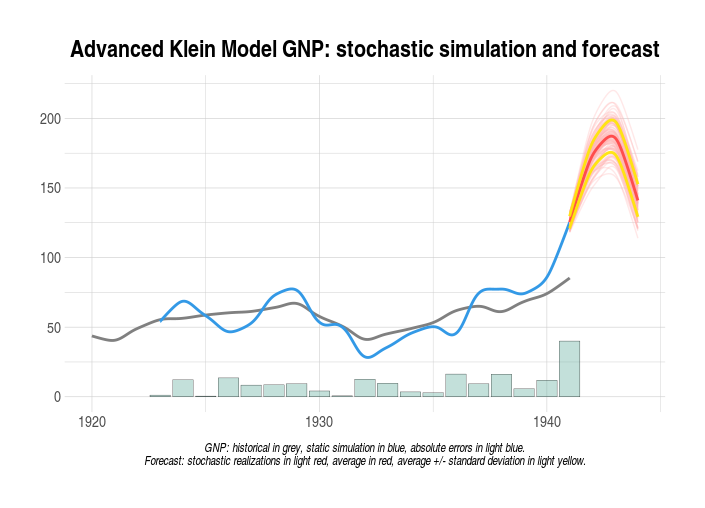
we want to perform a stochastic forecast of the GNP up to 1944
we will add normal disturbances to endogenous Consumption 'cn'
in 1942 by using its regression standard error
we will add uniform disturbances to exogenous Government Expenditure 'g'
in whole TSRANGE
myStochStructure <- list( cn=list( TSRANGE=c(1942,1,1942,1), TYPE='NORM', PARS=c(0,kleinModel$behaviorals$cn$statistics$StandardErrorRegression) ), g=list( TSRANGE=TRUE, TYPE='UNIF', PARS=c(-1,1) ) )
we need to extend exogenous variables up to 1944
kleinModel$modelData <- within(kleinModel$modelData,{ w2 = TSEXTEND(w2, UPTO=c(1944,1),EXTMODE='CONSTANT') t = TSEXTEND(t, UPTO=c(1944,1),EXTMODE='LINEAR') g = TSEXTEND(g, UPTO=c(1944,1),EXTMODE='CONSTANT') k = TSEXTEND(k, UPTO=c(1944,1),EXTMODE='LINEAR') time = TSEXTEND(time,UPTO=c(1944,1),EXTMODE='LINEAR') })
stochastic model forecast
kleinModel <- STOCHSIMULATE(kleinModel ,simType='FORECAST' ,TSRANGE=c(1941,1,1944,1) ,StochStructure=myStochStructure ,StochSeed=123 )
print mean and standard deviation of forecasted GNP
with(kleinModel$stochastic_simulation,TABIT(y$mean, y$sd))
Date, Prd., y$mean , y$sd
1941, 1 , 125.5045 , 4.250935
1942, 1 , 173.2946 , 9.2632
1943, 1 , 185.9602 , 11.87774
1944, 1 , 141.0807 , 11.6973
```
```r
MODEL MULTIPLIERS
get multiplier matrix in 1941
kleinModel <- MULTMATRIX(kleinModel, TSRANGE=c(1941,1,1941,1), INSTRUMENT=c('w2','g'), TARGET=c('cn','y'), simIterLimit = 100)
Multiplier Matrix: 100.00%
...MULTMATRIX OK
kleinModel$MultiplierMatrix
w21 g1
cn_1 0.2338194 3.753277
y_1 -0.2002040 7.444930
MODEL ENDOGENOUS TARGETING
we want an arbitrary value on Consumption of 66 in 1940 and 78 in 1941
we want an arbitrary value on GNP of 77 in 1940 and 98 in 1941
kleinTargets <- list( cn = TIMESERIES(66,78,START=c(1940,1),FREQ=1), y = TIMESERIES(77,98,START=c(1940,1),FREQ=1) )
Then, we can perform the model endogenous targeting
by using Government Wage Bill 'w2'
and Government Expenditure 'g' as
INSTRUMENT in the years 1940 and 1941:
kleinModel <- RENORM(kleinModel ,simConvergence=1e-5 ,INSTRUMENT = c('w2','g') ,TARGET = kleinTargets ,TSRANGE = c(1940,1,1941,1) ,simIterLimit = 100 )
Convergence reached in 3 iterations.
...RENORM OK
The calculated values of exogenous INSTRUMENT
that allow achieving the desired endogenous TARGET values
are stored into the model:
with(kleinModel,TABIT(modelData$w2, renorm$INSTRUMENT$w2, modelData$g, renorm$INSTRUMENT$g))
Date, Prd., modelData$w2, renorm$w2, modelData$g, renorm$g
...
1938, 1 , 7.7 , , 13 ,
1939, 1 , 7.8 , , 14.4 ,
1940, 1 , 8 , 5.577777 , 15.4 , 14.14058
1941, 1 , 8.5 , 5.354341 , 22.3 , 17.80586
So, if we want to achieve on "cn" (Consumption) an arbitrary simulated value of 66 in 1940
and 78 in 1941, and if we want to achieve on "y" (GNP) an arbitrary simulated value of 77
in 1940 and 98 in 1941, we need to change exogenous "w2" (Wage Bill of the Government
Sector) from 8 to 5.58 in 1940 and from 8.5 to 5.35 in 1941, and we need to change exogenous
"g"(Government Expenditure) from 15.4 to 14.14 in 1940 and from 22.3 to 17.81 in 1941.
Let's verify:
create a new model
kleinRenorm <- kleinModel
update the required INSTRUMENT
kleinRenorm$modelData <- kleinRenorm$renorm$modelData
simulate the new model
kleinRenorm <- SIMULATE(kleinRenorm ,TSRANGE=c(1940,1,1941,1) ,simConvergence=1e-4 ,simIterLimit=100 )
Simulation: 100.00%
...SIMULATE OK
verify TARGETs are achieved
with(kleinRenorm$simulation, TABIT(cn,y) )
Date, Prd., cn , y
1940, 1 , 65.99977 , 76.9996
1941, 1 , 77.99931 , 97.99879
MODEL OPTIMAL CONTROL
reset time series data in model
kleinModel <- LOADMODELDATA(kleinModel ,kleinModelData ,quietly = TRUE)
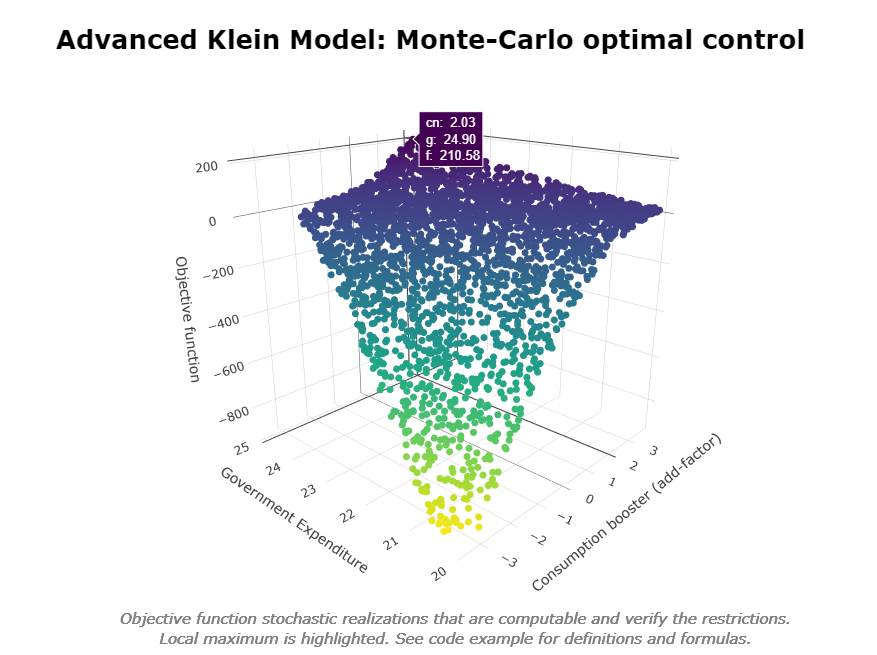
we want to maximize the non-linear objective function:
f()=(y-110)+(cn-90)*ABS(cn-90)-(g-20)^0.5
in 1942 by using INSTRUMENT cn in range (-5,5)
(cn is endogenous so we use the add-factor)
and g in range (15,25)
we will also impose the following non-linear restriction:
g+(cn^2)/2<27 & g+cn>17
we need to extend exogenous variables up to 1942
kleinModel$modelData <- within(kleinModel$modelData,{ w2 = TSEXTEND(w2, UPTO = c(1942,1), EXTMODE = 'CONSTANT') t = TSEXTEND(t, UPTO = c(1942,1), EXTMODE = 'LINEAR') g = TSEXTEND(g, UPTO = c(1942,1), EXTMODE = 'CONSTANT') k = TSEXTEND(k, UPTO = c(1942,1), EXTMODE = 'LINEAR') time = TSEXTEND(time, UPTO = c(1942,1), EXTMODE = 'LINEAR') })
define INSTRUMENT and boundaries
myOptimizeBounds <- list( cn = list( TSRANGE = TRUE ,BOUNDS = c(-5,5)), g = list( TSRANGE = TRUE ,BOUNDS = c(15,25)) )
define restrictions
myOptimizeRestrictions <- list( myRes1=list( TSRANGE = TRUE ,INEQUALITY = 'g+(cn^2)/2<27 & g+cn>17') )
define objective function
myOptimizeFunctions <- list( myFun1 = list( TSRANGE = TRUE ,FUNCTION = '(y-110)+(cn-90)*ABS(cn-90)-(g-20)^0.5') )
Monte-Carlo optimization by using 10.000 stochastic realizations
and 1E-7 convergence criterion
kleinModel <- OPTIMIZE(kleinModel ,simType = 'FORECAST' ,TSRANGE=c(1942,1,1942,1) ,simConvergence= 1E-7 ,simIterLimit = 100 ,StochReplica = 10000 ,StochSeed = 123 ,OptimizeBounds = myOptimizeBounds ,OptimizeRestrictions = myOptimizeRestrictions ,OptimizeFunctions = myOptimizeFunctions ,quietly = TRUE)
print local maximum
kleinModel$optimize$optFunMax
[1] 210.577
print INSTRUMENT that allow local maximum to be achieved
kleinModel$optimize$INSTRUMENT
$cn
Time Series:
Start = 1942
End = 1942
Frequency = 1
[1] 2.032203
$g
Time Series:
Start = 1942
End = 1942
Frequency = 1
[1] 24.89773
```
```
RATIONAL EXPECTATIONS
EXAMPLE OF FORWARD-LOOKING KLEIN-LIKE MODEL
HAVING RATIONAL EXPECTATION ON INVESTMENTS
define model
kleinLeadModelDefinition<- "MODEL COMMENT> Klein Model 1 of the U.S. Economy
COMMENT> Consumption BEHAVIORAL> cn TSRANGE 1921 1 1941 1 EQ> cn = a1 + a2p + a3TSLAG(p,1) + a4*(w1+w2) COEFF> a1 a2 a3 a4
COMMENT> Investment with TSLEAD IDENTITY> i EQ> i = (MOVAVG(i,2)+TSLEAD(i))/2
COMMENT> Demand for Labor BEHAVIORAL> w1 TSRANGE 1921 1 1941 1 EQ> w1 = c1 + c2(y+t-w2) + c3TSLAG(y+t-w2,1) + c4*time COEFF> c1 c2 c3 c4
COMMENT> Gross National Product IDENTITY> y EQ> y = cn + i + g - t
COMMENT> Profits IDENTITY> p EQ> p = y - (w1+w2)
COMMENT> Capital Stock IDENTITY> k EQ> k = TSLAG(k,1) + i
END"
define model data
kleinLeadModelData<-list( cn =TIMESERIES(39.8,41.9,45,49.2,50.6,52.6,55.1,56.2,57.3,57.8,55,50.9, 45.6,46.5,48.7,51.3,57.7,58.7,57.5,61.6,65,69.7, START=c(1920,1),FREQ=1), g =TIMESERIES(4.6,6.6,6.1,5.7,6.6,6.5,6.6,7.6,7.9,8.1,9.4,10.7,10.2,9.3,10, 10.5,10.3,11,13,14.4,15.4,22.3, START=c(1920,1),FREQ=1), i =TIMESERIES(2.7,-.2,1.9,5.2,3,5.1,5.6,4.2,3,5.1,1,-3.4,-6.2,-5.1,-3,-1.3, 2.1,2,-1.9,1.3,3.3,4.9, START=c(1920,1),FREQ=1), k =TIMESERIES(182.8,182.6,184.5,189.7,192.7,197.8,203.4,207.6,210.6,215.7, 216.7,213.3,207.1,202,199,197.7,199.8,201.8,199.9, 201.2,204.5,209.4, START=c(1920,1),FREQ=1), p =TIMESERIES(12.7,12.4,16.9,18.4,19.4,20.1,19.6,19.8,21.1,21.7,15.6,11.4, 7,11.2,12.3,14,17.6,17.3,15.3,19,21.1,23.5, START=c(1920,1),FREQ=1), w1 =TIMESERIES(28.8,25.5,29.3,34.1,33.9,35.4,37.4,37.9,39.2,41.3,37.9,34.5, 29,28.5,30.6,33.2,36.8,41,38.2,41.6,45,53.3, START=c(1920,1),FREQ=1), y =TIMESERIES(43.7,40.6,49.1,55.4,56.4,58.7,60.3,61.3,64,67,57.7,50.7,41.3, 45.3,48.9,53.3,61.8,65,61.2,68.4,74.1,85.3, START=c(1920,1),FREQ=1), t =TIMESERIES(3.4,7.7,3.9,4.7,3.8,5.5,7,6.7,4.2,4,7.7,7.5,8.3,5.4,6.8,7.2, 8.3,6.7,7.4,8.9,9.6,11.6, START=c(1920,1),FREQ=1), time =TIMESERIES(NA,-10,-9,-8,-7,-6,-5,-4,-3,-2,-1,0,1,2,3,4,5,6,7,8,9,10, START=c(1920,1),FREQ=1), w2 =TIMESERIES(2.2,2.7,2.9,2.9,3.1,3.2,3.3,3.6,3.7,4,4.2,4.8,5.3,5.6,6,6.1, 7.4,6.7,7.7,7.8,8,8.5, START=c(1920,1),FREQ=1) )
load model and model data
kleinLeadModel<-LOADMODEL(modelText=kleinLeadModelDefinition) kleinLeadModel<-LOADMODEL_DATA(kleinLeadModel,kleinLeadModelData)
estimate model
kleinLeadModel<-ESTIMATE(kleinLeadModel, quietly = TRUE)
set expected value of 2 for Investment in 1931
(note that simulation TSRANGE spans up to 1930)
kleinLeadModel$modelData$i[[1931,1]]<-2
simulate model
kleinLeadModel<-SIMULATE(kleinLeadModel ,TSRANGE=c(1924,1,1930,1))
print simulated investments
TABIT(kleinLeadModel$simulation$i)
Date, Prd., kleinLeadModel$simulation$i
1924, 1 , 3.594946
1925, 1 , 2.792062
1926, 1 , 2.390277
1927, 1 , 2.189125
1928, 1 , 2.08838
1929, 1 , 2.037915
1930, 1 , 2.012644
```
MODEL DESCRIPTION LANGUAGE SYNTAX
The mathematical expression available for use in model equations can include the standard arithmetic operators, parentheses and the following MDL functions:
TSLAG(ts,i): lag the ts time series by i-periods;TSLEAD(ts,i): lead the ts time series by i-periods;TSDELTA(ts,i): i-periods difference of the ts time series;TSDELTAP(ts,i): i-periods percentage difference of the ts time series;TSDELTALOG(ts,i): i-periods logarithmic difference of the ts time series;MOVAVG(ts,i): i-periods moving average of the ts time series;MOVSUM(ts,i): i-periods moving sum of the ts time series;LOG(ts): log of the ts time series;EXP(ts): exponential of the ts time series;ABS(ts): absolute values of the ts time series.
Transformations of the dependent variable are allowed in EQ> definition, e.g. TSDELTA(cn)=..., EXP(i)=..., TSDELTALOG(y)=..., etc.
More details are available in the reference manual.
COMPUTATIONAL DETAILS
The iterative simulation procedure is the most time-consuming operation of the bimets package. For small models, this operation is quite immediate; on the other hand, the simulation of models that count hundreds of equations could last for minutes, especially if the requested operation involves a parallel simulation having hundreds of realizations per equation. This could be the case for the endogenous targeting, the stochastic simulation and the optimal control. In these cases, a Newton-Raphson algorithm can speed up the execution.
The SIMULATE code has been optimized in order to minimize the execution time in these cases. In terms of computational efficiency, the procedure takes advantage of the fact that multiple datasets are bound together in matrices, therefore in order to achieve a global convergence, the iterative simulation algorithm is executed once for all perturbed datasets. This solution can be viewed as a sort of a SIMD (i.e. Single Instruction Multiple Data) parallel simulation: the SIMULATE algorithm transforms time series into matrices and consequently can easily bind multiple datasets by column. At the same time, the single run ensures a fast code execution, while each column in the output matrices represents a stochastic or perturbed realization.
The above approach is even faster if R has been compiled and linked to optimized multi-threaded numerical libraries, e.g. Intel(R) MKL, OpenBlas, Microsoft(R) R Open, etc.
Finally, model equations are pre-fetched into sorted R expressions, and an optimized R environment is defined and reserved to the SIMULATE algorithm; this approach removes the overhead usually caused by expression parsing and by the R looking for variables inside nested environments.
bimets estimation and simulation results have been compared to the output results of leading commercial econometric software by using several large and complex models.
The models used in the comparison have more than:
- +100 behavioral equations;
- +700 technical identities;
- +500 coefficients;
- +1000 time series of endogenous and exogenous variables;
In these models, we can find equations with restricted coefficients, polynomial distributed lags, error autocorrelation, and conditional evaluation of technical identities; all models have been simulated in static, dynamic, and forecast mode, with exogenization and constant adjustments of endogenous variables, through the use of bimets capabilities.
In the +800 endogenous simulated time series over the +20 simulated periods (i.e. more than 16.000 simulated observations), the average percentage difference between bimets and leading commercial software results has a magnitude of 10E-7 %. The difference between results calculated by using different commercial software has the same average magnitude.
Several advanced econometric exercises on the US Federal Reserve FRB/US econometric model (e.g., dynamic simulation in a monetary policy shock, rational expectations, endogenous targeting, stochastic simulation, etc.) are available in the "US Federal Reserve quarterly model (FRB/US) in R with bimets" vignette.
Installation
The package can be installed and loaded in R with the following commands:
r
install.packages("bimets")
library(bimets)
<!--
To install the latest development builds directly from GitHub, run this instead:
r
if (!require("devtools"))
  install.packages("devtools")
devtools::install_github("bimets")
-->
Guidelines for contributing
We welcome contributions to the bimets package. In the case, please use the git issue tracker or write to the maintainer.
License
The bimets package is licensed under the GPL-3.
Disclaimer: The views and opinions expressed in these pages are those of the authors and do not necessarily reflect the official policy or position of the Bank of Italy. Examples of analysis performed within these pages are only examples. They should not be utilized in real-world analytic products as they are based only on very limited and dated open source information. Assumptions made within the analysis are not reflective of the position of the Bank of Italy.
GitHub Events
Total
- Issues event: 5
- Watch event: 5
- Issue comment event: 11
- Push event: 1
- Create event: 1
Last Year
- Issues event: 5
- Watch event: 5
- Issue comment event: 11
- Push event: 1
- Create event: 1
Committers
Last synced: almost 3 years ago
Top Committers
| Name | Commits | |
|---|---|---|
| Andrea Luciani | a****i@b****t | 11 |
Committer Domains (Top 20 + Academic)
Issues and Pull Requests
Last synced: 11 months ago
All Time
- Total issues: 15
- Total pull requests: 0
- Average time to close issues: 17 days
- Average time to close pull requests: N/A
- Total issue authors: 7
- Total pull request authors: 0
- Average comments per issue: 3.27
- Average comments per pull request: 0
- Merged pull requests: 0
- Bot issues: 0
- Bot pull requests: 0
Past Year
- Issues: 5
- Pull requests: 0
- Average time to close issues: 3 months
- Average time to close pull requests: N/A
- Issue authors: 4
- Pull request authors: 0
- Average comments per issue: 2.6
- Average comments per pull request: 0
- Merged pull requests: 0
- Bot issues: 0
- Bot pull requests: 0
Top Authors
Issue Authors
- murao164jp (5)
- rrremedio (4)
- ferdinand-fichtner (2)
- juansqw (1)
- pugwalker1 (1)
- fuadlabgit (1)
- joaombdacosta (1)
Pull Request Authors
Top Labels
Issue Labels
Pull Request Labels
Packages
- Total packages: 1
-
Total downloads:
- cran 1,051 last-month
- Total docker downloads: 42,005
- Total dependent packages: 0
- Total dependent repositories: 1
- Total versions: 20
- Total maintainers: 1
cran.r-project.org: bimets
Time Series and Econometric Modeling
- Homepage: https://github.com/andrea-luciani/bimets
- Documentation: http://cran.r-project.org/web/packages/bimets/bimets.pdf
- License: GPL-3
-
Latest release: 4.0.4
published about 1 year ago
Rankings
Maintainers (1)
Dependencies
- R >= 3.3 depends
- xts * depends
- zoo * depends
- stats * imports