pipenostics
Heat loss, corrosion diagnostics, and predictive maintenance of pipeline systems. The package is designed for engineers who are involved in exploratory or routine calculations.
Science Score: 26.0%
This score indicates how likely this project is to be science-related based on various indicators:
-
○CITATION.cff file
-
✓codemeta.json file
Found codemeta.json file -
✓.zenodo.json file
Found .zenodo.json file -
○DOI references
-
○Academic publication links
-
○Committers with academic emails
-
○Institutional organization owner
-
○JOSS paper metadata
-
○Scientific vocabulary similarity
Low similarity (13.3%) to scientific vocabulary
Keywords
Repository
Heat loss, corrosion diagnostics, and predictive maintenance of pipeline systems. The package is designed for engineers who are involved in exploratory or routine calculations.
Basic Info
- Host: GitHub
- Owner: omega1x
- Language: R
- Default Branch: master
- Homepage: https://omega1x.github.io/pipenostics/
- Size: 7.29 MB
Statistics
- Stars: 1
- Watchers: 0
- Forks: 0
- Open Issues: 2
- Releases: 0
Topics
Metadata Files
README.md
pipenostics




R-package for diagnostics, reliability and predictive maintenance of pipeline systems.
Intro
The package aggregates some of the separate knowledge regarding engineering, reliability, diagnostics, and predictive maintenance of pipeline systems. At the moment, the package includes utilities for processing corrosion data commonly collected by inline inspection, as well as empirical models for calculating local thermal-hydraulic conditions in district heating networks. Additionally, the package provides a variety of useful tools and datasets that can assist with solving a range of related issues.
Installation
For the stable version install from CRAN:
R
install.packages("pipenostics")
For the latest version leverage r-universe:
R
install.packages("pipenostics", repos = "https://omega1x.r-universe.dev")
Usage examples
Corrosion diagnostics
By using of b31crvl() simply imitate the output of CRVL.BAS which is the honored software for determining the allowable length and maximum
allowable working pressure presented in ASME B31G-1991:
```R library(pipenostics)
b31crvl(maop = 910, d = 30, wth = .438, smys = 52000, def = .72, depth = .1, l = 7.5) ```
txt
-- Calculated data --
Intermediate factor (A) = 1.847
Design pressure = 1093 PSI; Safe pressure = 1093 PSI
Pipe may be operated safely at MAOP, 910 PSI
With corrosion length 7.500 inch, maximum allowed corrosion depth is 0.2490 inch; A = 1.847
With corrosion depth 0.100 inch, maximum allowed corrosion length is Inf inch; A = 5.000
Probability of failure
Let's consider a pipe in district heating network with
R
diameter           <- 762         # [mm]
wall_thickness     <-  10         # [mm]
UTS                <- 434.3697    # [MPa]
which transfers heat-carrier (water) at
R
operating_pressure <-   0.588399  # [MPa]
temperature        <-  95         # [°C]
During inline inspection four corroded areas (defects) are detected with:
R
depth  <- c(2.45,  7.86,   7.93,   8.15)  # [mm]
whereas the length of all defects is not greater 200 mm:
R
length <- rep(200, 4)  # [mm]
print(length)
R
[1] 200 200 200 200
Corrosion rates in radial and in longitudinal directions are not well-known and
may vary in range .01 - .30 mm/year:
R
rar = function(n) stats::runif(n, .01, .30) / 365
ral = function(n) stats::runif(n, .01, .30) / 365
Then probabilities of failure (POFs) related to each corroded area are near:
R
pof <- mepof(depth, length, rep(diameter, 4), rep(wall_thickness, 4),
             rep(UTS, 4), rep(operating_pressure, 4), rep(temperature, 4),
             rar, ral, method = "dnv")
txt
pipenostics::mepof: process case [4/4] - 100 % . All done, thanks!
R
print(pof)
R
[1] 0.000000 0.252935 0.368741 0.771299
So, the POF of the pipe is near
R
print(max(pof))
R
[1] 0.771299
The value of POF changes in time. So, in a year after inline inspection of the pipe we can get something near
R
pof <- mepof(depth, length, rep(diameter, 4), rep(wall_thickness, 4),
             rep(UTS, 4), rep(operating_pressure, 4), rep(temperature, 4),
             rar, ral, method = "dnv", days = 365)
txt
pipenostics::mepof: process case [4/4] - 100 % . All done, thanks!
R
print(pof)
R
[1] 0.000000 0.526646 0.647422 0.928825
For entire pipe we get something near:
R
print(max(pof))
R
[1] 0.928825
Two years ago before inline inspection the pipe state was rather good:
R
pof <- mepof(depth, length, rep(diameter, 4), rep(wall_thickness, 4),
             rep(UTS, 4), rep(operating_pressure, 4), rep(temperature, 4),
             rar, ral, method = "dnv", days = -2 * 365)
txt
pipenostics::mepof: process case [4/4] - 100 % . All done, thanks!
R
print(pof)
R
[1] 0.000000 0.040849 0.072734 0.272358
For entire pipe we get something near:
R
print(max(pof))
R
[1] 0.272358
Regime tracing
Let's consider the next 4-segment tracing path:
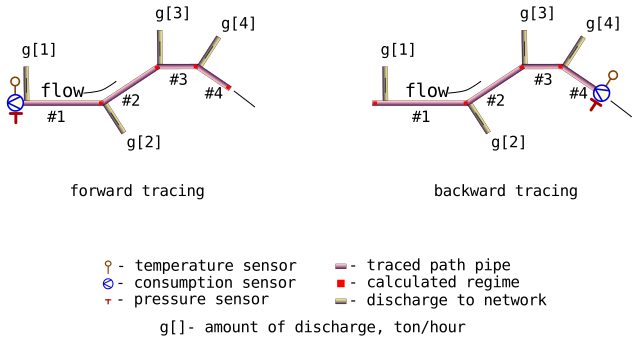
Suppose we have the next sensor readings for forward tracing:
R
t_fw <- 130         # [°C]
p_fw <-   0.588399  # [MPa]
g_fw <- 250         # [ton/hour]
Let's discharges to network for each pipeline segment are somehow determined as
R
discharges <- seq(0, 30, 10)  # [ton/hour]
print(discharges)
R
[1]  0 10 20 30
Then the calculated regime (red squares) for forward tracing is
R
regime_fw <- m325traceline(t_fw, p_fw, g_fw, discharges, forward = TRUE)
print(regime_fw)
```R $temperature [1] 129.1799 128.4269 127.9628 127.3367
$pressure [1] 0.5878607 0.5874226 0.5872143 0.5870330
$flow_rate [1] 250 240 220 190 ```
ℹ Read article Concepts and useful notes for a deeper dive into the topic.
Owner
- Name: Yuri Possokhov
- Login: omega1x
- Kind: user
- Website: http://www.linkedin.com/in/possokhoff
- Repositories: 13
- Profile: https://github.com/omega1x
PhD, AI Senior Developer
GitHub Events
Total
- Issues event: 1
- Watch event: 1
- Push event: 3
Last Year
- Issues event: 1
- Watch event: 1
- Push event: 3
Committers
Last synced: over 3 years ago
All Time
- Total Commits: 81
- Total Committers: 3
- Avg Commits per committer: 27.0
- Development Distribution Score (DDS): 0.062
Top Committers
| Name | Commits | |
|---|---|---|
| omega1x | o****x@g****m | 76 |
| Yuri Possokhov | p****f@g****m | 3 |
| devpro | d****o@g****m | 2 |
Issues and Pull Requests
Last synced: 12 months ago
All Time
- Total issues: 21
- Total pull requests: 2
- Average time to close issues: about 2 months
- Average time to close pull requests: 2 days
- Total issue authors: 2
- Total pull request authors: 1
- Average comments per issue: 0.19
- Average comments per pull request: 0.0
- Merged pull requests: 1
- Bot issues: 0
- Bot pull requests: 0
Past Year
- Issues: 2
- Pull requests: 0
- Average time to close issues: N/A
- Average time to close pull requests: N/A
- Issue authors: 2
- Pull request authors: 0
- Average comments per issue: 0.0
- Average comments per pull request: 0
- Merged pull requests: 0
- Bot issues: 0
- Bot pull requests: 0
Top Authors
Issue Authors
- omega1x (18)
- llrs (1)
Pull Request Authors
- omega1x (4)
Top Labels
Issue Labels
Pull Request Labels
Packages
- Total packages: 1
-
Total downloads:
- cran 163 last-month
- Total dependent packages: 0
- Total dependent repositories: 0
- Total versions: 2
- Total maintainers: 1
cran.r-project.org: pipenostics
Diagnostics, Reliability and Predictive Maintenance of Pipeline Systems
- Homepage: https://omega1x.github.io/pipenostics/
- Documentation: http://cran.r-project.org/web/packages/pipenostics/pipenostics.pdf
- License: GPL-3
-
Latest release: 0.2.0
published over 2 years ago
Rankings
Maintainers (1)
Dependencies
- R >= 3.5.0 depends
- checkmate * imports
- covr * suggests
- testthat >= 3.0.0 suggests
- actions/checkout v2 composite
- r-lib/actions/setup-pandoc v2 composite
- r-lib/actions/setup-r v2 composite
- r-lib/actions/setup-r-dependencies v2 composite
- actions/checkout v4 composite
- r-lib/actions/check-r-package v2 composite
- r-lib/actions/setup-pandoc v2 composite
- r-lib/actions/setup-r v2 composite
- r-lib/actions/setup-r-dependencies v2 composite