https://github.com/hackingmaterials/robocrystallographer
Automatic generation of crystal structure descriptions.
Science Score: 57.0%
This score indicates how likely this project is to be science-related based on various indicators:
-
○CITATION.cff file
-
✓codemeta.json file
Found codemeta.json file -
✓.zenodo.json file
Found .zenodo.json file -
✓DOI references
Found 2 DOI reference(s) in README -
○Academic publication links
-
✓Committers with academic emails
1 of 6 committers (16.7%) from academic institutions -
✓Institutional organization owner
Organization hackingmaterials has institutional domain (hackingmaterials.lbl.gov) -
○JOSS paper metadata
-
○Scientific vocabulary similarity
Low similarity (15.0%) to scientific vocabulary
Keywords
Keywords from Contributors
Repository
Automatic generation of crystal structure descriptions.
Basic Info
- Host: GitHub
- Owner: hackingmaterials
- License: other
- Language: Python
- Default Branch: main
- Homepage: https://hackingmaterials.github.io/robocrystallographer/
- Size: 115 MB
Statistics
- Stars: 116
- Watchers: 7
- Forks: 29
- Open Issues: 28
- Releases: 16
Topics
Metadata Files
README.md


Robocrystallographer is a tool to generate text descriptions of crystal structures. Similar to how a real-life crystallographer would analyse a structure, robocrystallographer looks at the symmetry, local environment, and extended connectivity when generating a description. The package includes utilities for identifying molecule names, component orientations, heterostructure information, and more...
Usage
Robocrystallographer can be used from the command-line or from a python API. The package integrates with the Materials Project to for allow generation of structure descriptions directly from Materials Project ids. For example, to generate the description of SnO2 (mp-856), one can simply run:
bash
robocrys mp-856
Alternatively, a structure file can be specified in place of a Materials Project id. Robocrystallographer supports the same file formats as pymatgen, including the Crystallographic Information Format (CIF), and common electronic structure package formats such as POSCAR files. More information can be found on the command-line interface page.
Python interface
The two core classes in robocrystallographer are:
StructureCondenser: to condense the structure into an descriptive JSON representation.StructureDescriber: to turn the condensed structure into a text description.
A minimal working example for generating text descriptions is simply:
```python from pymatgen import Structure from robocrys import StructureCondenser, StructureDescriber
structure = Structure.fromfile("mystructure.cif") # other file formats also supported
alternatively, uncomment the lines below to use the MPRester object
to fetch structures from the Materials Project database
from mp_api.client import MPRester
structure = MPRester(apikey=None).getstructurebymaterial_id("mp-856")
condenser = StructureCondenser() describer = StructureDescriber()
condensedstructure = condenser.condensestructure(structure) description = describer.describe(condensed_structure) ```
Where structure is a pymatgen Structure object. Both classes have many
options for customising the output of the structure
descriptions. More information is provided in the
module documentation.
Intermediate JSON format
The format of the intermediate JSON representation is detailed on the condensed structure format page.
Example output
An example of the output generated by robocrystallographer for SnO2 (mp-856) is given below:
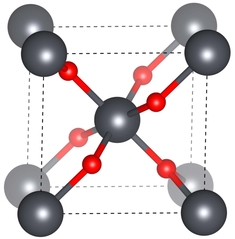
SnO2 is Rutile structured and crystallizes in the tetragonal P4_2/mnm space group. The structure is three-dimensional. Sn(1) is bonded to six equivalent O(1) atoms to form a mixture of edge and corner-sharing SnO6 octahedra. The corner-sharing octahedral tilt angles are 51°. All Sn(1)–O(1) bond lengths are 2.09 Å. O(1) is bonded in a trigonal planar geometry to three equivalent Sn(1) atoms.
How to cite robocrystallographer
Please considering citing the following publication if using robocrystallographer in your work:
Ganose, A., & Jain, A. (2019). Robocrystallographer: Automated crystal structure text descriptions and analysis. MRS Communications, 9(3), 874-881. https://doi.org/10.1557/mrc.2019.94
Installation
Robocrystallographer can be installed using pip:
bash
pip install robocrys
Robocrystallographer requires Python 3.7+. The OpenBabel package is required to determine molecule names. This is an optional requirement but its use is recommended for best results. If you are using the Conda package management system, OpenBabel can be installed using:
bash
conda install -c conda-forge openbabel
What’s new?
Track changes to robocrystallographer through the Changelog.
Contributing
Robocrystallographer is in early development but we still welcome your contributions. Please read our contribution guidelines for more information. We maintain a list of all contributors here.
License
Robocrystallographer is released under a modified BSD license; the full text can be found here.
Acknowledgements
Logo by Somewan from the Noun Project.
Owner
- Name: Hacking Materials Research Group
- Login: hackingmaterials
- Kind: organization
- Location: Lawrence Berkeley National Lab, CA
- Website: https://hackingmaterials.lbl.gov
- Repositories: 22
- Profile: https://github.com/hackingmaterials
GitHub Events
Total
- Create event: 29
- Release event: 1
- Issues event: 3
- Watch event: 19
- Delete event: 33
- Member event: 1
- Issue comment event: 32
- Push event: 15
- Pull request event: 69
- Fork event: 3
Last Year
- Create event: 29
- Release event: 1
- Issues event: 3
- Watch event: 19
- Delete event: 33
- Member event: 1
- Issue comment event: 32
- Push event: 15
- Pull request event: 69
- Fork event: 3
Committers
Last synced: about 3 years ago
Top Committers
| Name | Commits | |
|---|---|---|
| Alex Ganose | a****e@g****m | 291 |
| dependabot[bot] | 4****]@u****m | 197 |
| dependabot-preview[bot] | 2****]@u****m | 62 |
| Alex Ganose | u****f@u****m | 39 |
| Alex Dunn | a****n@l****v | 2 |
| Matthew Horton | m****n@u****m | 1 |
Committer Domains (Top 20 + Academic)
Issues and Pull Requests
Last synced: 11 months ago
All Time
- Total issues: 12
- Total pull requests: 303
- Average time to close issues: over 1 year
- Average time to close pull requests: about 1 month
- Total issue authors: 11
- Total pull request authors: 4
- Average comments per issue: 1.67
- Average comments per pull request: 0.66
- Merged pull requests: 98
- Bot issues: 1
- Bot pull requests: 292
Past Year
- Issues: 2
- Pull requests: 73
- Average time to close issues: 3 days
- Average time to close pull requests: 13 days
- Issue authors: 2
- Pull request authors: 2
- Average comments per issue: 0.0
- Average comments per pull request: 0.38
- Merged pull requests: 16
- Bot issues: 1
- Bot pull requests: 71
Top Authors
Issue Authors
- sgbaird (2)
- zakidotai (1)
- antonmilev (1)
- kdmsit (1)
- whyydsforever (1)
- plasmon1977 (1)
- ViktoriiaBaib (1)
- Andrew-S-Rosen (1)
- dependabot[bot] (1)
- computron (1)
Pull Request Authors
- dependabot[bot] (300)
- esoteric-ephemera (7)
- kavanase (2)
- sgbaird (1)
Top Labels
Issue Labels
Pull Request Labels
Packages
- Total packages: 3
-
Total downloads:
- pypi 12,801 last-month
-
Total dependent packages: 2
(may contain duplicates) -
Total dependent repositories: 21
(may contain duplicates) - Total versions: 19
- Total maintainers: 2
pypi.org: robocrys
Automatic generation of crystal structure descriptions
- Homepage: https://github.com/hackingmaterials/robocrystallographer
- Documentation: https://robocrys.readthedocs.io/
- License: modified BSD
-
Latest release: 0.2.11
published over 1 year ago
Rankings
Maintainers (1)
spack.io: py-robocrys
Robocrystallographer is a tool to generate text descriptions of crystal structures. Similar to how a real-life crystallographer would analyse a structure, robocrystallographer looks at the symmetry, local environment, and extended connectivity when generating a description. The package includes utilities for identifying molecule names, component orientations, heterostructure information, and more.
- Homepage: https://github.com/hackingmaterials/robocrystallographer
- License: []
-
Latest release: 0.2.7
published over 3 years ago
Rankings
Maintainers (1)
conda-forge.org: robocrys
Robocrystallographer is a tool to generate text descriptions of crystal structures. Similar to how a real-life crystallographer would analyse a structure, robocrystallographer looks at the symmetry, local environment, and extended connectivity when generating a description. The package includes utilities for identifying molecule names, component orientations, heterostructure information, and more...
- Homepage: https://github.com/hackingmaterials/robocrystallographer
- License: MIT
-
Latest release: 0.2.7
published about 5 years ago
Rankings
Dependencies
- inflect ==5.6.1
- matminer ==0.7.6
- monty ==2022.1.19
- networkx ==2.8.4
- numpy ==1.23.1
- pubchempy ==1.0.4
- pybtex ==0.24.0
- pymatgen ==2022.7.8
- scipy ==1.8.1
- spglib ==1.16.5
- inflect *
- matminer *
- monty *
- networkx *
- numpy *
- pubchempy *
- pybtex *
- pymatgen >=2020.10.20
- ruamel.yaml *
- scipy *
- spglib *
- actions/checkout v1 composite
- actions/create-release v1 composite
- pypa/gh-action-pypi-publish master composite
- s-weigand/setup-conda v1 composite
- actions/checkout v2 composite
- s-weigand/setup-conda v1 composite
- actions/checkout v4 composite
- actions/setup-python v5 composite