geocmeans
geocmeans: An R package for spatial fuzzy c-means - Published in JOSS (2023)
Science Score: 93.0%
This score indicates how likely this project is to be science-related based on various indicators:
-
○CITATION.cff file
-
✓codemeta.json file
Found codemeta.json file -
✓.zenodo.json file
Found .zenodo.json file -
✓DOI references
Found 12 DOI reference(s) in README and JOSS metadata -
✓Academic publication links
Links to: zenodo.org -
○Committers with academic emails
-
○Institutional organization owner
-
✓JOSS paper metadata
Published in Journal of Open Source Software
Keywords
Repository
An R package to perform Spatial Fuzzy C-means
Basic Info
Statistics
- Stars: 28
- Watchers: 1
- Forks: 2
- Open Issues: 0
- Releases: 1
Topics
Metadata Files
README.md
geocmeans 
An R package to perform Spatial Fuzzy C-means.




The website of the package is available here
Breaking news
Here we are! We are moving from maptools, sp, rgeos, raster and
rgdal to sf, terra and tmap. All the functions and the
documentation were modified accordingly. If you spot an error or a bug,
please open an issue on github.
Installation
The stable version of geocmeans is available on CRAN. You can install
it with the command below.
install.packages("geocmeans")
You can install a development version of the geocmeans package using
the command below.
remotes::install_github(repo = "JeremyGelb/geocmeans", build_vignettes = TRUE, force = TRUE)
Authors
Jeremy Gelb, Laboratoire d’Équité Environnemental INRS (CANADA), Email: jeremy.gelb@ucs.inrs.ca
Contributors
Philippe Apparicio, Laboratoire d’Équité Environnemental INRS (CANADA), Email: philippe.apparicio@ucs.inrs.ca
About the package
Provides functions to apply Spatial Fuzzy c-means Algorithm, visualize and interpret results. This method is well suited when the user wants to analyze data with a fuzzy clustering algorithm and to account for the spatial dimension of the dataset. In addition, indexes for measuring the spatial consistency and classification quality are proposed. The algorithms were developed first for brain imagery as described in the articles of Cai and al. 2007 and Zaho and al. 2013. Gelb and Apparicio proposed to apply the method to perform a socio-residential and environmental taxonomy in Lyon (France). The methods can be applied to dataframes or to rasters.
Fuzzy classification algorithms
Four Fuzzy classification algorithms are proposed :
- FCM: Fuzzy C-Means, with the function
CMeans - GFCM: Generalized Fuzzy C-Means, with the function
GFCMeans - SFCM: Spatial Fuzzy C-Means, with the function
SFCMeans - SGFCM: Spatial Generalized Fuzzy C-Means, with the function
SGFCMeans
Each function return a membership matrix, the data used for the classification (scaled if required) and the centers of the clusters.
For each algorithm, it is possible to calculate a “robust version” and
to add a noise group (used to catch outliers). See the parameters
robust and noise_cluser in the documentation for more details.
Parameter selections
The algorithms available require different parameters to be fixed by the
user. The function selectParameters is a useful tool to compare the
results of different combinations of parameters. A multicore version,
selectParameters.mc, using a plan from the package future is also
available to speed up the calculus.
Classification quality
Many indices of classification quality can be calculated with the
function calcqualityIndexes:
- Silhouette.index: the silhouette index (
fclust::SIL.F) - Partition.entropy: the partition entropy index (
fclust::PE) - Partition.coeff: the partition entropy coefficient (
fclust::PC) - Modified.partition.coeff: the modified partition entropy coefficient
(
fclust::MPC) - XieBeni.index: the Xie and Beni index (
fclust::XB) - FukuyamaSugeno.index: the Fukuyama and Sugeno index
(
geocmeans::calcFukuyamaSugeno) - DavidBoudlin.index: the David-Bouldin index
(
geocmeans::calcDavidBouldin) - CalinskiHarabasz.index: the Calinski-Harabasz index
(
geocmeans::calcCalinskiHarabasz) - GD43.index and GD53.index: two version of the generalized Dunn
index (
geocmeans::calcGD43andcalcGD53) - Negentropy.index: the Negentropy Increment index
(
geocmeans::calcNegentropyI) - Explained.inertia: the percentage of total inertia explained by the solution
Classification consistency
To assess the stability of the obtained clusters, a function for
bootstrap validation is proposed: boot_group_validation. The results
can be used to verify if the obtained clusters are stable and how much
their centres vary.
Reproductibility
Clustering methods like CMeans depend on the initial centers selected.
In geocmeans, they are selected randomly, and two runs of the
functions can yield different results. To facilitate the
reproductibility of the results, the main functions of the package
(CMeans, GFCMeans, SFCMeans, SGFCMeans, selectParameters,
selectParameters.mc) have a seed parameter. It can be set by the
user to ensure that the results of the functions are exactly the same.
Interpretation
Several functions are also available to facilitate the interpretation of the classification:
- summary statistics for each cluster:
summarizeClusters(also accessible with the generic functionsummary) - spider charts:
spiderPlots - violin plots:
violinPlots - maps of the membership matrix:
mapClusters(support polygon, points and polylines)
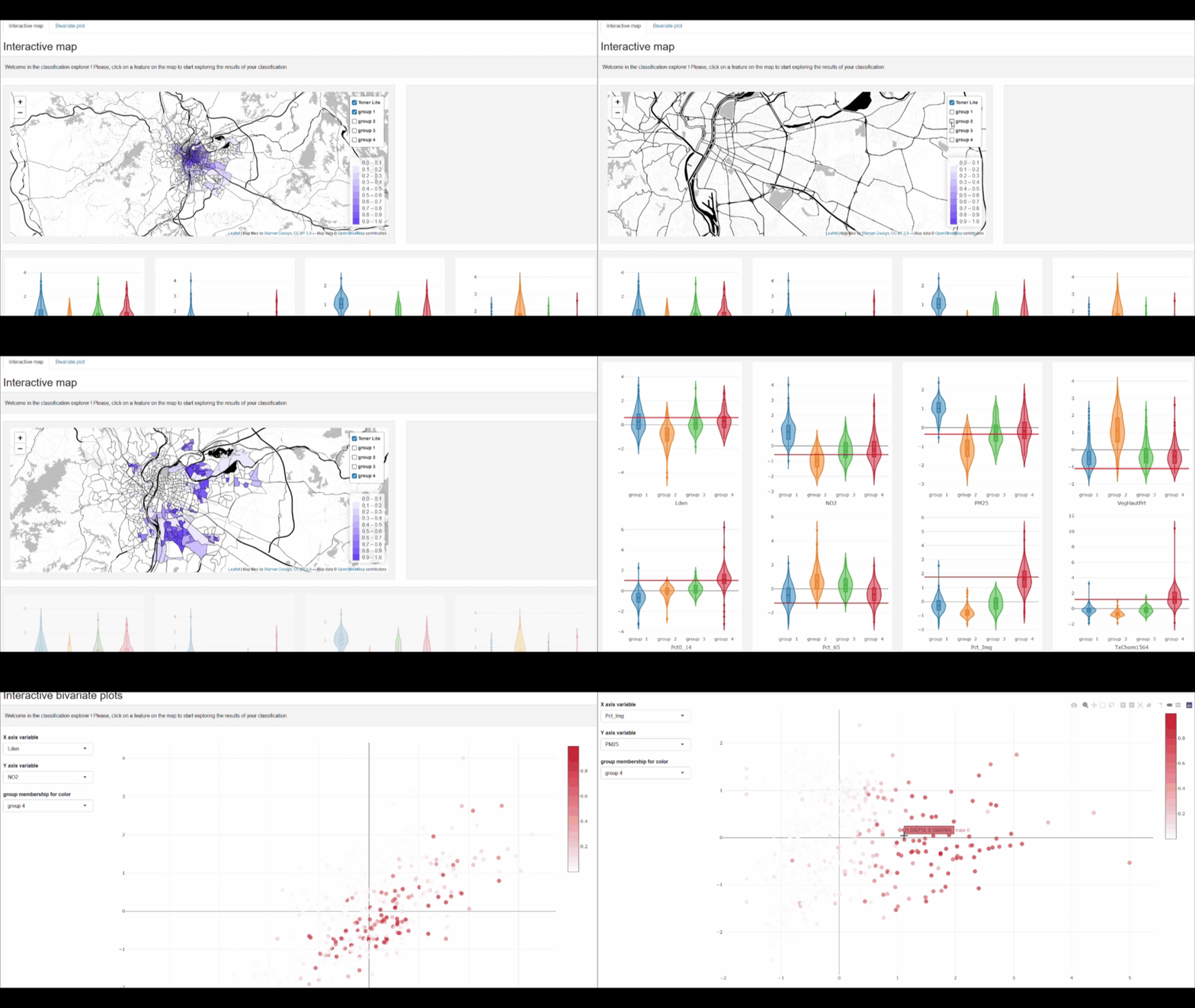
There is also a shiny app that can be used to go deeper in the result
interpretation. It requires the packages shiny, leaflet, bslib,
plotly, shinyWidgets, car.
Spatial diagnostic
Several spatial indices can be calculated to have a better spatial
understanding of the obtained clusters, like the global or local Moran I
calculated on the membership values, or the join-count-test on the most
likely group for each observation. ELSA and Fuzzy ELSA statistics can
also be calculated to identify areas with high or low multidimensional
spatial autocorrelation in the membership values. See functions
spConsistency, calcELSA, calcFuzzyELSA and spatialDiag.
We proposed an index to quantify the spatial inconsistency of a
classification (Gelb and
Apparicio). If in a
classification close observations tend to belong to the same group, then
the value of the index is close to 0. If the index is close to 1, then
the belonging to groups is randomly distributed in space. A value higher
than one can happen in the case of negative spatial autocorrelation. The
index is described in the vignette adjustinconsistency. The function
spatialDiag does a complete spatial diagnostic of the membership
matrix resulting from a classification.
Examples
Detailed examples are given in the vignette introduction
vignette("introduction","geocmeans")
Testing
If you would like to install and run the unit tests interactively,
include INSTALL_opts = "--install-tests" in the installation code.
remotes::install_github(repo = "JeremyGelb/geocmeans", build_vignettes = TRUE, force = TRUE, INSTALL_opts = "--install-tests")
testthat::test_package("geocmeans", reporter = "stop")
Contribute
To contribute to geocmeans, please follow these
guidelines.
Please note that the geocmeans project is released with a Contributor
Code of
Conduct.
By contributing to this project, you agree to abide by its terms.
License
geocmeans version 0.3.4 is licensed under GPL2
License.
JOSS Publication
geocmeans: An R package for spatial fuzzy c-means
Authors

Laboratoire d'Équité Environnemental, Institut National de la Recherche Scientifique (INRS)
Editor
Martin Fleischmann
Tags
unsupervised classification cmeans spatial analysis fuzzy classificationGitHub Events
Total
- Issues event: 1
- Watch event: 1
- Issue comment event: 2
- Push event: 1
Last Year
- Issues event: 1
- Watch event: 1
- Issue comment event: 2
- Push event: 1
Committers
Last synced: 11 months ago
Top Committers
| Name | Commits | |
|---|---|---|
| JeremyGelb | j****b@u****a | 145 |
| JeremyGelb | g****2@g****m | 28 |
Committer Domains (Top 20 + Academic)
Issues and Pull Requests
Last synced: 11 months ago
All Time
- Total issues: 8
- Total pull requests: 0
- Average time to close issues: about 1 month
- Average time to close pull requests: N/A
- Total issue authors: 7
- Total pull request authors: 0
- Average comments per issue: 2.38
- Average comments per pull request: 0
- Merged pull requests: 0
- Bot issues: 0
- Bot pull requests: 0
Past Year
- Issues: 1
- Pull requests: 0
- Average time to close issues: 7 months
- Average time to close pull requests: N/A
- Issue authors: 1
- Pull request authors: 0
- Average comments per issue: 2.0
- Average comments per pull request: 0
- Merged pull requests: 0
- Bot issues: 0
- Bot pull requests: 0
Top Authors
Issue Authors
- HenrikBengtsson (1)
- vincentj10 (1)
- rsbivand (1)
- KatieMurenbeeld (1)
- Naeemkh (1)
- JeremyGelb (1)
- StephanLo (1)
Pull Request Authors
Top Labels
Issue Labels
Pull Request Labels
Packages
- Total packages: 3
-
Total downloads:
- cran 318 last-month
-
Total dependent packages: 0
(may contain duplicates) -
Total dependent repositories: 0
(may contain duplicates) - Total versions: 9
- Total maintainers: 1
proxy.golang.org: github.com/JeremyGelb/geocmeans
- Documentation: https://pkg.go.dev/github.com/JeremyGelb/geocmeans#section-documentation
- License: gpl-2.0
-
Latest release: v0.3.4
published almost 3 years ago
Rankings
proxy.golang.org: github.com/jeremygelb/geocmeans
- Documentation: https://pkg.go.dev/github.com/jeremygelb/geocmeans#section-documentation
- License: gpl-2.0
-
Latest release: v0.3.4
published almost 3 years ago
Rankings
cran.r-project.org: geocmeans
Implementing Methods for Spatial Fuzzy Unsupervised Classification
- Homepage: https://github.com/JeremyGelb/geocmeans
- Documentation: http://cran.r-project.org/web/packages/geocmeans/geocmeans.pdf
- License: GPL-2
-
Latest release: 0.3.4
published almost 3 years ago
Rankings
Maintainers (1)
Dependencies
- R >= 3.5 depends
- Rcpp >= 1.0.6 imports
- Rdpack >= 2.1.1 imports
- dplyr >= 0.8.3 imports
- fclust >= 2.1.1 imports
- fmsb >= 0.7.0 imports
- future.apply >= 1.4.0 imports
- ggplot2 >= 3.2.1 imports
- grDevices >= 3.5 imports
- leaflet >= 2.0.4.1 imports
- matrixStats >= 0.58.0 imports
- methods >= 3.5 imports
- plotly >= 4.9.3 imports
- progressr >= 0.4.0 imports
- raster >= 3.4 imports
- reldist >= 1.6.6 imports
- reshape2 >= 1.4.4 imports
- rgeos >= 0.5 imports
- shiny >= 1.6.0 imports
- sp >= 1.4 imports
- spdep >= 1.1.2 imports
- stats >= 3.5 imports
- ClustGeo >= 2.0 suggests
- RColorBrewer >= 1.1 suggests
- bslib >= 0.2.5 suggests
- car >= 3.0 suggests
- covr * suggests
- future >= 1.16.0 suggests
- ggpubr >= 0.2.5 suggests
- kableExtra >= 1.1.0 suggests
- knitr >= 1.28 suggests
- maptools >= 0.9 suggests
- markdown >= 1.1 suggests
- ppclust >= 1.1.0 suggests
- rgdal >= 1.5 suggests
- rgl >= 0.100 suggests
- rmarkdown >= 2.1 suggests
- sf >= 0.9 suggests
- shinyWidgets >= 0.6 suggests
- shinyhelper >= 0.3.2 suggests
- testthat >= 3.0.0 suggests
- tmap >= 3.3 suggests
- viridis >= 0.5.1 suggests
- waiter >= 0.2.2 suggests
- actions/cache v2 composite
- actions/checkout v2 composite
- actions/upload-artifact main composite
- actions/upload-artifact v1 composite
- openjournals/openjournals-draft-action master composite
- r-lib/actions/setup-pandoc v1 composite
- r-lib/actions/setup-r v1 composite
- actions/checkout v2 composite
- actions/upload-artifact v1 composite
- openjournals/openjournals-draft-action master composite
- actions/checkout v2 composite
- r-lib/actions/setup-pandoc v1 composite
- r-lib/actions/setup-r v1 composite
- r-lib/actions/setup-r-dependencies v1 composite