covid19.analytics
covid19.analytics: An R Package to Obtain, Analyze and Visualize Data from the 2019 Coronavirus Disease Pandemic - Published in JOSS (2021)
Science Score: 95.0%
This score indicates how likely this project is to be science-related based on various indicators:
-
○CITATION.cff file
-
✓codemeta.json file
Found codemeta.json file -
✓.zenodo.json file
Found .zenodo.json file -
✓DOI references
Found 29 DOI reference(s) in README and JOSS metadata -
✓Academic publication links
Links to: arxiv.org, researchgate.net, scholar.google, ncbi.nlm.nih.gov, joss.theoj.org, zenodo.org -
✓Committers with academic emails
1 of 3 committers (33.3%) from academic institutions -
○Institutional organization owner
-
✓JOSS paper metadata
Published in Journal of Open Source Software
Keywords
Scientific Fields
Repository
R package to obtain and analyze live data from the nCOVID19 coronavirus
Basic Info
- Host: GitHub
- Owner: mponce0
- License: gpl-2.0
- Language: R
- Default Branch: master
- Homepage: https://mponce0.github.io/covid19.analytics/
- Size: 482 MB
Statistics
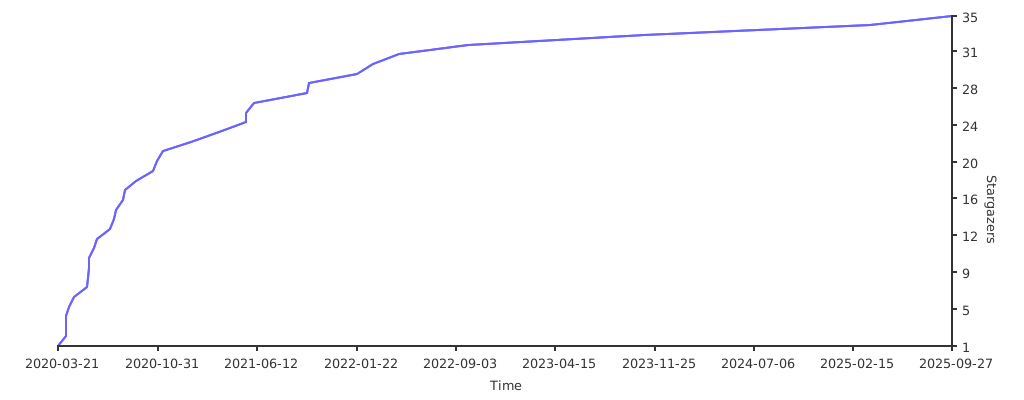
- Stars: 35
- Watchers: 2
- Forks: 11
- Open Issues: 4
- Releases: 9
Topics
Metadata Files
README.md
COVID19.Analytics



 <!--
<!-- -->
-->
 <!--
<!--  -->
<!-- badges: end -->
<!-- ~*~ -->
-->
<!-- badges: end -->
<!-- ~*~ -->
Table of Contents
- Introduction
- covid19.analytics Main Features
- Installation
- Examples
- About
- Media & Press
- References and Citation
- Citing covid19.analytics <!-- --> <!------------- TOC ----------------->
Introduction
The "covid19.analytics" R package allows users to obtain live* worldwide data from the novel Coronavirus Disease originally reported in 2019, COVID-19.
One of the main goals of this package is to make the latest data about the COVID-19 pandemic promptly available to researchers and the scientific community.
The "covid19.analytics" package also provides basic analysis tools and functions to investigate these datasets.
<!-- . -->
The following sections briefly describe some of the covid19.analytics package main features, we strongly recomend users to read our paper "covid19.analytics: An R Package to Obtain, Analyze and Visualize Data from the Coronavirus Disease Pandemic" (https://arxiv.org/abs/2009.01091) where further details about the package are presented and discussed.
covid19.analytics Main Features
The covid19.analytics package is an open source tool, which its main implementation and API
is the R package.
In addition to this, the package has a few more adds-on:
a central GitHub repository, https://github.com/mponce0/covid19.analytics where the latest development version and source code of the package are available. Users can also submit tickets for bugs, suggestions or comments using the "issues" tab.
a rendered version with live examples and documentation also hosted at GitHub pages, https://mponce0.github.io/covid19.analytics/
a dashboard for interactive usage of the package with extended capabilities for users without any coding expertise, https://covid19analytics.scinet.utoronto.ca
The dashboard can also be deployed locally using the covid19Explorer() function which
is part of the covid19.analytics package.
- a backup data repository hosted at GitHub, https://github.com/mponce0/covid19analytics.datasets -- where replicas of the live datasets are stored for redundancy and robust accesibility sake.
Data Sources
The "covid19.analytics" package provides access to the following open-access data sources:
[1] 2019 Novel CoronaVirus COVID-19 (2019-nCoV) Data Repository by Johns Hopkins University Center for Systems Science and Engineering (JHU CSSE) https://github.com/CSSEGISandData/COVID-19
[2] COVID-19: Status of Cases in Toronto -- City of Toronto https://www.toronto.ca/home/covid-19/covid-19-latest-city-of-toronto-news/covid-19-status-of-cases-in-toronto/
[3] COVID-19: Open Data Toronto https://open.toronto.ca/dataset/covid-19-cases-in-toronto/
[4] COVID-19: Health Canada https://health-infobase.canada.ca/covid-19/ <!-- https://health-infobase.canada.ca/src/data/covidLive https://health-infobase.canada.ca/src/data/covidLive/covid19-download.csv -->
[5] Severe acute respiratory syndrome coronavirus 2 isolate Wuhan-Hu-1, complete genome NCBI Reference Sequence: NC045512.2 https://www.ncbi.nlm.nih.gov/nuccore/NC045512.2
[6] COVID-19 Vaccination and Testing records from "Our World In Data" (OWID) https://github.com/owid/
[7] Pandemics historical records from Visual Capitalist (and sources within) https://www.visualcapitalist.com/history-of-pandemics-deadliest/ https://www.visualcapitalist.com/the-race-to-save-lives-comparing-vaccine-development-timelines/
Click to Expand/Collapse
### Data AccessibilityClick to Expand/Collapse
The `covid19.data()` function allows users to obtain realtime data about the COVID-19 reported cases from the JHU's CCSE repository, in the following modalities: * "aggregated" data for the latest day, with a great 'granularity' of geographical regions (ie. cities, provinces, states, countries) * "time series" data for larger accumulated geographical regions (provinces/countries) * "deprecated": we also include the original data style in which these datasets were reported initially. The datasets also include information about the different categories (status) "confirmed"/"deaths"/"recovered" of the cases reported daily per country/region/city. This data-acquisition function, will first attempt to retrieve the data directly from the JHU repository with the latest updates. If for what ever reason this fails (eg. problems with the connection) the package will load a preserved "image" of the data which is **not** the latest one but it will still allow the user to explore this older dataset. In this way, the package offers a more robust and resilient approach to the quite dynamical situation with respect to data availability and integrity. #### Data retrieval options| argument | description |
|---|---|
aggregated |
latest number of cases aggregated by country |
| Time Series data | |
ts-confirmed |
time series data of confirmed cases |
ts-deaths |
time series data of fatal cases |
ts-recovered |
time series data of recovered cases |
ts-ALL |
all time series data combined |
| Deprecated data formats | |
ts-dep-confirmed |
time series data of confirmed cases as originally reported (deprecated) |
ts-dep-deaths |
time series data of deaths as originally reported (deprecated) |
ts-dep-recovered |
time series data of recovered cases as originally reported (deprecated) |
| Combined | |
ALL |
all of the above |
| Time Series data for specific locations | |
ts-Toronto |
time series data of confirmed cases for the city of Toronto, ON - Canada |
ts-confirmed-US |
time series data of confirmed cases for the US detailed per state |
ts-deaths-US |
time series data of fatal cases for the US detailed per state |
| "Province.State" | "Country.Region" | "Lat" | "Long" | ... | seq of dates | ... |
| type | description | source |
| genomic | a composite list containing different indicators and elements of the SARS-CoV-2 genomic information | https://www.ncbi.nlm.nih.gov/sars-cov-2/ |
| genome | genetic composition of the reference sequence of the SARS-CoV-2 from GenBank | https://www.ncbi.nlm.nih.gov/nuccore/NC_045512 |
| fasta | genetic composition of the reference sequence of the SARS-CoV-2 from a fasta file | https://www.ncbi.nlm.nih.gov/nuccore/NC_045512.2?report=fasta |
| ptree | phylogenetic tree as produced by NCBI data servers | https://www.ncbi.nlm.nih.gov/labs/virus/vssi/#/precomptree |
| nucleotide / protein | list and composition of nucleotides/proteins from the SARS-CoV-2 virus | https://www.ncbi.nlm.nih.gov/labs/virus/vssi/#/ |
| nucleotide-fasta / protein-fasta | FASTA sequences files for nucleotides, proteins and coding regions | https://www.ncbi.nlm.nih.gov/labs/virus/vssi/#/ |
Analytical & Graphical Indicators
Click to Expand/Collapse
In addition to the access and retrieval of the data, the package includes some basics functions to estimate totals per regions/country/cities, growth rates and daily changes in the reported number of cases. ### Overview of the Main Functions from the "covid19.analytics" Package| Function | Description | Main Type of Output |
|---|---|---|
| Data Acquisition | ||
covid19.data |
obtain live* worldwide data for COVID-19 virus, from the JHU's CCSE repository [1] | return dataframes/list with the collected data |
covid19.Toronto.data |
obtain live* data for COVID-19 cases in the city of Toronto, ON Canada, from the City of Toronto reports [2] --or-- Open Data Toronto [3] | return dataframe/list with the collected data |
covid19.Canada.data |
obtain live* Canada specific data for COVID-19 cases, from Health Canada [4] | return dataframe/list with the collected data |
covid19.US.data |
obtain live* US specific data for COVID-19 virus, from the JHU's CCSE repository [1] | return dataframe with the collected data |
covid19.vaccination |
obtain up-to-date COVID-19 vaccination records from [5] | return dataframe/list with the collected data |
covid19.testing.data |
obtain up-to-date COVID-19 testing records from [5] | return dataframe with the testing data or testing data details |
pandemics.data |
obtain pandemics and pandemics vaccination *historical* records from [6] | return dataframe with the collected data |
covid19.genomic.data c19.refGenome.data c19.fasta.data c19.ptree.data c19.NPs.data c19.NP_fasta.data |
obtain covid19's genomic sequencing data from NCBI [5] | list, with the RNA seq data in the "$NC_045512.2" entry |
| Data Quality Assessment | ||
data.checks |
run integrity and consistency checks on a given dataset | diagnostics about the dataset integrity and consistency |
consistency.check |
run consistency checks on a given dataset | diagnostics about the dataset consistency |
integrity.check |
run integrity checks on a given dataset | diagnostics about the dataset integrity |
nullify.data |
remove inconsistent/incomplete entries in the original datasets | original dataset (dataframe) without "suspicious" entries |
| Analysis | ||
report.summary |
summarize the current situation, will download the latest data and summarize different quantities | on screen table and static plots (pie and bar plots) with reported information, can also output the tables into a text file |
tots.per.location |
compute totals per region and plot time series for that specific region/country | static plots: data + models (exp/linear, Poisson, Gamma), mosaic and histograms when more than one location are selected |
growth.rate |
compute changes and growth rates per region and plot time series for that specific region/country | static plots: data + models (linear,Poisson,Exp), mosaic and histograms when more than one location are selected |
single.trend mtrends |
visualize different indicators of the "trends" in daily changes for a single or mutliple locations | compose of static plots: total number of cases vs time, daily changes vs total changes in different representations |
estimateRRs |
compute estimates for fatality and recovery rates on a rolling-window interval | list with values for the estimates (mean and sd) of reported cases and recovery and fatality rates |
| Graphics and Visualization | ||
total.plts |
plots in a static and interactive plot total number of cases per day, the user can specify multiple locations or global totoals | static and interactive plot |
itrends |
generates an interactive plot of daily changes vs total changes in a log-log plot, for the indicated regions | interactive plot |
live.map |
generates an interactive map displaying cases around the world | static and interactive plot |
| Modelling | ||
generate.SIR.model |
generates a SIR (Susceptible-Infected-Recovered) model | list containing the fits for the SIR model |
plt.SIR.model |
plot the results from the SIR model | static and interactive plots |
sweep.SIR.model |
generate multiple SIR models by varying parameters used to select the actual data | list containing the values parameters, $\beta, \gamma$ and $R_0$ |
| Data Exploration | ||
covid19Explorer |
launches a dashboard interface to explore the datasets provided by covid19.analytics | web-based dashboard |
| Auxiliary functions | ||
geographicalRegions |
determines which countries compose a given continent | list of countries |
Click to Expand/Collapse
#### Reports The `report.summary()` generates an overall report summarizing the different datasets. It can summarize the "Time Series" data (`cases.to.process="TS"`), the "aggregated" data (`cases.to.process="AGG"`) or both (`cases.to.process="ALL"`). It will display the top 10 entries in each category, or the number indicated in the `Nentries` argument, for displaying all the records set `Nentries=0`. The function can also target specific geographical location(s) using the `geo.loc` argument. When a geographical location is indicated, the report will include an additional "Rel.Perc" column for the confirmed cases indicating the *relative* percentage among the locations indicated. Similarly the totals displayed at the end of the report will be for the selected locations. In each case ("TS" or/and "AGG") will present tables ordered by the different cases included, i.e. confirmed infected, deaths, recovered and active cases. The dates when the report is generated and the date of the recorded data will be included at the beginning of each table. It will also compute the totals, averages, standard deviations and percentages of various quantities: * it will determine the number of *unique* locations processed within the dataset * it will compute the total number of cases per case * Percentages: percentages are computed as follow: - for the "Confirmed" cases, as the ratio between the corresponding number of cases and the total number of cases, i.e. a sort of *"global percentage"* indicating the percentage of infected cases wrt the rest of the world - for "Confirmed" cases, when geographical locations are specified, a *"Relative percentage"* is given as the ratio of the confirmed cases over the total of the selected locations - for the other categories, "Deaths"/"Recovered"/"Active", the percentage of a given category is computed as the ratio between the number of cases in the corresponding category divided by the "Confirmed" number of cases, i.e. a *relative percentage* with respect to the number of confirmed infected cases in the given region * For "Time Series" data: - it will show the *delta* (change or variation) in the last day, daily changes day before that (t-2), three days ago (t-3), a week ago (t-7), two weeks ago (t-14) and a month ago (t-30) - when possible, it will also display the percentage of "Recovered" and "Deaths" with respect to the "Confirmed" number of cases - The column "GlobalPerc" is computed as the ratio between the number of cases for a given country over the total of cases reported - The *"Global Perc. Average (SD: standard deviation)"* is computed as the average (standard deviation) of the number of cases among all the records in the data - The *"Global Perc. Average (SD: standard deviation) in top X"* is computed as the average (standard deviation) of the number of cases among the top *X* records Typical structure of a `summary.report()` output for the Time Series data: ``` ################################################################################ ##### TS-CONFIRMED Cases -- Data dated: 2020-04-12 :: 2020-04-13 12:02:27 ################################################################################ Number of Countries/Regions reported: 185 Number of Cities/Provinces reported: 83 Unique number of geographical locations combined: 264 -------------------------------------------------------------------------------- Worldwide ts-confirmed Totals: 1846679 -------------------------------------------------------------------------------- Country.Region Province.State Totals GlobalPerc LastDayChange t-2 t-3 t-7 t-14 t-30 1 US 555313 30.07 28917 29861 35098 29595 20922 548 2 Spain 166831 9.03 3804 4754 5051 5029 7846 1159 3 Italy 156363 8.47 4092 4694 3951 3599 4050 3497 4 France 132591 7.18 2937 4785 7120 5171 4376 808 5 Germany 127854 6.92 2946 2737 3990 3251 4790 910 . . . -------------------------------------------------------------------------------- Global Perc. Average: 0.38 (sd: 2.13) Global Perc. Average in top 10 : 7.85 (sd: 8.18) -------------------------------------------------------------------------------- ******************************************************************************** ******************************** OVERALL SUMMARY******************************** ******************************************************************************** **** Time Series TOTS **** ts-confirmed ts-deaths ts-recovered 1846679 114091 421722 6.18% 22.84% **** Time Series AVGS **** ts-confirmed ts-deaths ts-recovered 6995 432.16 1686.89 6.18% 24.12% **** Time Series SDS **** ts-confirmed ts-deaths ts-recovered 39320.05 2399.5 8088.55 6.1% 20.57% * Statistical estimators computed considering 250 independent reported entries ******************************************************************************** ``` Typical structure of a `summary.report()` output for the *Aggregated* data: ``` ################################################################################################################################# ##### AGGREGATED Data -- ORDERED BY CONFIRMED Cases -- Data dated: 2020-04-12 :: 2020-04-13 12:02:29 ################################################################################################################################# Number of Countries/Regions reported: 185 Number of Cities/Provinces reported: 138 Unique number of geographical locations combined: 2989 --------------------------------------------------------------------------------------------------------------------------------- Location Confirmed Perc.Confirmed Deaths Perc.Deaths Recovered Perc.Recovered Active Perc.Active 1 Spain 166831 9.03 17209 10.32 62391 37.40 87231 52.29 2 Italy 156363 8.47 19899 12.73 34211 21.88 102253 65.39 3 France 132591 7.18 14393 10.86 27186 20.50 91012 68.64 4 Germany 127854 6.92 3022 2.36 60300 47.16 64532 50.47 5 New York City, New York, US 103208 5.59 6898 6.68 0 0.00 96310 93.32 . . . ================================================================================================================================= Confirmed Deaths Recovered Active Totals 1846680 114090 421722 1310868 Average 617.83 38.17. 141.09 438.56 Standard Deviation 6426.31 613.69 2381.22 4272.19 * Statistical estimators computed considering 2989 independent reported entries ``` In both cases an overall summary of the reported cases is presented by the end, displaying totals, average and standard devitation of the computed quantities. A full example of this report for today can be seen here (updated twice a day, daily). In addition to this, the function will also generate some graphical outputs, including pie and bar charts representing the top regions in each category. #### Totals per Location & Growth Rate It is possible to dive deeper into a particular location by using the `tots.per.location()` and `growth.rate()` functions. Theses functions are capable of processing different types of data, as far as these are "Time Series" data. It can either focus in one category (eg. "TS-confirmed","TS-recovered","TS-deaths",) or all ("TS-all"). When these functions detect different type of categories, each category will be processed separatedly. Similarly the functions can take multiple locations, ie. just one, several ones or even "all" the locations within the data. The locations can either be countries, regions, provinces or cities. If an specified location includes multiple entries, eg. a country that has several cities reported, the functions will group them and process all these regions as the location requested. ##### Totals per Location This function will plot the number of cases as a function of time for the given locations and type of categories, in two plots: a log-scale scatter one a linear scale bar plot one. When the function is run with multiple locations or all the locations, the figures will be adjusted to display multiple plots in one figure in a mosaic type layout. Additionally, the function will attempt to generate different fits to match the data: * an exponential model using a Linear Regression method * a Poisson model using a General Linear Regression method * a Gamma model using a General Linear Regression method The function will plot and add the values of the coefficients for the models to the plots and display a summary of the results in screen. It is possible to instruct the function to draw a "confidence band" based on a *moving average*, so that the trend is also displayed including a region of higher confidence based on the mean value and standard deviation computed considering a time interval set to equally dividing the total range of time over 10 equally spaced intervals. The function will return a list combining the results for the totals for the different locations as a function of time. ##### Growth Rate The `growth.rate()` function allows to compute *daily changes* and the *growth rate* defined as the ratio of the daily changes between two consecutive dates. The `growth.rate()` shares all the features of the `tots.per.location()` function, i.e. can process the different types of cases and multiple locations. The graphical output will display two plots per location: * a scatter plot with the number of changes between consecutive dates as a function of time, both in linear scale (left vertical axis) and log-scale (right vertical axis) combined * a bar plot displaying the growth rate for the particular region as a function of time. When the function is run with multiple locations or all the locations, the figures will be adjusted to display multiple plots in one figure in a mosaic type layout. In addition to that, when there is more than one location the function will also generate two different styles of heatmaps comparing the changes per day and growth rate among the different locations (vertical axis) and time (horizontal axis). The function will return a list combining the results for the "changes per day" and the "growth rate" as a function of time. #### Trends in Daily Changes We provide three different functions to visualize the *trends* in daily changes of reported cases from time series data. *single.trend, allows to inspect one single location, this could be used with the worldwide data sliced by the corresponding location, the Toronto data or the user's own data formatted as "Time Series" data.
* mtrends, similar to single.trend function, but accepts multiple or single locations generating one plot per location requested
* itrends, function to generate an interactive plot of the trend in daily changes representing changes in number of cases vs total number of cases in log-scale using **splines** techniques to smooth the abrupt variations in the data
The first two functions will generate "static" plots in a compose with different insets:
- the main plot represents daily changes as a function of time
- the inset figures in the top, from left to right:
- total number of cases (in linear and semi-log scales),
- changes in number of cases vs total number of cases
- changes in number of cases vs total number of cases in log-scale
- the second row of insets, represent the "growth rate" (as defined above) and the "normalized" growth rate defined as the growth rate divided by the maximum growth rate reported for this location
#### Plotting Totals
The function `totals.plt()` will generate plots of the total number of cases as a function of time.
It can be used for the total data or for an specific or multiple locations.
The function can generate static plots and/or interactive ones, as well, as linear and/or semi-log plots.
#### Plotting Cases in the World
The function `live.map()` will display the different cases in each corresponding location all around the world in an interactive map of the world.
It can be used with time series data or aggregated data, aggregated data offers a much more detailed information about the geographical distribution.
### Experimental: Modelling the evolution of the Virus spread
We are working in the development of *modelling* capabilities.
A preliminary prototype has been included and can be accessed using the `generate.SIR.model` function, which implements a simple SIR (*Susceptible-Infected-Recovered*) ODE model using the actual data of the virus.
This function will try to identify the data points where the onset of the epidemy began and consider the following data points to generate a proper guess for the two parameters describing the SIR ODE system.
After that, it will solve the different equations and provide details about the solutions as well as plot them in a static and interactive plot.
#### Sweeping models...
For exploring the parameter space of the SIR model, it is possible to produce a
series of models by varying the conditions, i.e. range of dates considered for
optimizing the parameters of the SIR equation, which will effectively *sweep*
a range for the parameters $\beta, \gamma$ and $R_0$.
This is implemented in the function `sweep.SIR.models()`, which takes a
range of dates to be used as starting points for the number of cases used to
feed into the `generate.SIR.model()` producing as many models as different
ranges of dates are indicated.
One could even use this in combination to other resampling or Monte Carlo
techniques to estimate statistical variability of the parameters from the
model.
Further Features
We will continue working on adding and developing new features to the package, in particular modelling and predictive capabilities.
Please contact us if you think of a functionality or feature that could be useful to add.
Installation
Click to Expand/Collapse
For using the "covi19.analytics" package, first you will need to install it. The stable version can be downloaded from the CRAN repository: ```R install.packages("covid19.analytics") ``` To obtain the development version you can get it from the github repository, i.e. ```R # need devtools for installing from the github repo install.packages("devtools") # install covid19.analytics from github devtools::install_github("mponce0/covid19.analytics") ``` For using the package, either the stable or development version, just load it using the library function: ```R # load "covid19.analytics" library(covid19.analytics) ```Examples
In this section, we include basic examples of the main features of the covid19.analytics package.
We strongly recommend users to check further examples and details about the
covid19.analyticspackage available in our manuscript, https://arxiv.org/abs/2009.01091Code/scripts with examples and tutorials are available at https://github.com/mponce0/covid19.analytics/tree/literature/tutorial
Click to Expand/Collapse
### Reading data ```R # obtain all the records combined for "confirmed", "deaths" and "recovered" cases -- *aggregated* data covid19.data.ALLcases <- covid19.data() # obtain time series data for "confirmed" cases covid19.confirmed.cases <- covid19.data("ts-confirmed") # reads all possible datasets, returning a list covid19.all.datasets <- covid19.data("ALL") # reads the latest aggregated data covid19.ALL.agg.cases <- covid19.data("aggregated") # reads time series data for casualties covid19.TS.deaths <- covid19.data("ts-deaths") # reads testing data testing.data <- covid19.testing.data() ``` Read covid19's genomic data ```R # obtain covid19's genomic data covid19.gen.seq <- covid19.genomic.data() # display the actual RNA seq covid19.gen.seq$NC_045512.2 ``` Obtaining Pandemics data ```R # Pandemic historical records pnds <- pandemics.data(tgt="pandemics") # Pandemics vaccines development times pnds.vacs <- pandemics.data(tgt="pandemics_vaccines") ``` ### Some basic analysis #### Summary Report ```R # a quick function to overview top cases per region for time series and aggregated records report.summary() ```
Interactive examples can be seen at https://mponce0.github.io/covid19.analytics/
#### Simulating the Virus spread ```R # read time series data for confirmed cases data <- covid19.data("ts-confirmed") # run a SIR model for a given geographical location generate.SIR.model(data,"Hubei", t0=1,t1=15) generate.SIR.model(data,"Germany",tot.population=83149300) generate.SIR.model(data,"Uruguay", tot.population=3500000) generate.SIR.model(data,"Ontario",tot.population=14570000) # the function will aggregate data for a geographical location, like a country with multiple entries generate.SIR.model(data,"Canada",tot.population=37590000) ```
About
Authors
- Marcelo Ponce: creator, author, mantainer and main developer of the package
- Amit Sandhel: contributor, main developer of the covid19.Explorer dashboard
- Community contributions are welcome and can be done via pull-requests
Media and Press
in the news
Click to Expand/Collapse
##### University Resources * The Bulletin Brief -- University of Toronto (UofT): https://mailchi.mp/9cea706971a2/bulletinbrief-april6-2020?e=caa3066921 * UofT Libraries: - Tutorials https://mdl.library.utoronto.ca/covid-19/tutorials - Data & Statistical Sources https://mdl.library.utoronto.ca/covid-19/data * Department of Statistics, Warwick University (UK): https://warwick.ac.uk/fac/sci/statistics/courses/offerholders-post-2020/welcome2020/package1 * ResCOVID-19 (FR): http://rescovid19.fr/db/outils.html ##### Compute Ontario, Compute Canada ##### Social media * https://twitter.com/ComputeOntario/status/1245825891562917888 * https://twitter.com/ComputeOntario/status/1270736806724632576?s=20 * https://twitter.com/ComputeCanada/status/1246123408418426880 * https://twitter.com/paulchenz/status/1244799016736624640?s=20 * https://twitter.com/JamesBradley002/status/1247139312245899264?s=20 * https://twitter.com/hauselin/status/1247209180492169218?s=20 * https://twitter.com/Ssiamba/status/1271794279510409217?s=20 * https://m.facebook.com/nexacu/photos/a.133550136841673/1407169096146431/?type=3used in ...
Click to Expand/Collapse
##### Publications * C.M.Yeşilkanat, *"Spatio-temporal estimation of the daily cases of COVID-19 in worldwide using random forest machine learning algorithm"*, Chaos, Solitons & Fractals (2020); 140(110210) -- https://doi.org/10.1016/j.chaos.2020.110210 * M.Deldar et al., *"SIR Model for Estimations of the Coronavirus Epidemic Dynamics in Iran"*, Journal of Biostatistics and Epidemiology (2020); 6(2):101-106 -- https://doi.org/10.18502/jbe.v6i2.4872 * Hackenberger BK, *"From apparent to true - from frequency to distributions (II)"*, Croat Med J. (2020); 61(4):381-385 -- https://www.ncbi.nlm.nih.gov/pmc/articles/PMC7480748/ * D.Mercatelli et al., *"Web tools to fight pandemics: the COVID-19 experience"*, Briefings in Bioinformatics (2020) -- https://doi.org/10.1093/bib/bbaa261 * N.Hussain, B.Li, *"Using R-studio to examine the COVID-19 Patients in Pakistan Implementation of SIR Model on Cases"*, Int Journal of Scientific Research in Multidisciplinary Studies (2020); 6(8):54-59 -- https://www.isroset.org/pub_paper/IJSRMS/9-IJSRMS-04417.pdf * List of all publications using "covid19.analytics" (from Google Scholar) ##### RECON: R Epidemics Consortium - COVID19 Challenge * https://tasks.repidemicsconsortium.org/ ##### CoronaWhy datasets * http://datasets.coronawhy.org/dataset.xhtml?persistentId=doi:10.5072/FK2/MYQFTR ##### Dashboards * https://shiny.cliffweaver.com/covid/ -- https://shiny.cliffweaver.com/covid/#section-about * https://shiny.cliffweaver.com/covid_mobility/ -- https://shiny.cliffweaver.com/covid_mobility/#section-about * https://covid19analytics.scinet.utoronto.ca ##### Other publications and studies * Yadav et al., *"Analyzing the Current Status of India in Global Scenario with Reference to COVID-19 Pandemic"*, Preprints (2020) -- https://doi.org/10.20944/preprints202007.0001.v1 * M.Murali and R.Srinivasan, "Forecasting COVID-19 Confirmned Cases in India with Snaive, ETS, ARIMA Methods"*, (2020) -- http://bulletinmonumental.com/gallery/4-sep2020.pdf * https://www.researchgate.net/publication/341832722_An_Evaluation_of_the_Frameworks_for_Predicting_COVID-19_in_Nigeria_using_Data_Analytics * Annex I -- RDA COVID-19 Epidemiology WG, *"Sharing COVID-19 Epidemiology Data"*, Research Data Alliance (2020) -- https://doi.org/10.15497/rda00049 * A.Claire C.et al., *"COVID-19 Surveillance Data and Models: Review and Analysis, Part 1"*, SSRN (Sept.2020) -- http://dx.doi.org/10.2139/ssrn.3695335 ##### Community & Tutorials * Featured on "R-bloggers" - Top 40 CRAN packages (April 2020): https://www.r-bloggers.com/2020/05/april-2020-top-40-new-cran-packages/amp/ * Featured on "Eye on AI" papers review: https://www.eye-on.ai/ai-research-watch-papers/2020/9/7/202097-society-papers * https://youtu.be/n-sCFsUw0yg * https://www.kaggle.com/nishantbhadauria/r-covid19-analytics-tutorial-sir-model-maps-glms * https://rstudio-pubs-static.s3.amazonaws.com/627247_4a5e9d5780844ca2bcddfdd13733cb67.html * https://people.math.carleton.ca/~davecampbell/datasets/2020/07/24/covid-data-covid-19-govenrmne-of-canada-and-jhu-csse/ * https://theactuarialclub.com/2020/05/15/covid-19-analysis-modelling-visualization-using-r/ * https://stackoverflow.com/questions/63822239/get-r-data-frame-in-python-using-rpy2 * https://stackoverflow.com/questions/65155336/how-do-you-add-the-live-map-function-from-covid19-analytics-to-a-shiny-app * http://bactra.org/weblog/1176.html * https://rpubs.com/alexvezeau * https://rpubs.com/MirzaWAhmed/689518 * https://rpubs.com/pawan_thapa * https://rpubs.com/Drshunya * https://rpubs.com/vegatroz * https://forums.futura-sciences.com/programmation-langages-algorithmique/883064-r-data-science-analyse-de-donnees-covid19.html * https://www.europeanvalley.es/noticias/analizamos-datos-del-covid19-con-r/ * https://medium.com/r-tutorials/how-to-get-daily-covid-19-data-using-r-25bde150df5e * https://medium.com/analytics-vidhya/corona-19-visualizations-with-r-and-tableau-595296894ca7 * http://www.sanaitics.com/research-paper.aspx?id=112
<!-- GitHub badges stats -->









 <!--
<!--
-->
<!-- badges: end -->
<!--
 --> <!--
 -->
<!--
References
(*) Data can be upto 24 hs delayed wrt the latest updates.
Click to Expand/Collapse
### Data Sources [1] 2019 Novel CoronaVirus COVID-19 (2019-nCoV) Data Repository by Johns Hopkins University Center for Systems Science and Engineering (JHU CSSE) https://github.com/CSSEGISandData/COVID-19 [2] COVID-19: Status of Cases in Toronto -- City of Toronto https://www.toronto.ca/home/covid-19/covid-19-latest-city-of-toronto-news/covid-19-status-of-cases-in-toronto/ [3] COVID-19: Open Data Toronto https://open.toronto.ca/dataset/covid-19-cases-in-toronto/ [4] COVID-19: Health Canada https://health-infobase.canada.ca/covid-19/ [5] Severe acute respiratory syndrome coronavirus 2 isolate Wuhan-Hu-1, complete genome NCBI Reference Sequence: NC_045512.2 https://www.ncbi.nlm.nih.gov/nuccore/NC_045512.2 [6] COVID-19 Vaccination and Testing records from "Our World In Data" (OWID) https://github.com/owid/ [7] Pandemics historical records from Visual Capitalist (and sources within) https://www.visualcapitalist.com/history-of-pandemics-deadliest/ https://www.visualcapitalist.com/the-race-to-save-lives-comparing-vaccine-development-timelines/How to Cite this Package
If you are using this package please cite our main publication about the covid19.analytics package:
Ponce et al., (2021). "covid19.analytics: An R Package to Obtain, Analyze and Visualize Data from the 2019 Coronavirus Disease Pandemic." Journal of Open Source Software, 6(59), 2995. https://doi.org/10.21105/joss.02995
You can also ask for this citation information in R: ```R
citation("covid19.analytics")
To cite covid19.analytics in publications use:
Ponce et al., (2021). covid19.analytics: An R Package to Obtain, Analyze and Visualize Data from the 2019 Coronavirus Disease Pandemic. Journal of Open Source Software, 6(59), 2995. https://doi.org/10.21105/joss.02995
A BibTeX entry for LaTeX users is
@Article{covid19analytics_JOSS, title = "{covid19.analytics: An R Package to Obtain, Analyze and Visualize Data from the Coronavirus Disease Pandemic}", author = {Marcelo Ponce and Amit Sandhel}, journal = "{Journal of Open Source Software}", year = {2021}, vol = {6}, doi = {10.21105/joss.02995} } ```
Examples and tutorials are available at, ```R
Marcelo Ponce, Amit Sandhel (2020). covid19.analytics: An R Package to Obtain, Analyze and Visualize Data from the Coronavirus Disease Pandemic. URL https://arxiv.org/abs/2009.01091
A BibTeX entry for LaTeX users is
@Article{covid19analytics_RefManual, title = "{covid19.analytics: An R Package to Obtain, Analyze and Visualize Data from the Coronavirus Disease Pandemic}", author = {Marcelo Ponce and Amit Sandhel}, journal = {pre-print}, year = {2020}, url = {https://arxiv.org/abs/2009.01091}, } ```
Further Resources
Click to Expand/Collapse
### Other References * Delamater PL, Street EJ, Leslie TF, Yang Y, Jacobsen KH. Complexity of the Basic Reproduction Number (R0). Emerg Infect Dis. 2019;25(1):1-4. https://dx.doi.org/10.3201/eid2501.171901 https://wwwnc.cdc.gov/eid/article/25/1/17-1901_article ### More R Resources * The R Epidemics Consortium (RECON): https://www.repidemicsconsortium.org/ * SIR model: https://blog.ephorie.de/epidemiology-how-contagious-is-novel-coronavirus-2019-ncov * EpiModel: https://rviews.rstudio.com/2020/03/19/simulating-covid-19-interventions-with-r/ * https://rviews.rstudio.com/2020/03/05/covid-19-epidemiology-with-r/ ### Dashboards * https://covidgraph.com * https://ici.radio-canada.ca/info/2020/coronavirus-covid-19-pandemie-cas-carte-maladie-symptomes-propagation/index-en.html * https://resources-covid19canada.hub.arcgis.com/ * https://aatishb.com/covidtrends/ * https://nextstrain.org/ncov * http://gabgoh.github.io/COVID/index.html * https://coronavirus.jhu.edu/map.html * https://coronavirus.jhu.edu/data/new-cases ### Vaccines * https://ici.radio-canada.ca/info/2021/03/vaccination-variants-covid-19-arn-pfizer-moderna-spicule-infection-immunite/en * https://www.youtube.com/watch?v=K3odScka55A * https://www.youtube.com/watch?v=mvA9gs5gxNY ### Models * https://www.youtube.com/watch?v=wKOslhIFt6U
Owner
- Login: mponce0
- Kind: user
- Repositories: 5
- Profile: https://github.com/mponce0
JOSS Publication
covid19.analytics: An R Package to Obtain, Analyze and Visualize Data from the 2019 Coronavirus Disease Pandemic
Authors

SciNet HPC Consortium, University of Toronto, Canada
Independent Researcher
Editor
Frederick Boehm
Tags
R CRAN coronavirus data accessGitHub Events
Total
- Watch event: 1
Last Year
- Watch event: 1
Committers
Last synced: over 1 year ago
Top Committers
| Name | Commits | |
|---|---|---|
| Marcelo Ponce | m****e@s****a | 12,657 |
| Andrew | c****a@s****g | 3 |
| marcelo | m****o@S****l | 1 |
Committer Domains (Top 20 + Academic)
Issues and Pull Requests
Last synced: 11 months ago
All Time
- Total issues: 8
- Total pull requests: 4
- Average time to close issues: 2 days
- Average time to close pull requests: about 6 hours
- Total issue authors: 6
- Total pull request authors: 3
- Average comments per issue: 6.75
- Average comments per pull request: 1.0
- Merged pull requests: 3
- Bot issues: 0
- Bot pull requests: 0
Past Year
- Issues: 0
- Pull requests: 0
- Average time to close issues: N/A
- Average time to close pull requests: N/A
- Issue authors: 0
- Pull request authors: 0
- Average comments per issue: 0
- Average comments per pull request: 0
- Merged pull requests: 0
- Bot issues: 0
- Bot pull requests: 0
Top Authors
Issue Authors
- ZellW (2)
- mponce0 (2)
- reeshmabijosh (1)
- carloserwin (1)
- genghiskhanofnz (1)
- jamalrogers (1)
Pull Request Authors
- mponce0 (2)
- crispaSLHS (1)
- danielskatz (1)
Top Labels
Issue Labels
Pull Request Labels
Packages
- Total packages: 1
-
Total downloads:
- cran 382 last-month
- Total docker downloads: 21,613
- Total dependent packages: 0
- Total dependent repositories: 1
- Total versions: 12
- Total maintainers: 1
cran.r-project.org: covid19.analytics
Load and Analyze Live Data from the COVID-19 Pandemic
- Homepage: https://mponce0.github.io/covid19.analytics/
- Documentation: http://cran.r-project.org/web/packages/covid19.analytics/covid19.analytics.pdf
- License: GPL-2 | GPL-3 [expanded from: GPL (≥ 2)]
-
Latest release: 2.1.3
published almost 4 years ago
Rankings
Maintainers (1)
Dependencies
- DT * imports
- ape * imports
- collapsibleTree * imports
- deSolve * imports
- dplyr * imports
- gplots * imports
- htmlwidgets * imports
- pheatmap * imports
- plotly * imports
- readxl * imports
- rentrez * imports
- shiny * imports
- shinycssloaders * imports
- shinydashboard * imports
- devtools * suggests
- knitr * suggests
- markdown * suggests
- rmarkdown * suggests
- roxygen2 * suggests
- testthat * suggests